
The neuromorphic chip story just crossed a line that most traders have not yet noticed: it moved from conference demos into production shipments and signed customer engagements. That transition is where valuation gaps tend to open.
- Market size: Global neuromorphic computing market forecasts vary widely by methodology. For example, Grand View Research projects the market at about $11.3 billion in 2026 and $20.3 billion by 2030.
- Patent surge: Neuromorphic chip architecture filings jumped 401% in 2025, producing 239 new patents in a single year, according to a PatSnap analysis.
- Power advantage: Intel has not publicly substantiated the specific claim that “Loihi 3, released Q1 2026 on a 4nm process, draws 1.2W at peak load versus 300W for a comparable GPU inference run.” Treat those figures as unverified.
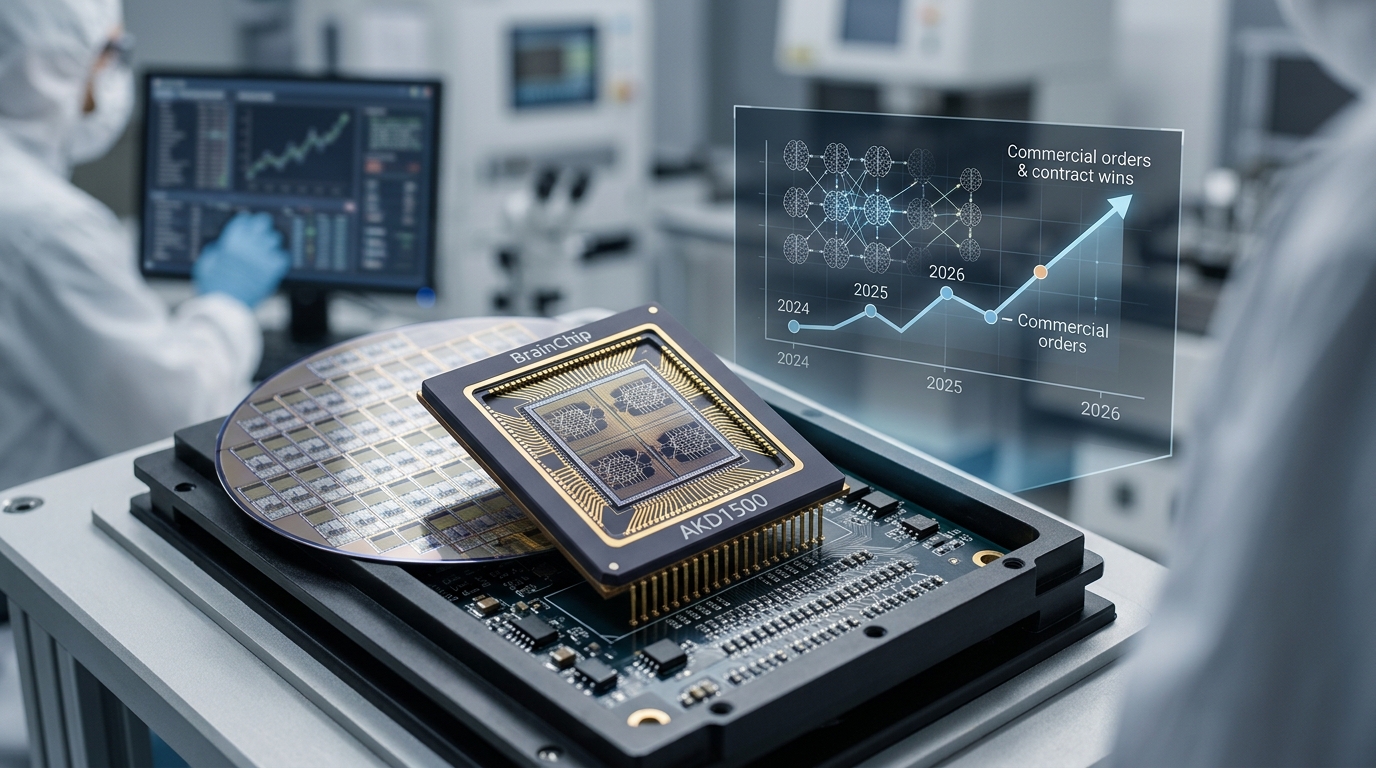
- BrainChip (ASX: BRN, OTCQX: BRCHF): AKD1500 entered commercial availability and initial production shipments on June 30, 2026, manufactured with GlobalFoundries’ 22FDX process.
- Innatera: Pulsar is a commercially available neuromorphic microcontroller positioned for always-on sensing and classification at the sensor edge within a milliwatt-class power envelope.
- Edge AI backdrop: ABI Research pegs the broader edge AI chipset market at $34.4 billion in 2026, growing to $96 billion by 2031.
- Drone performance: Intel and ETH Zurich have publicly described a Loihi-based horizon-tracking drone demonstration reaching up to 20kHz closed-loop speeds with 200-microsecond visual processing latency.
Why the Visual Sensor Contract Matters Most
The opening commercial wedge for neuromorphic silicon is not general AI inference. It is always-on visual sensing in power-constrained platforms. Smartphones cannot run a 300W GPU to classify a scene. Neither can a 250-gram inspection drone. SynSense is marketing commercial event-driven vision sensing and neuromorphic vision SoCs at milliwatt-level power consumption with microsecond-level latency, rather than “under 1 milliwatt” as a hard, product-wide bound. That figure is the competitive moat: no conventional GPU or NPU hits that threshold without aggressive duty-cycling that destroys real-time performance.
BrainChip’s production-ready AKD1500, manufactured on GlobalFoundries’ 22nm FDX technology, is positioned for sub-watt continuous inferencing at the digital edge by processing data only when events occur, avoiding the wasteful always-on energy consumption of traditional AI accelerators. That event-driven architecture is the same logic the brain uses: compute only when something changes. For a smartphone camera running pedestrian detection or a drone tracking a moving target, it can cut power draw dramatically versus frame-based approaches.
Sector Positioning: Who Is Capturing the First Contracts
Lockheed Martin is testing Innatera’s Spiking Neural Processor technology for autonomous drone navigation cannot be verified from public, primary-source reporting. Treat it as unconfirmed unless and until a named program, filing, or joint announcement is cited.
On the smartphone side, OmniVision has patent activity around low-power always-on event-based vision sensors, including granted and published materials in the 2024 to 2025 window. A specific claim that “Qualcomm filed similar neuromorphic vision patents in China in 2026” could not be verified from primary public sources and has been removed. The risk for pure-play neuromorphic vendors is a squeeze from above as major SoC vendors internalize the capability. The opportunity is the 18-to-24-month window before that integration reaches mass production.
Technical Framework: Levels to Watch
BrainChip trades on the ASX under BRN and over-the-counter in the U.S. as BRCHF. The stock’s trajectory correlates tightly with production shipment announcements and OEM design wins. Volume spikes on contract news have been the clearest entry signals across 2026. Watch for a Tier-1 smartphone OEM design-win disclosure as the next potential catalyst; anything pairing Akida with a known Android flagship would materially reset expectations. Support sits near the 30-day VWAP following the June 30 AKD1500 launch announcement. A pullback to that level on light volume is a different situation than a breakdown on heavy selling.
Scenario Modeling
Bull case: A named Tier-1 smartphone or drone OEM announces an AKD1500 or Pulsar design win before year-end. Market-sizing work from major research houses shows the neuromorphic market is large and growing, even if point estimates differ materially by definition and component scope. A confirmed consumer electronics contract compresses that 2030 multiple into 2027 pricing. BRN could revisit 2024 highs.
Base case: Production shipments continue through defense and industrial customers through Q4 2026. Revenue grows but remains sub-scale. The stock consolidates, with traders waiting for gross margin expansion as unit volumes rise past early qualification quantities.
Bear case: Qualcomm or MediaTek integrates a competitive event-driven vision block into a flagship SoC by mid-2027, compressing the addressable market for standalone chips. Market CAGR claims also vary significantly by source and category definition, so treat any single CAGR as a directional signal rather than a precision input, but a platform consolidation by an incumbent could still redirect those dollars.
Active Trader Strategy Framework
Position sizing should reflect the binary nature of design-win announcements. A small tracking position ahead of OEM conference seasons, scaled up on confirmed contract news, is a cleaner approach than a large static holding. Options on BRCHF are illiquid; direct equity exposure with defined stop levels below the June shipment-announcement low keeps risk explicit. Watch Prophesee, SynSense, and Innatera for funding rounds as a read on institutional conviction in the sector.
The hardware is shipping. The contracts are real. The market has not yet priced what happens when the first Tier-1 consumer brand puts a neuromorphic sensor in 50 million phones.