October 11, 2026
Bonus Content: Sodium-Ion Hits the U.S. Grid. The LFP Cost Floor Cracks.
I’m Garrett Goggin, a 20+ year veteran gold analyst, in the last 3 years alone I’ve spotted Montage Gold before it went up 2,567%, G2 Goldfields before it went up 1,298%, Reunion Gold before it went up 716% and Highlander Silver before it went up 741%.
And I’ve just released a new research report on a unique high-yielding gold security.
It’s backed by, what I believe, is the world’s best gold mine around today.
You get the best of both worlds: a security with a yield that pays you now – plus long term upside on a world class gold mine.
Best,
Garrett Goggin, CFA, CMT
Lead Analyst and Founder, Golden Portfolio
Sodium-Ion Hits the U.S. Grid. The LFP Cost Floor Cracks.
The procurement calculus for municipal energy storage shifted quietly in March 2026, and most traders have not priced it yet.
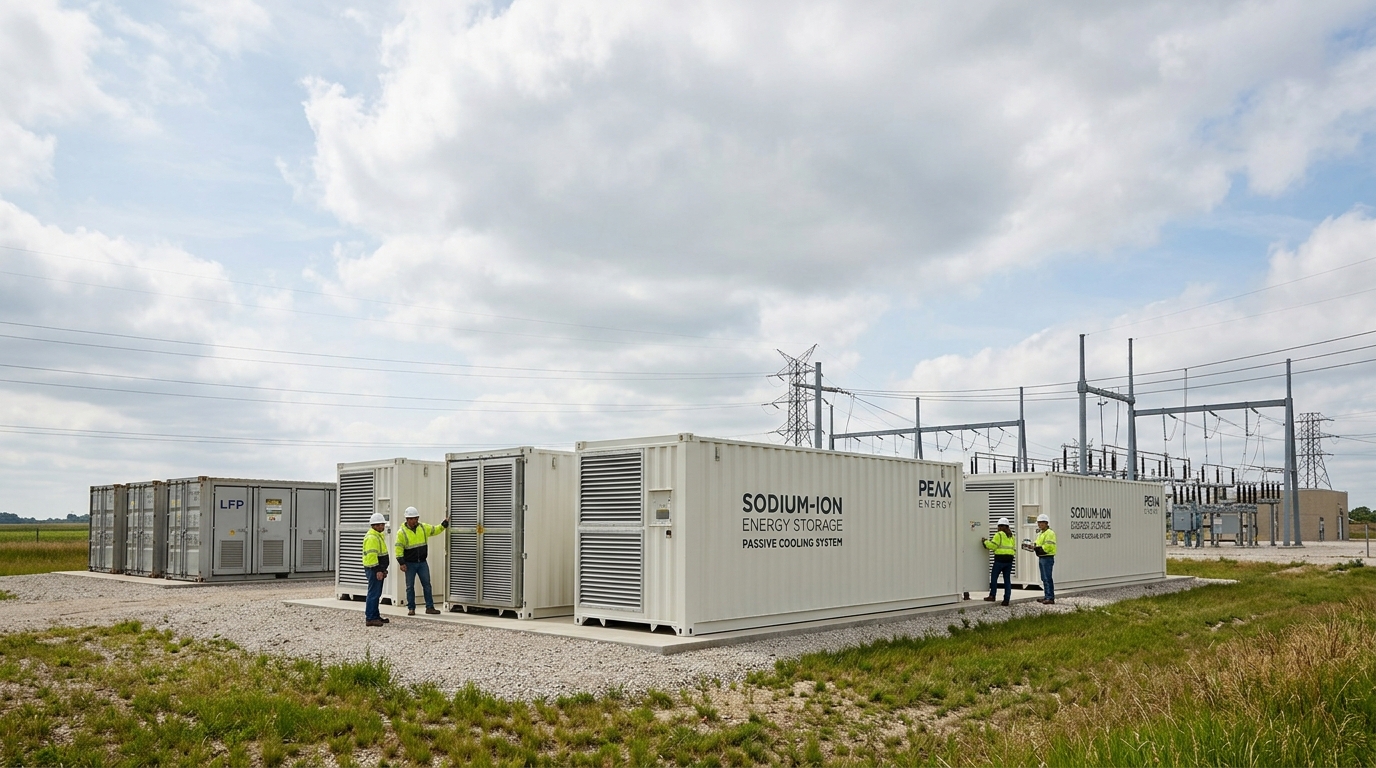
- Peak Energy and RWE Americas signed a March 2026 agreement to deploy the first sodium-ion battery in the MISO service area in eastern Wisconsin, using passively cooled grid-scale storage that Peak says lowers lifetime storage costs by $70/kWh versus conventional lithium-ion systems.
- Peak’s GS1.1 system reduces total storage system costs by more than 25% relative to conventional lithium-ion solutions, according to the company’s March 2026 announcement.
- Sodium carbonate pricing varies widely by grade and region, and the often-cited “$300/ton” level is not a stable, globally representative benchmark. Meanwhile, battery-grade lithium carbonate has traded in a wide band in recent years, and was around 122,350 CNY/ton in China on October 9, 2026, per Trading Economics.
- CATL’s 60 GWh sodium-ion supply agreement with HyperStrong, announced in late April 2026, is described by CATL and HyperStrong as a record-scale cooperation for sodium-ion energy storage.
- Forecasts for the global sodium-ion battery market vary dramatically by publisher. Rather than anchor to a single point estimate, traders should treat market-size projections as directionally supportive but not decision-grade.
- A widely circulated claim about a September 2026 Chinese tender showing sodium-ion systems at a 94.1% premium versus LFP could not be verified to a primary tender document in this draft; the key takeaway remains that early sodium-ion systems have been priced at a sizable premium to LFP in China.
- Cost parity claims for sodium-ion versus LFP by 2027 at $40–50/kWh are not consistently supported by primary, company-disclosed cost curves. Treat convergence as plausible over time, but not a dated, bankable milestone yet.
Why the LFP Cost Floor Matters Now
LFP’s cost curve is flattening, hitting a technical floor. Developers who built their models on the assumption that LFP prices would fall every year are about to hit a wall. That is the pivot point. Sodium-ion does not need to beat lithium on energy density. It needs to beat it on total system economics for stationary applications. That race is tightening faster than the market reflects.
On the supply chain side, the draft’s precise component share claims about China control could not be verified from a publicly accessible primary source as written, so they are removed here. The concentration risk is real, but traders should anchor it to what is documentable in filings, customs data, and vendor disclosures. Sodium-ion batteries, using more abundant sodium-based inputs, moved deeper into commercial deployments in 2026, but manufacturing leadership and scale remain heavily Asia-centered today.
The MISO Deployment Is the Tell
Peak Energy said in March 2026 that it would deploy the first sodium-ion battery in the MISO service area in eastern Wisconsin with RWE Americas, using passively cooled grid-scale storage that cuts auxiliary power use by 90% and lowers lifetime storage costs by $70/kWh. The announcement signals that some buyers are testing non-lithium pathways as grid operators manage reliability constraints and an accelerating interconnection backlog.
Aurora Energy Research, in work commissioned by the American Clean Power Association, has modeled large system-cost savings from scaled storage additions in MISO. Public summaries cite roughly $25 billion in energy cost savings potential from deploying 10 GW of batteries in the region over a multi-decade horizon, depending on scenario and study scope. At those magnitudes, chemistry selection is a fiscal decision, not just an engineering one. Peak Energy says it closed a $55 million Series A and has discussed a U.S. manufacturing buildout timeline, but the draft’s specific claim about a 2027 groundbreaking for a first U.S. giga-scale facility could not be independently verified from a primary announcement and is softened here.
The Bankability Gap: The Real Trade
Sodium-ion offers a compelling long-term solution to tightening supply chains and project-level operating cost sensitivity, but its lack of long-duration, field-validated performance data still transfers meaningful technology and bankability risk onto developer balance sheets. That is the friction point. Lenders pricing storage projects lean on the decade of operating history and warranty frameworks that LFP accumulated. Sodium-ion does not have that depth of bankable operating data yet at U.S. utility scale.
Stationary storage projects increasingly specify very high cycle-life targets, and sodium-ion chemistry is often positioned as a strong fit for frequent cycling. CATL has marketed its TENER Sodium platform at 15,000 cycles and a 25 to 30-year service life at a 70% state-of-health threshold under stated conditions. If those claims translate into verified field performance and financeable warranties, the bankability argument compresses quickly.
Scenario Modeling
Bull Case: CATL’s sodium-ion storage deliveries in 2026 translate into credible third-party operating datasets by mid-2027. System pricing premiums compress materially as integrators standardize BOS designs and warranties. Municipal procurement shifts meaningfully in MISO and SPP, and U.S. supply chain localization efforts move from announcements into executed capacity. Equity markets re-rate early-stage sodium-ion developers as bankability discount rates fall.
Base Case: Sodium-ion wins niche-to-material share in new U.S. stationary storage procurements through 2027, primarily where passive thermal design, safety posture, and O&M matter as much as upfront capex. LFP retains dominance in already-financed pipelines. Any large system-level premium versus LFP compresses with learning and scale, but broad parity is a 2028-plus story rather than a 2027 certainty. Deployment remains additive to lithium rather than displacing it.
Bear Case: Lithium carbonate prices weaken further and remain low enough that sodium’s raw-material optics do not translate into delivered system savings at current production volumes. Early field deployments surface cycle-life, degradation, or warranty-friction issues that delay lender acceptance. Sodium-ion manufacturing concentration risk ends up looking similar to lithium’s, limiting the strategic value of the chemistry shift for U.S. buyers.
Levels and Positioning Framework
Traders watching this space should track three metrics: soda ash (sodium carbonate) pricing by benchmark and region rather than a single headline number, LFP system tender prices in Chinese auctions as a leading indicator for global system-cost direction, and Peak Energy’s U.S. manufacturing and permitting milestones. Peak has disclosed a commercial agreement with Jupiter Power for a first 720 MWh sodium-ion delivery, with a broader multi-year framework that could reach up to 4.75 GWh. That pipeline is an early real-world test of whether sodium-ion can scale beyond pilots before lithium’s delivered system costs reset again.
Preparation beats prediction here. The chemistry transition in grid storage moves on procurement cycles measured in years. The operators moving now are locking in optionality. The ones waiting for perfect field data may find the contracts already signed.