October 19, 2026
Bonus Content: RAM Just Crossed $450. Memory Suppliers Win.
Dear Reader,
The SpaceX IPO created 4,400 millionaires overnight.
I believe the next wave is already in motion – and most investors don’t even know it’s happening.
Here’s why.
One firm operating in the shadows with SpaceX is the only company in America that can unlock the next phase of Elon’s master plan.
And I’m not the only one who sees it.
BlackRock. Morgan Stanley. JP Morgan. Goldman Sachs.
The same institutions who already made a fortune on the IPO are all over this SpaceX-connected company.
What exactly is Elon planning next?
I’ve put the details of what I’m calling “Mission X” inside a brand-new masterclass.
Go here to watch it now, completely free of charge – and hurry – because…
This firm’s CEO has already said he plans to announce more details about the relationship with Elon Musk “in the coming weeks.”
The moment that happens, I believe our window to get positioned today slams shut.
Best,
Tim Bohen
RAM Just Crossed $450. Memory Suppliers Win.
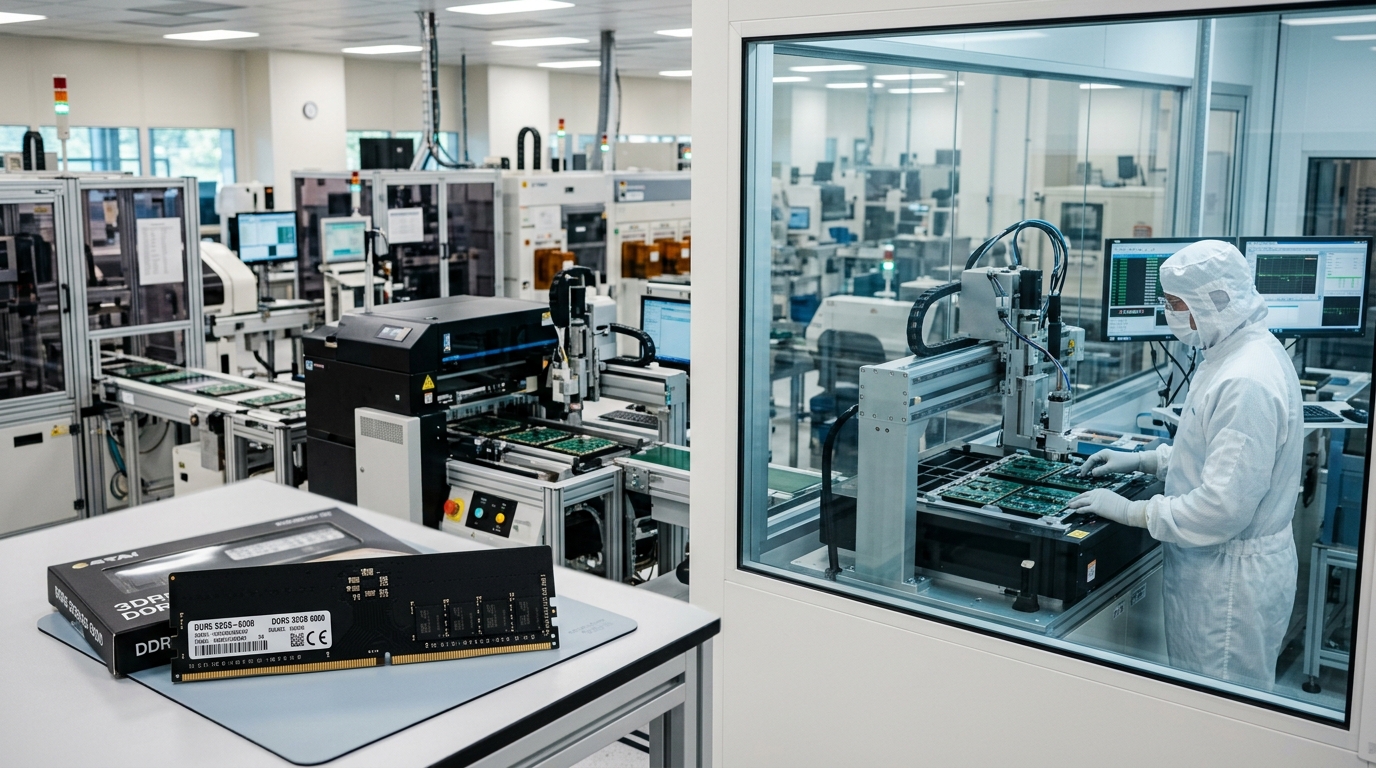
The memory market just delivered a number worth marking. As of October 14, a 32GB DDR5-6000 kit hit $449.97 at the lowest advertised price in the United States, as reported by Tom’s Hardware. That is not a rounding error. The same class of kit sold for roughly $400 in August, and roughly $100 to $200 a year earlier. For active traders, the relevant question is not whether consumers feel the pinch. It is who captures the spread and who absorbs the hit.
- 32GB DDR5-6000 kit: $449.97 as of Oct. 14, per Tom’s Hardware’s tracked low
- 64GB DDR5-6000: pricing varies by brand and timings; the specific $915 “current” level and $159 “lowest-ever” level could not be verified from primary sources and are omitted
- HBM pricing outlook: TrendForce projects average HBM ASP up about 121% next year (as reported by Seoul Economic Daily)
- Micron FY2026 revenue: $133.19 billion vs. $37.38 billion in FY2025, with GAAP net income of $84.97 billion
- Dell product gross margin: down 210 basis points in FY2026, primarily tied to a mix shift toward AI-optimized servers
- U.S. PPI (September): up 6.3% year over year, largest 12-month gain since December 2022
- 2027 memory capacity: industry reporting indicates major suppliers have largely allocated 2027 output via forward agreements, implying limited incremental supply
Where the Macro Pressure Is Coming From
The Bureau of Labor Statistics reported October 15 that the producer price index for final demand increased 1.3% in September, with the 12-month gain reaching 6.3%, the largest annual increase since December 2022. That is the inflation backdrop against which memory prices are accelerating. Component costs rising into a 6%-handle wholesale inflation environment compress every hardware assembler’s margin math simultaneously.
Samsung, SK Hynix, and Micron have shifted a larger share of capacity toward high-bandwidth memory for AI accelerators, which carries far higher margins than standard DDR5. On the capacity math, a widely cited rule of thumb in the industry is that each gigabyte of HBM can consume roughly three times the wafer capacity of DDR5, reflecting stacking and yield loss. That is the mechanism by which AI-grade supply can crowd out consumer memory.
Suppliers: The Widening Toll Booth
Micron reported fiscal 2026 revenue of $133.19 billion versus $37.38 billion in the prior year, with GAAP net income of $84.97 billion. Fourth-quarter DRAM revenue alone increased 343% year over year to $39.8 billion, representing 73% of total sales. The operating margin structure at these volumes is extraordinary.
SK Hynix holds the structural advantage in HBM, with multiple financial outlets citing a roughly 58% global HBM share. On pricing, TrendForce projects average HBM ASP up about 121% next year, as reported by Seoul Economic Daily. Separately, industry reporting has indicated that 2027 capacity across the major DRAM suppliers is heavily allocated through forward agreements, which limits the market’s ability to flex supply quickly if demand stays firm.
The Payers: Dell, HP, and the Hardware Stack
Dell Technologies and Hewlett Packard Enterprise face shortages of memory components as demand for AI servers surges among enterprises and data centers, executives said on separate earnings calls, as reported by Supply Chain Dive. Dell raised list prices across its product line by approximately 17% effective March 30, as reported by channel and trade coverage. Dell’s product gross margin percentage fell 210 basis points in FY2026, driven primarily by a shift in mix toward AI-optimized server offerings, as disclosed in its fiscal 2026 annual report. HP took targeted pricing actions after flagging that memory prices were roughly doubling versus the prior quarter in its fiscal Q1 2026 commentary. Passing costs downstream buys time, but it does not recover the margin already given up on signed contracts.
The cost-pass-through dynamic extends beyond Dell and HP. Nvidia notified major customers of AI server price increases exceeding 15%, with HBM and server DRAM shortages cited as the direct driver.
Technical Framework
MU has been the clearest expression of this trade. The stock re-rated sharply on HBM revenue visibility, and with FY2026 fully in the books, the market is now pricing FY2027 expectations. Watch for any guidance revision relative to the $61.5 billion fiscal Q1 2027 revenue target Micron issued on September 30, 2026. A miss on that figure, or a narrowing of the HBM pricing premium, is the primary downside catalyst. On the cost-payer side, DELL’s ISG operating margin, guided to improve sequentially, is the cleanest tell on whether memory inflation is being absorbed or passed through.
Scenario Modeling
Bull Case: HBM yields improve faster than consensus and Samsung closes the gap with SK Hynix on certification, unlocking incremental supply. MU and SK Hynix maintain 80%-plus gross margins as demand absorbs all available capacity. DELL successfully passes costs through, keeping ISG operating margins above 11%.
Base Case: Supply-chain reporting and industry forecasts continue to point to tight memory conditions into 2027, with HBM pricing staying elevated and DDR5 retail kits holding above $400. Suppliers capture the majority of the margin pool. Hardware assemblers manage thin single-digit operating margins on AI server lines while volume growth offsets rate compression.
Bear Case: A demand air pocket from hyperscaler capex rationalization, combined with faster-than-expected HBM yield improvements, collapses spot premiums. If demand fails to materialize on the timeline implied by 2027 pricing expectations, the downside move in MU from peak cycle margins would be steep.
Active Trader Framework
The structural long in this cycle sits with MU, Samsung, and SK Hynix, where pricing power is confirmed and forward contracts are increasingly locked. The structural short risk sits inside any hardware assembler priced for volume growth but not yet discounting the margin drag from memory costs. Monitor MU’s fiscal Q1 2027 guidance revision as the next binary event. For DELL and HPQ, margin trajectory is the variable that decides whether the stock trades the revenue growth or the margin compression. Risk management requires respecting that this is a cycle, and all cycle peaks eventually invert.