October 19, 2026
Chevron’s dairy biomethane network is carbon-negative
Chevron reports Q3 2026 earnings on October 30, before the open. Consensus sits at $4.85 EPS, a 162% jump from the $1.85 posted in Q3 2025, against expected revenue of roughly $60.5 billion. The commodity backdrop is constructive: Brent was widely expected to average roughly the low-$100s per barrel in Q2, and Q3 pricing has remained elevated versus early-2026 levels. None of that is the interesting question heading into the call.
The Energy Stock Trump Once Called “A Big Mistake” to Mess With
When a U.S. ally tried to tax ONE American energy company…
Trump didn’t hesitate to issue a direct warning.
Now this same company is generating over $3 billion in operating income…
And partnering with the hottest AI stock on Wall Street.
Out of 23,281 publicly traded stocks, this is the ONLY one that meets all the “unicorn” criteria.
The interesting question is what Chevron’s agricultural methane infrastructure is actually worth, and why the street is still not pricing it correctly.
The Infrastructure No One Is Asking About
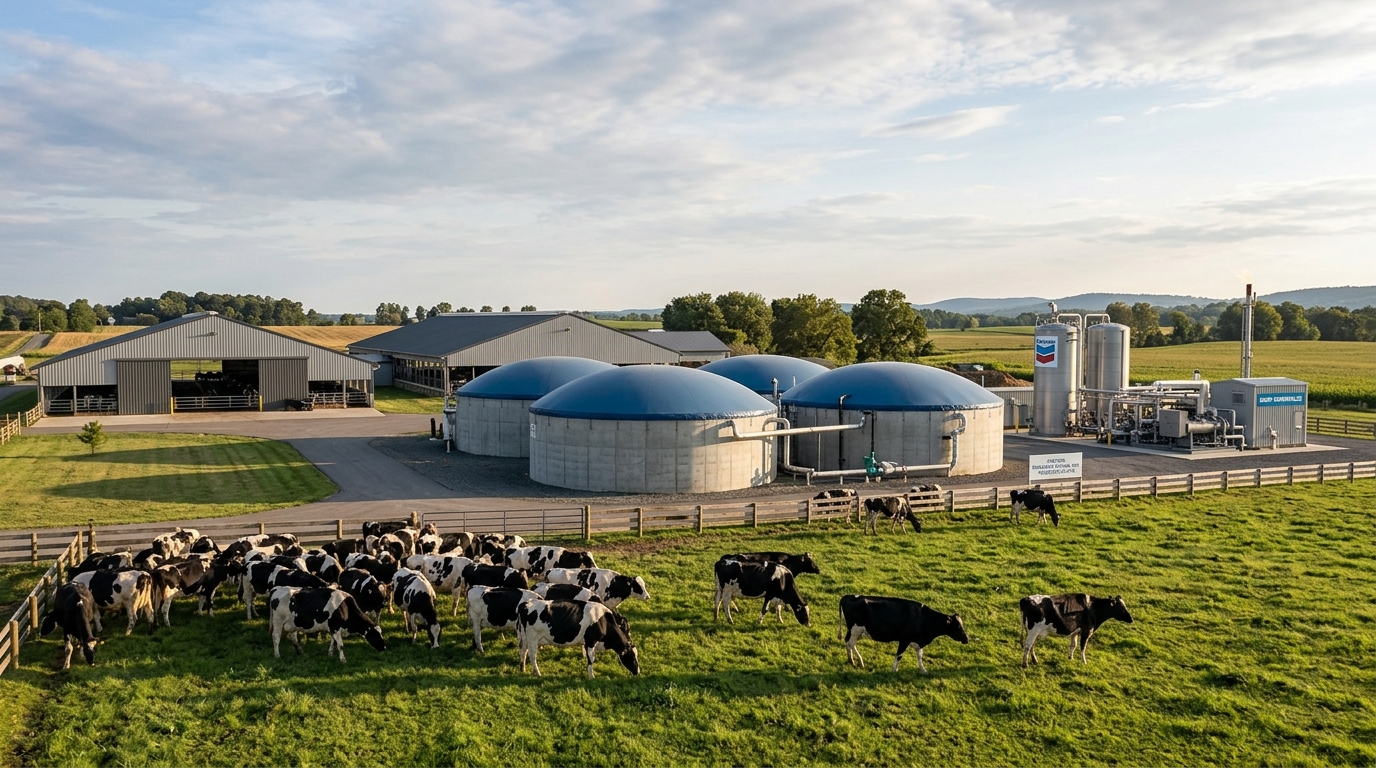
Through its joint venture with California Bioenergy (CalBio), Chevron completed the Hilmar central processing facility in Merced County in November 2024. Seven anaerobic digesters feed captured dairy manure biogas into a centralized upgrading plant, which strips it to pipeline-grade renewable natural gas and injects it into PG&E’s grid. The project carries a carbon intensity score well below zero under California’s Low Carbon Fuel Standard, with estimated annual emissions reductions of approximately 95,000 metric tons of CO2-equivalent per year.
That carbon-negative designation is commercially significant. LCFS credits have largely been in the $50 to $70 per credit range in 2026, following tighter supply conditions as post-amendment requirements phase in. Dairy biogas pathways, because they credit avoided methane emissions (with methane’s near-term warming impact far higher than CO2), can generate credit stacks that dwarf what conventional pipeline gas earns.
Certified low-emission LNG commands a market premium of $0.50 to $2.00 per MMBtu over conventional supply. At scale, that margin differential is structural, not cyclical.
Big Tech is bidding against itself for dead mines
Google quietly backstopped a bitcoin miner for 1.8 billion dollars.
Amazon signed 5.5 billion with a second one. Microsoft wired 9.7 billion to a third.
Roughly 63 billion dollars of Big Tech money landed on bitcoin miners inside a single year.
None of it is about bitcoin.
They are bidding for something the miners picked up cheap in 2021, and once a site is taken it is gone for twenty years.
The Scale Ambition
Chevron’s stated target is 40,000 MMBtu per day of RNG production by 2030. The Brightmark joint venture already operates projects across multiple U.S. states, and CalBio operates clustered dairy RNG systems that feed centralized processing. Together, these form a hyper-localized capture network where Chevron owns the offtake, the LCFS credit stream, and increasingly the liquefaction pathway as bio-LNG demand scales internationally.
Europe’s bio-LNG production capacity stood at approximately 270,000 tonnes per year at the start of 2026, with another 240,000 tonnes under development. Chevron’s existing LNG infrastructure, anchored by Gorgon and Wheatstone with combined nameplate capacity of about 24.5 million tons per annum, gives any domestically captured agricultural biogas a credible liquefaction and export route that a standalone digester operator simply cannot replicate.
The Valuation Gap
CVX trades near $222, at roughly 21x forward earnings in most quote services, with a TTM EPS of about $10.60. Morgan Stanley lifted its target to $226 on October 15 (overweight). UBS sits at $235 (buy). Piper Sandler is at $243 (overweight). All three are anchored to upstream oil realizations and production growth, where Chevron has highlighted record U.S. and worldwide net oil-equivalent production in the past year following the Hess acquisition, which closed in July 2025.
None of those targets model an LCFS credit stack or a bio-LNG premium at any meaningful scale. Chevron has committed $10 billion to low-carbon initiatives through 2028. The RNG and agricultural methane portion of that budget is generating carbon-negative fuel with negative-CI LCFS credits right now, not in a future scenario.
Scenario Framework
Bull Case: Q3 EPS clears $5.00 on oil realizations above $100/bbl, management quantifies RNG production volumes and LCFS credit revenue on the call, and analysts begin assigning a standalone multiple to the low-carbon segment. CVX tests $240.
They Proved It Worked in ’76. Then Buried It.
In 1976, Chevron tapped an energy source so powerful it could run a city, then killed the project, and Unocal and Texaco did the same.
Now one company has spent sixty years perfecting what Big Oil refused to touch.
Google locked in a 15-year contract, Bill Gates wrote a $100 million check, and on October 20th, the government hands it an edge no other energy source gets.
Base Case: Q3 EPS lands near consensus at $4.85, upstream volumes confirm the production trajectory, and RNG commentary remains qualitative. CVX holds the $218 to $228 range through November.
Bear Case: Brent slips below $90 before the print, LCFS credit tightening reverses on a California regulatory delay, and the stock retraces toward the $200 to $205 support zone established in September.
What Traders Should Watch
The October 30 call is the first opportunity to hear Chevron quantify RNG volumes against that 40,000 MMBtu/day target. If management provides a credible progress update, the low-carbon segment shifts from qualitative ESG language into a revenue line with a calculable credit yield. That is the valuation trigger that conventional upstream models are missing. Position sizing should account for oil price beta first. The RNG optionality is real, but it is not yet a catalyst with a hard date.
Preparation, not prediction, is the framework. Know the levels, know the credit market, and listen to what management does, or does not, disclose on October 30.