October 22, 2026
Bonus Content: Amazon’s Robot Fleet Just Hit 1 Million. The Cost Math Is What Matters Now.
Dear Reader,
On May 3rd, 2025, Warren Buffett looked at his shareholders for the last time and said:
“The dollar is going to hell.”
Six words. Sixty years defending the currency. He didn’t soften them.
Ray Dalio isn’t softening his either.
The founder of Bridgewater Associates, with $150 billion in assets under management, is calling it a “debt death spiral.”
*Source: International Business Times
Look at the math these two are staring at.
$40 trillion in debt. A trillion added every 60 days. A billion every 8 hours.
If the dollar falls, most people will get hurt badly.
But there’s a specific asset class and investment system built to thrive when the dollar collapses.
It’s called the ABN System.
It adapts the principles behind BlackRock’s own investing strategy so everyday investors can apply the same framework to protect themselves.
Over 4,500 of our members have already implemented it.
If you have $50k+ exposed to the dollar right now… including your 401(k), stocks, real estate, or savings… you need to pay attention.
Watch how to protect what Buffett and Dalio see coming →
To your freedom,
Tan Gera, CFA©
Decentralized Masters
P.S. JPMorgan warned we’ve crossed 120% debt-to-GDP. Greece collapsed at 130% and cut pensions 40% overnight. Watch the presentation now →
Amazon’s Robot Fleet Just Hit 1 Million. The Cost Math Is What Matters Now.
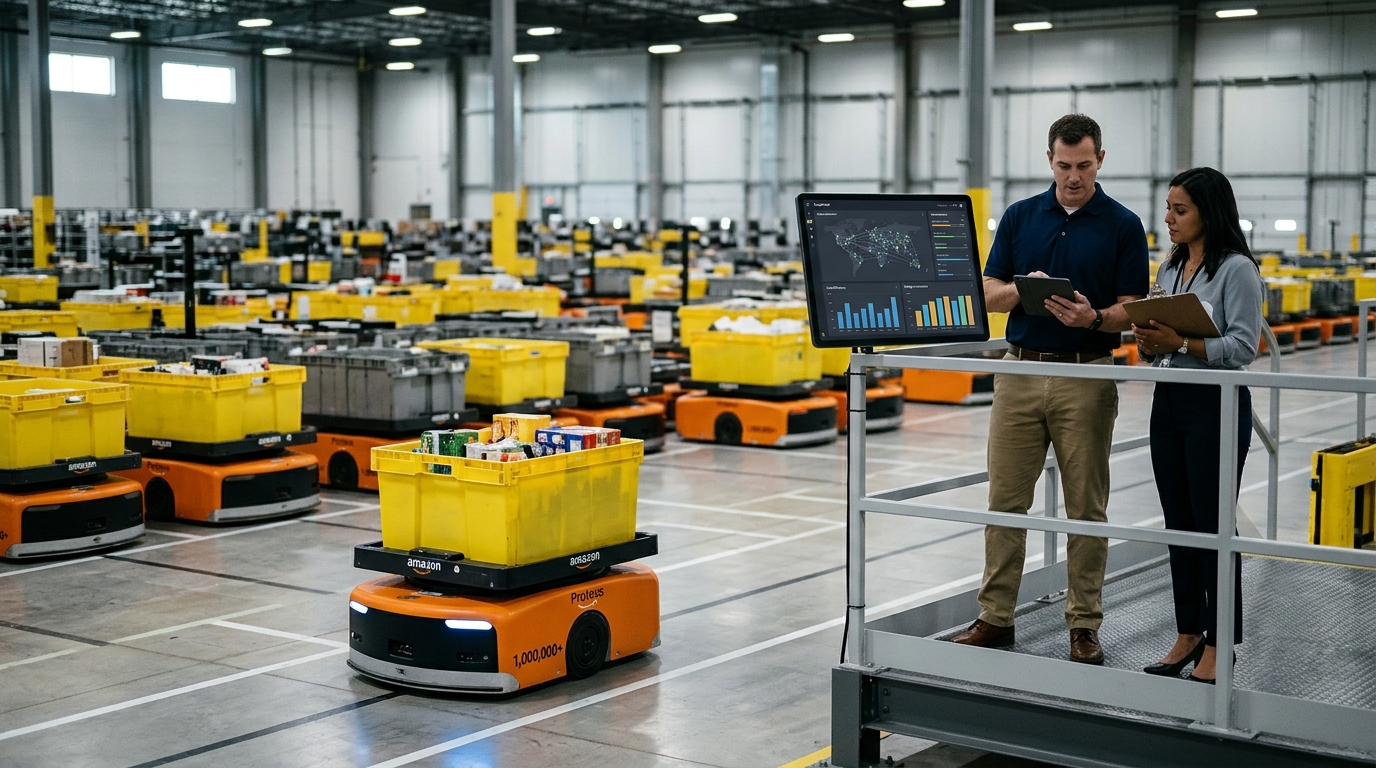
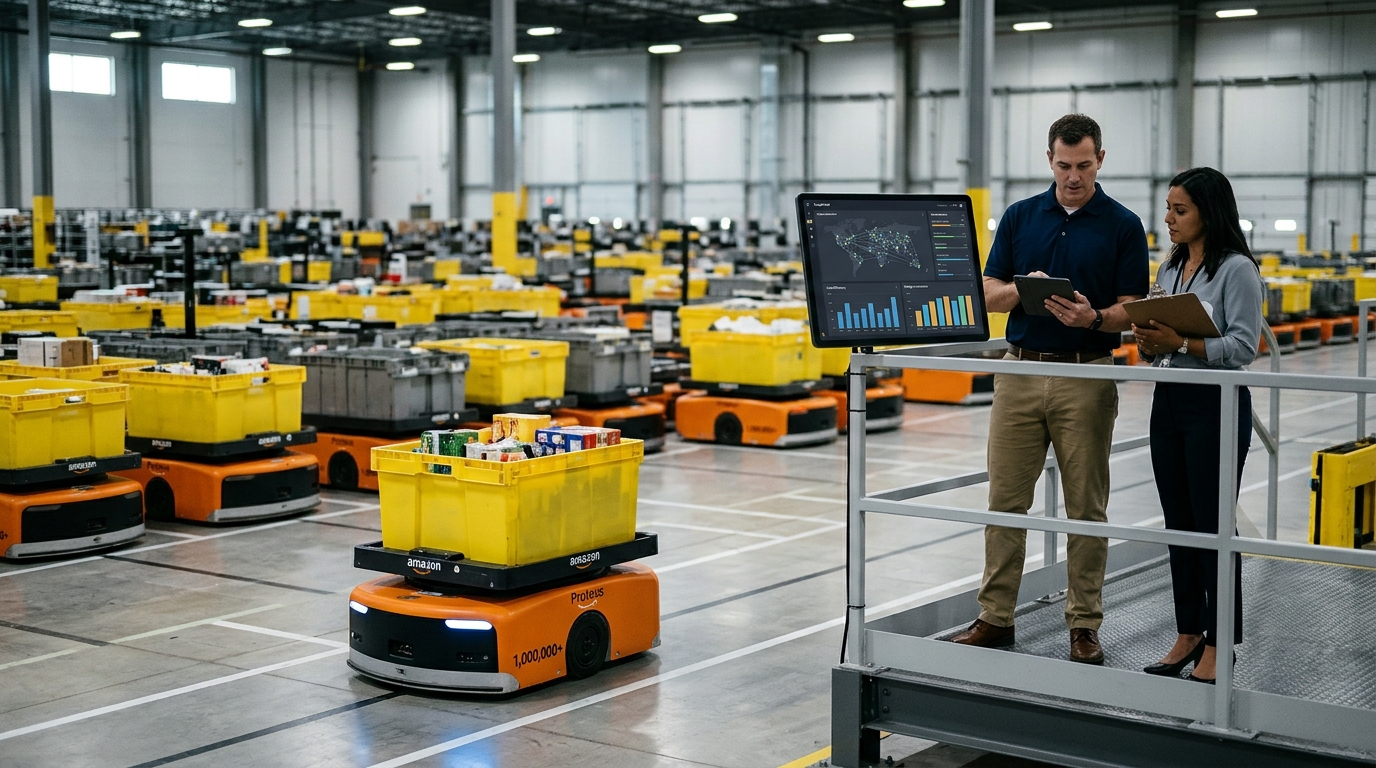
The headline number is striking: over 1 million robots deployed across more than 300 Amazon fulfillment and sortation facilities globally, assisting with 75% of all customer orders Amazon delivers worldwide as of September 2026. But the robot count is not the trade. The margin conversion is.
The Swarm Layer Nobody Is Pricing
Amazon’s real structural advantage is not any single machine. It is DeepFleet, a generative AI foundation model built using AWS tools and trained on Amazon’s proprietary inventory-movement and robot-movement data. DeepFleet coordinates robot movement across the network, improving robot travel time by about 10%. At a fleet of one million units running continuous shifts, a 10% travel reduction is not an incremental gain. It compounds into recovered operational capacity annually, plus measurable energy savings across every site.
The system functions as a peer-aware routing layer: each robot’s path is dynamically adjusted based on the real-time state of every other unit in the building. Less congestion, shorter paths, faster order throughput. Amazon Robotics VP Scott Dresser described it as an “intelligent traffic management system” for a city of robots. The more accurate framing for traders: it is a proprietary data moat that gets more defensible with each additional robot added to the network.
The Financial Setup Ahead of Oct. 29
Amazon’s Q2 2026 results showed operating income of $27.5 billion, up 43% year-over-year. Q3 guidance targets operating income of $22.5 billion to $26.5 billion on net sales of $197 billion to $202 billion. The Street consensus from 27 analysts sits near $202 billion in revenue and $1.96 in EPS, though those estimates carry unusual noise because Q2’s $5.75 actual EPS included large Anthropic remeasurement gains.
Your Free Options Book Is About to Vanish
In case you missed it… make sure you get your free “Simple Options Trading For Beginners” book before your link expires.
I eventually plan to charge money for this training, so do yourself a favor and download it now…
That way, no matter what it costs in the future, you’ll have a free copy.
Sound good?
The question robotics answers specifically: how much of the fulfillment margin improvement is structural rather than cyclical? Amazon plans to more than double its fleet of robotic arms in 2026, supported by new manufacturing plants in Austin, Texas and a more than $100 million Indiana facility announced in September. Analysts at Bernstein estimated the overall robotics buildout exceeds $14 billion over a three-year period, a figure now embedded in the $220 billion full-year CapEx projection management raised after Q2.
Competitive Spread
Walmart has outlined a multi-year push to modernize its supply chain with more automated distribution capacity, including new high-tech perishable distribution centers and retrofits. The directional point is real, but it trails Amazon’s pace by a wide margin, and it does not include a fleet-level AI coordination layer with comparable training data. Globally, millions of autonomous mobile robots are now deployed across the logistics industry, but Amazon’s proprietary closed-loop system, where hardware, warehouse data, and DeepFleet software train each other continuously, is not something outside vendors can replicate inside Amazon’s network.
Walmart’s automation push faces a harder margin math than its headline numbers suggest. Walmart’s comparable sales deceleration punished the stock even when revenue guidance was raised, a reminder that supply-chain investment without margin proof draws no credit from the market.
Levels and Scenarios to Watch
Bull case: Q3 operating income prints at or above $27 billion, and management quantifies DeepFleet’s contribution to cost-per-package. AMZN holds above $220 and analysts raise 2027 margin targets toward 15.7%.
Base case: Operating income lands in the $24 billion to $26 billion range. Robotics efficiency is referenced qualitatively but not broken out as a discrete line item. Stock holds current levels; multiple stays range-bound near 35x forward earnings.
Bear case: Fulfillment costs come in higher than expected due to the ongoing CapEx ramp, narrowing North America retail margins quarter-over-quarter. The swarm build is a cost story before it becomes a savings story, and the market resets the robotics timeline.
Trader Framework
The honest positioning question is not whether Amazon’s robotics program works. The data confirms it does. The question is when DeepFleet’s 10% efficiency gain converts into an auditable reduction in cost-per-order that shows up in segment reporting. Oct. 29 is the first earnings call where that number is large enough to move the needle in the fulfillment segment. Watch North America operating margin specifically. A sequential improvement, attributed even partially to robotics efficiency, changes the 2027 margin thesis from a projection into a trend. That is when the positioning opportunity sharpens.
Preparation is the edge. Know the levels, watch the segment line, and let the data confirm the structural case before sizing into it.