October 30, 2026
Bonus Content: Nvidia’s Real Bottleneck Is Not Compute. It’s What Connects It.
Most traders live in absolute terror of the market pulling a sudden U-turn right after they enter a position…
They buy a breakout, watch it start moving, and then freeze as price completely reverses and wipes out their account…
It’s an exhausting way to trade, but it happens because standard trading forces you to guess direction…
What if a trade could go completely backwards, and still give you a shot at $500 in your pocket before lunch?
Look at what happened back on Tuesday, August 11th…
There were no major headlines moving the market and no surprise economic announcements…

But, according to our research, right around 10:00 AM, a morning setup triggered a clean breakout to the upside…
Everything looked normal until price suddenly reversed and slammed right back inside the morning range…
For traditional traders, that sudden reversal was a guaranteed loss…
Yet anyone who placed this single morning trade would have still walked away with a $520 payout before lunch…
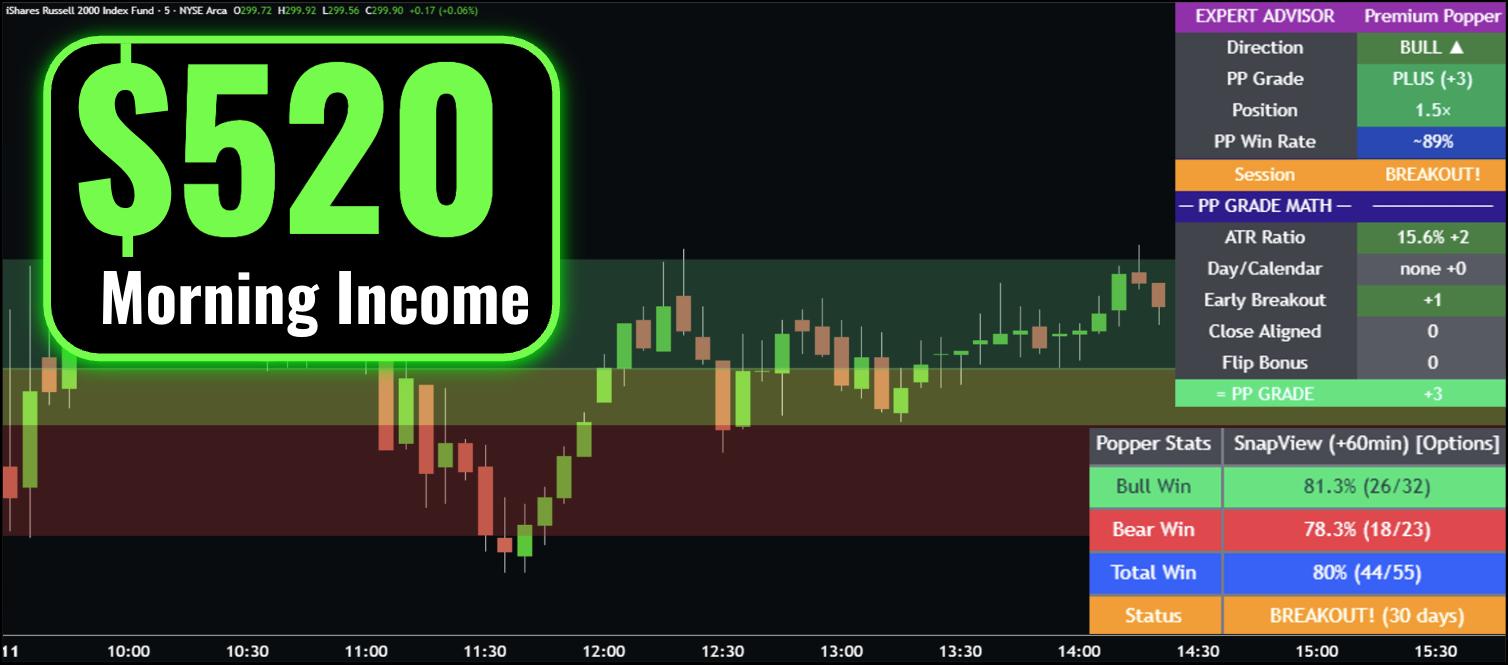
The very next day, August 12th, it would have happened again…
A downside trade was looking great by 11:30 AM, but then price turned on a dime, reversed back into the opening range, and stayed there all afternoon…
The breakout failed completely… yet it still would have resulted in another $500 payday on a simple $1,000 starting stake…
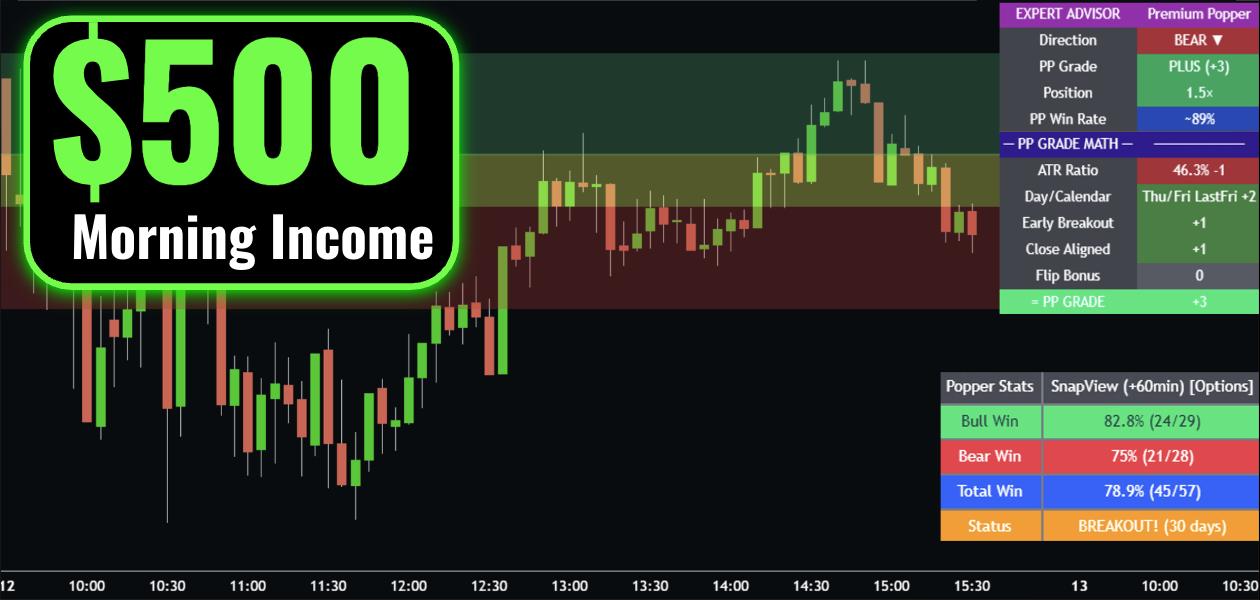
Of course, there would have been smaller gains and some that did not work out, but…
How is it possible to profit when a breakout completely fails?
It all comes down to what happens between 9:30 AM and 9:50 AM every single morning…
During those first 20 minutes, institutional buyers and sellers clash to settle block orders, dumping nearly 25% of the entire day’s volume into the market…
That surge in volume creates the exact price levels where buyers and sellers failed…
Instead of guessing where stocks will go before the bell, waiting until 9:50 AM lets you react to where money is actually flowing…
When structured correctly, there are three distinct ways to win:
If the market moves in your direction, you win… If the market stays completely flat, you win.
And even if the market moves slightly against you, you can still win.
While I cannot make any guarantees in the market…
Recently, I sat down live for a private presentation with a former money manager to pull back the curtain on this 9:50 AM phenomenon and show how these setups work step-by-step…
Access to this is restricted, but for the next couple of hours…
You can follow this link to watch and access the full presentation before access closes.
See you there,
Silas Peters
Nvidia’s Real Bottleneck Is Not Compute. It’s What Connects It.
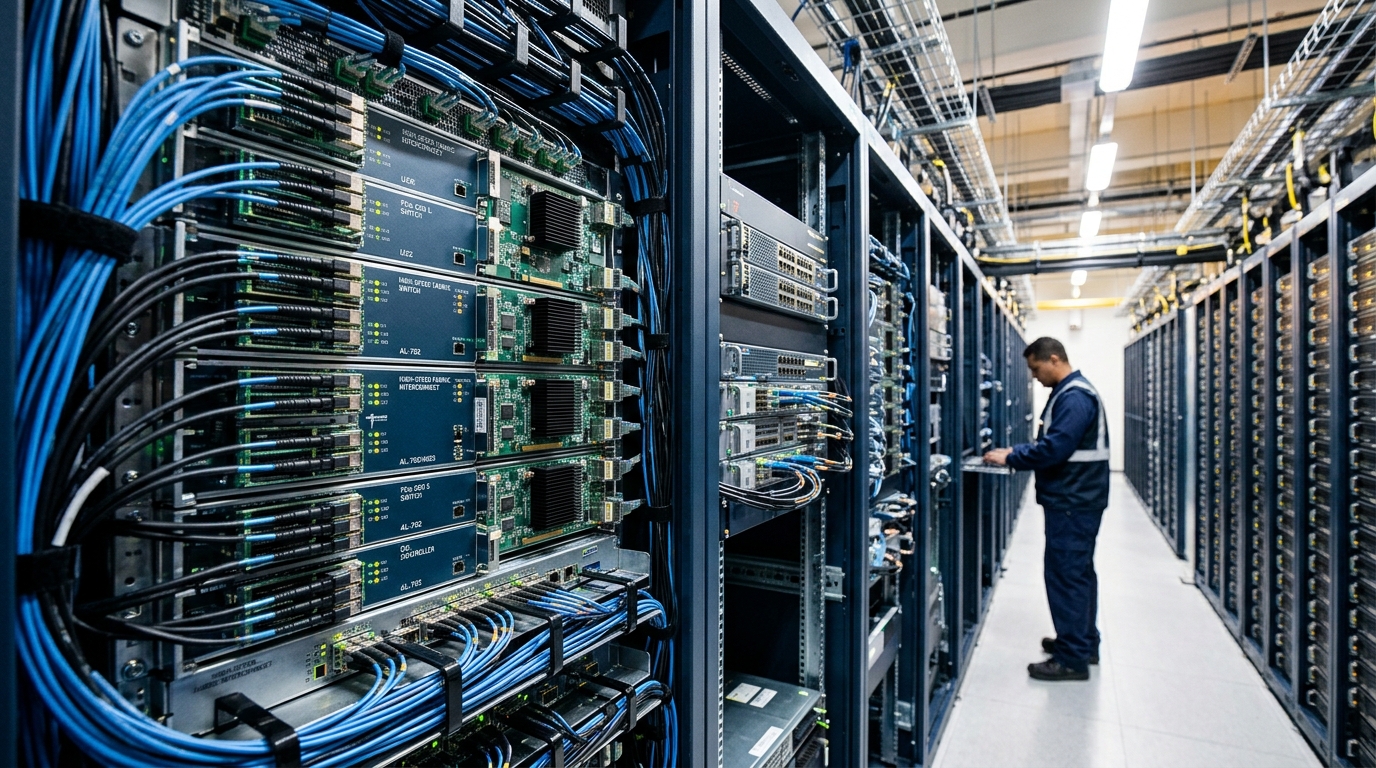
Nvidia controls the GPU. It controls the rack. It increasingly controls the software stack. What it does not fully control is the silicon that moves data between everything it sells. That gap is growing into a structural risk, and Astera Labs is the company sitting directly inside it.
Why the Connectivity Layer Now Matters More Than the Chip
Mega-gigawatt AI clusters are not compute-constrained in isolation. They are fabric-constrained. As GPU counts inside a single rack scale past 72 and toward 128 and beyond, the bottleneck migrates from raw FLOPS to how fast data moves between them. Astera Labs describes its Intelligent Connectivity Platform as integrating multiple connectivity standards and pairing its silicon with its COSMOS software suite to deliver a software-defined connectivity architecture. No other independent company covers that full stack.
Astera Labs positions itself as a key player in next-gen data center connectivity with products spanning PCIe, CXL, Ethernet, and UALink, including retimers and fabric switches. First-mover advantage in silicon generations compounds. Losing those design wins to a potential acquirer would take years to recover.
The Numbers That Make the Case
Astera Labs delivered Q2 2026 revenue of $392.4 million, up 27% sequentially and 104% year-over-year. The company guided Q3 revenue to $540 million to $560 million, with the midpoint representing about 40% sequential growth. On the Street, the Q3 2026 EPS estimate clusters around $1.19, broadly consistent with the company’s non-GAAP EPS outlook of $1.16 to $1.21.
Management has pointed to content reaching about $1,000 per XPU, as it shifts from component supplier toward end-to-end fabric solutions. That is not a component business. That is a platform business, exactly the kind Nvidia pays a premium to own.
ALAB’s 52-week range runs from $97.89 to $499.48. As of October 28, 2026, the stock closed at $297.20 with a market cap of about $51.54 billion. That is roughly 40% below the June 30, 2026 high, compressing the acquisition cost precisely as the fundamental case strengthens.
The NVLink Fusion Entanglement
The strategic dependency is already being built in public. In an Astera Labs announcement about its custom solutions work, NVIDIA Vice President of Engineering Ashish Karandikar said: “NVLink Fusion, combined with Astera Labs’ purpose-built connectivity solutions, gives customers access to the industry’s best scale-up interconnect with NVLink in a proven rack-scale architecture.”
Jensen Huang has a pattern of using public stages to signal which connectivity partners Nvidia considers strategic. Marvell received a similar Huang endorsement at Computex that repriced the stock nearly 30% in a single session.
That is not a partnership. That is a dependency Nvidia could choose to internalize.
Technical and Scenario Framework
ALAB traded above its 200-day SMA near $254 and below its 50-day SMA near $309 as of October 28, 2026. Street targets vary by source and methodology, but compiled consensus sets commonly place the high target near $500 with an average target in the high-$300s to low-$400s. The November 3 earnings report is the next binary event.
Bull case: Q3 revenue clears $560 million, Scorpio X-Series volumes confirm margin stabilization, and Nvidia signals deeper strategic partnership. ALAB reclaims the $400 level. Acquisition premium speculation re-enters the market.
Base case: Q3 lands in-line near $550 million, stock consolidates between $270 and $320, and the story remains a standalone AI fabric compounder.
Bear case: Gross margin compresses toward the ~72% level embedded in Q3 guidance on hardware mix, Scorpio ramp disappoints, and hyperscaler capex caution re-emerges. ALAB revisits the $200 range.
The sector rotation into networking names is not isolated to ALAB. Arista, Cisco, and Ciena each surged 4–5% in a single session as capital rotated surgically into AI connectivity stocks.
Positioning Considerations
The acquisition angle is not a trade on a rumor. It is a framework for understanding why ALAB’s strategic value to Nvidia grows faster than its market cap implies. Traders monitoring the November 3 earnings report should watch Q3 gross margin closely alongside Scorpio revenue mix, the two variables that determine whether ALAB is acquired at a premium or merely owned by institutions. Risk management matters most here: ALAB’s reported beta varies by data provider, but screens have recently put it around the high-3s.
Preparation over prediction. The data fabric is the next contested layer in AI infrastructure. Astera Labs built it. The question traders must price is whether Nvidia decides to buy it.