November 3, 2026
Bonus Content: Brent Lost $8.66 Monday. It Got Most of It Back Overnight.
Dear Reader,
If you have $100,000 sitting in a bank account, you lost roughly $17,000 last year.
Not from a bad trade.
Not from a market crash.
From doing absolutely nothing.
In 2025, the dollar lost 12% in value.
Real inflation hit 5%+.
12% + 5% = 17% purchasing power gone.
And it’s happening again this year. And next year. And the year after that.
The people who understand this are already moving.
In a free presentation I just recorded, I’m revealing what we call “The 2026 AI Gold Rush.”
The ONE AI-linked asset class the U.S. government has no choice but to fuel… and BlackRock, Goldman Sachs, and 170 public companies are already positioning into it.
The same strategy that delivered 12,480% for Mastercard investors since its 2006 IPO.
Mastercard was the pick-and-shovels play of the e-commerce boom.
The question every serious investor should be asking: what’s the pick-and-shovels play of the AI boom?
Sitting idle isn’t “playing it safe.” It’s the most expensive decision you’ll make this decade.
Watch the free presentation (and see how to stop the purchasing power bleed) →
To your wealth,
Tan Gera, CFA®
Decentralized Masters
P.S. BlackRock, Goldman, and 170 public companies are all positioning into the same asset class. Watch the free presentation to see which one →
Brent Lost $8.66 Monday. It Got Most of It Back Overnight.
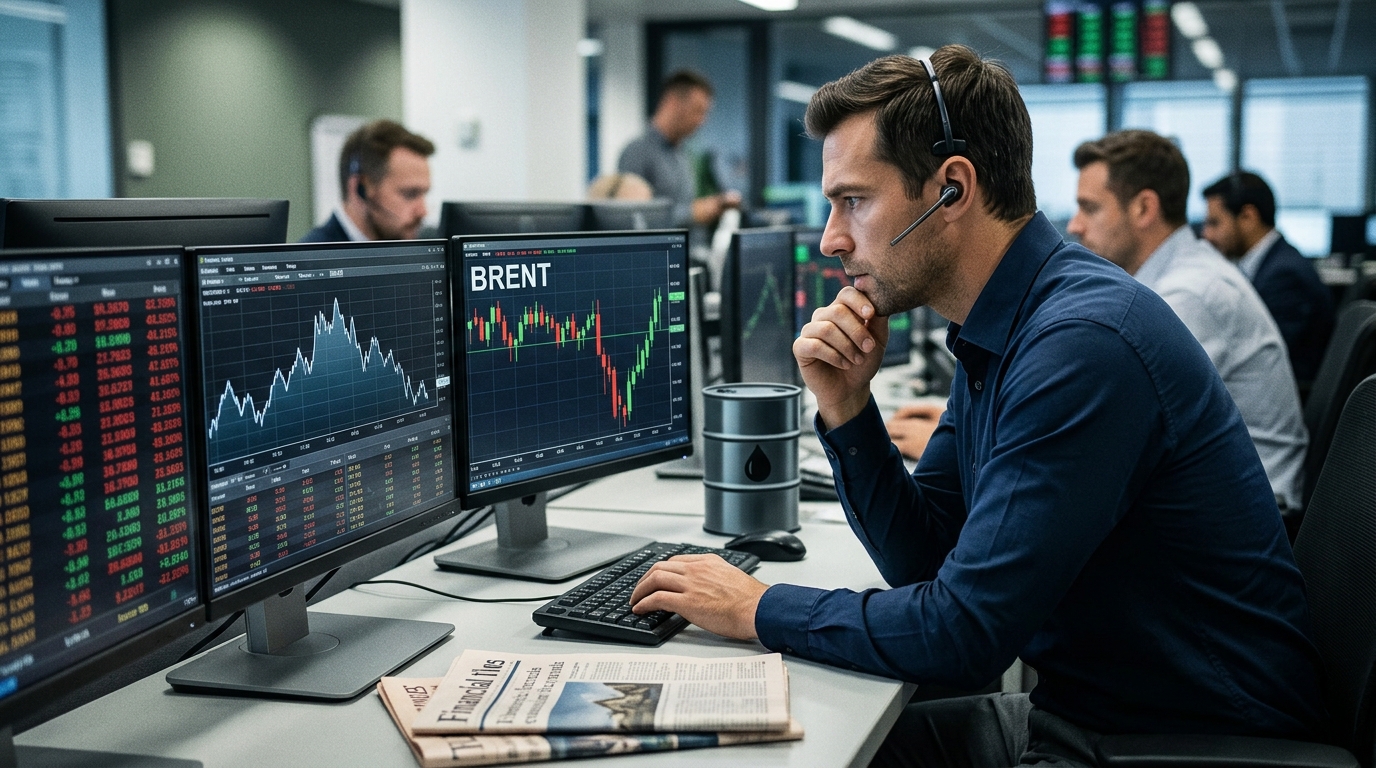
Monday’s 7.6% plunge in Brent was one of the sharpest single-session drops in oil this year. By Tuesday’s Asian open it was already partially unwound. The round-trip took less than 12 hours and it reordered every position built on the peace-talk thesis the market had spent a week constructing.
What Happened, in Order
Brent crude futures settled $8.66, or 7.63%, lower at $104.77 a barrel on Monday after Trump signaled more time for Iran diplomacy and Iranian negotiators left Qatar carrying a draft peace proposal. Iran’s president said the supreme leader had granted the government certain authorities regarding peace talks; the country’s negotiators held days of talks with Qatari mediators, and a follow-up meeting remained possible. Airlines surged on the relief: JetBlue jumped 11% as oil fell on U.S.-Iran peace talk hopes, with cheaper fuel helping airlines near breakeven most. United rallied 6% and American Airlines gained 5%.
Overnight, the Wall Street Journal changed the picture entirely. The attack was first reported by the Wall Street Journal, while Iranian state media confirmed several explosions on the island situated in the Strait of Hormuz. It was the latest in a series of limited strikes carried out by Washington in recent weeks. Strikes have been kept deliberately limited and purposefully secret so as not to signal any intent of resuming a major military campaign against Iran.
Brent crude futures rose 48 cents, or 0.5%, to $105.25 a barrel by 0104 GMT while WTI was up 47 cents, or 0.5%, at $96.93. By Tuesday morning in the U.S. session, Brent was up 1.75% at $106.60 per barrel, while WTI was up 1.7% to $98.10.
The Energy Side: XOM and CVX
“The oil market is still reacting with extreme sensitivity to every headline out of the Middle East,” UBS analyst Giovanni Staunovo noted. That sensitivity creates asymmetric positioning on the integrated majors. XOM closed Monday at $179.67, off 4.05% on the peace-talk flush, after posting Q3 revenue of $113.16 billion and earnings of $15.4 billion. JPMorgan carries a $199 price target with an Overweight rating. CVX settled Monday at $227.77, down 3.29%, having reported adjusted EPS of $5.28 and revenue near $67.8 billion in Q3, with adjusted free cash flow of about $14.2 billion. Both stocks are recovering with oil this morning. Traders who sold the majors on the peace-talk headline and failed to cover are now facing a retracement at worse prices.
Airlines: The Positions That Need Reassessment Now
JetBlue paid $3.91 a gallon for fuel in Q3, 57% more than a year earlier, and guides to an adjusted operating margin of (4.5)% to (6.5)% for full-year 2026. The company’s Q4 guidance assumes fuel at $4.64 a gallon, so any sustained drop in oil would feed straight into its cost line. With Brent snapping back above $106 this morning, that assumption is already under pressure. JetBlue does not currently have a fuel hedge, and fuel costs remain its biggest immediate risk if oil keeps rebounding.
United and American, with broader global networks, loyalty revenue, and cargo businesses, absorb fuel shocks more readily than JetBlue’s leisure-focused model. Monday’s relative moves confirmed that: JBLU’s 11% surge versus UAL’s 6% and AAL’s 5% reflects exactly this operating leverage differential. The same math runs in reverse with oil climbing back.
Frontline: The Conflict’s Clearest Beneficiary
FRO shares fell 8.47% to $52.08 on Monday as crude tanker stocks gave back recent geopolitical gains, the primary catalyst being a sharp unwind in the Strait of Hormuz risk premium after the U.S. and Iran signaled possible diplomacy. The Qeshm Island strike reverses that logic immediately. Frontline CEO Lars Barstad has said tanker traffic through the Strait of Hormuz should quickly increase if the U.S. and Iran reach a credible deal, which means the opposite holds: confirmed military activity keeps disruption in place and rate support intact. FRO has recently traded around a trailing P/E near 7.8 with trailing EPS of $6.68 and a 52-week range of $20.47 to $59.75.
Rate support for tanker operators depends entirely on how long Hormuz disruption persists. Frontline’s record quarterly profit and $2.61 dividend were built on VLCC spot rates that only exist under sustained strait disruption.
Scenario Modeling
Bull Case: Diplomatic talks collapse entirely following the Qeshm strike. Brent pushes toward $110-$115. XOM and CVX reclaim their pre-Monday levels. FRO retests $59.75. Airline longs from Monday are stopped out.
Base Case: Back-channel diplomacy continues despite the strike, which is characterized as defensive. Brent consolidates $104-$108. Integrated majors hold $180-$232 ranges. Airlines give back roughly half of Monday’s gains over the next two sessions.
Bear Case for Oil: Iran confirms the strike was defensive in nature and publicly reaffirms willingness to negotiate. Brent retraces back toward $102. Monday’s airline long trades recover. FRO tests the $50 level.
Active Trader Framework
The central risk today is binary headline flow ahead of Tuesday’s U.S. midterm elections. “The report added a degree of risk premium back into the oil price. Just when markets were starting to price in a more diplomatic path, this reminder of ongoing military activity has flipped the tone,” said Tim Waterer, chief market analyst at KCM Trade. Key levels: Brent $104.77 is Monday’s settlement and the first support. $106.60 is the current Asian-session high and the level to hold for bulls to maintain momentum. On the airline side, JBLU’s intraday VWAP from Monday’s session is the reference for mean reversion. Any Brent print above $108 should pressure airline positions regardless of equity-market direction. Raymond James analyst Pavel Molchanov has flagged that skepticism is warranted after many false dawns over the past several months. Position sizing against that backdrop is the only edge available.
Preparation, not prediction, is the framework here. The Qeshm strike proves that the geopolitical variable can invalidate a week of pricing in hours. Keep risk defined, watch Brent’s $104.77-$108 corridor, and let the midterm result inform the next leg.