November 8, 2026
Bonus Content: America’s Borrowers Are Breaking Down. The Fed May Hike Anyway.
Let’s be real for a second.
While most traders are still squinting at lagging indicators and trying to “guess” where the next move is coming from…
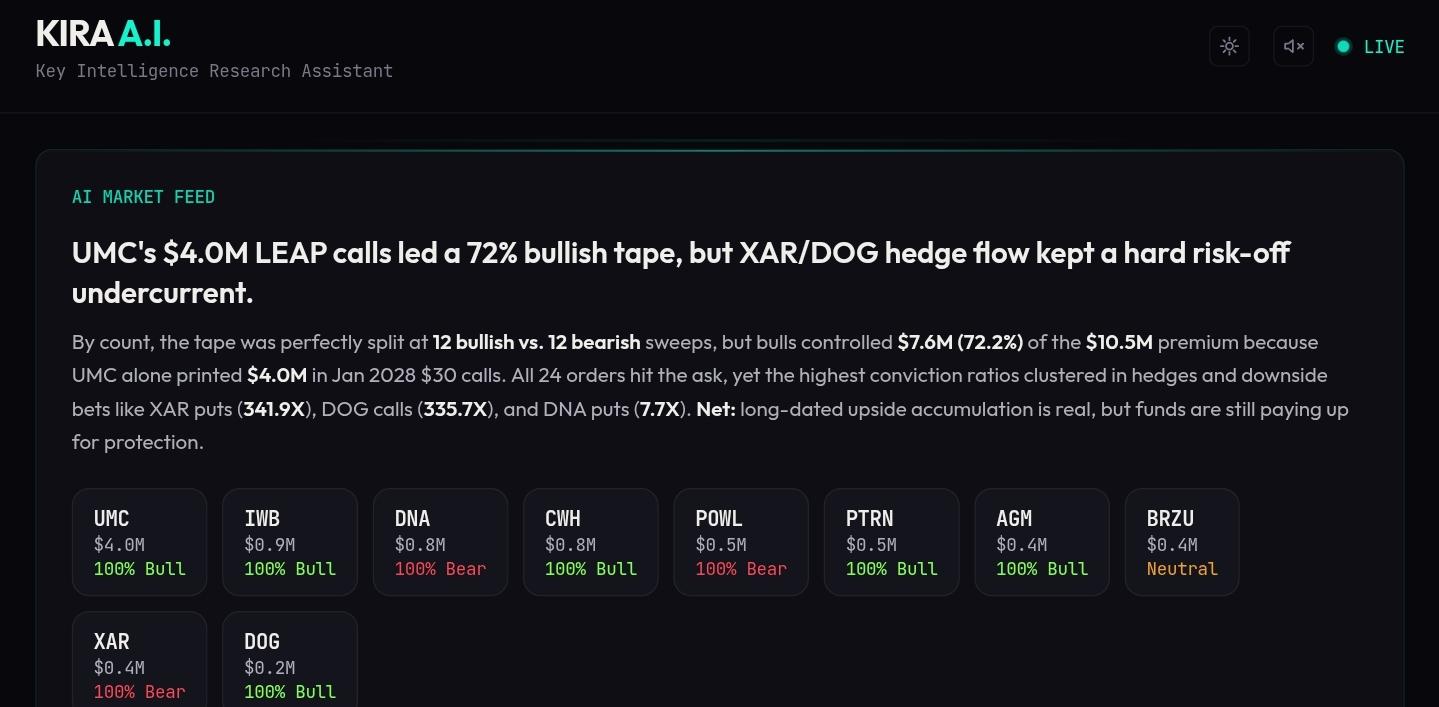
My top AI trading engine is already light years ahead.
I’ve spent months and a small fortune making sure this engine outclasses any other trading tool you’ll find out there.
And right now, it’s flagging the kind of setups that typically stay hidden behind the velvet ropes of hedge funds and institutional banks.
I’m talking about the ability to:
- Identify moves before they even register on a standard chart.
- Target “time-warp” returns that can compress years of gains into days.
- Choose your own risk so you never have to “bet the farm” to see results.
If you still haven’t grabbed your free access, I have to ask… What are you waiting for?
The market isn’t going to slow down for you. The robots running the show today certainly won’t wait for you to catch up.
You can keep doing things the hard way… dealing with the stress, the overthinking, and the emotional roller coaster…
Or you can let AI do the heavy lifting for you.
Claim your FREE access to the AI engine right here (No credit card required)
The proof is waiting inside.
Till the next trade,
Lance Ippolito
America’s Borrowers Are Breaking Down. The Fed May Hike Anyway.
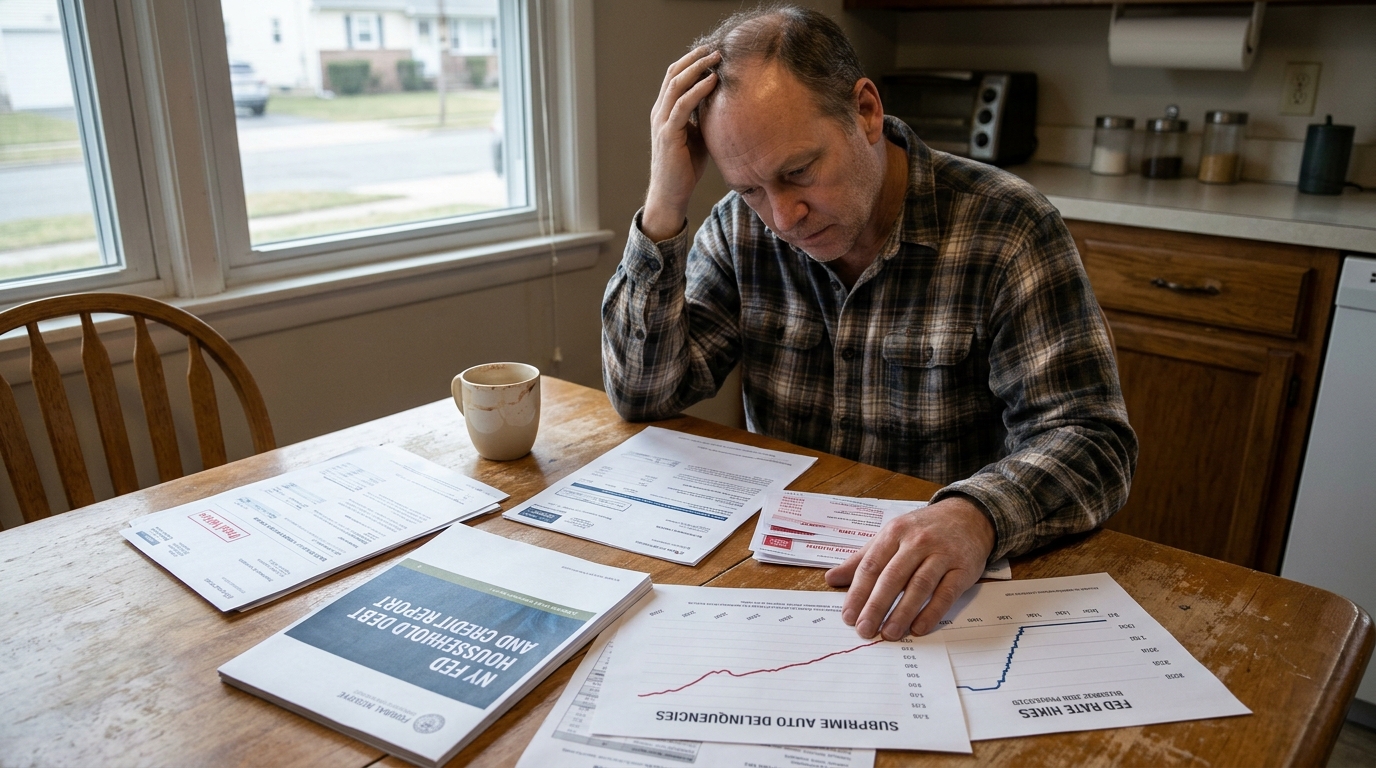
Tuesday at 11:00 ET, the New York Fed drops its Q3 2026 Household Debt and Credit Report. The timing could not be more loaded. Odds of a December Fed rate hike sit near 73% per the CME FedWatch Tool, and the balance sheet that would absorb another hike is already cracking at the seams.
- Subprime 60-day-plus auto delinquency hit 6.9% in January 2026, a 32-year record stretching back to 1994, according to Fitch Ratings
- In securitized pools, 17.68% of subprime auto balances were at least 30 days past due in September
- Delinquency rates rose at 10 of the 12 issuers holding at least $500 million in subprime balances
- Michigan consumer sentiment rose to 51.0 in early November from 48.0 in October, but remains near historic lows
- Total household debt stood at $18.8 trillion after declining $13 billion in Q2 2026, with auto debt at about $1.71 trillion
The Macro Setup Before Tuesday’s Print
Consumer sentiment fell in October as frustration over the higher cost of living weighed on Americans’ views of the economy. Five-year inflation expectations reached 3.5%, 150 basis points above target, and they moved higher versus the prior month. That is the Fed’s problem in one number.
The companion Liberty Street Economics post will examine newly delinquent credit card borrowers and how their socioeconomic profile has evolved, adding a distributional lens to raw delinquency figures. Traders should watch whether the Q3 data shows auto stress broadening or plateauing. Subprime delinquency had eased to 5.67% in June 2026, down 64 basis points year over year, so the trajectory into September is the question Tuesday answers.
Sector Breakdown: Who Carries the Risk
The auto-lending complex is not monolithic, and Tuesday’s data will likely separate the market accordingly. Subprime borrowers hold just 17% of all active auto loan accounts yet account for nearly two-thirds of all delinquent loans, according to Federal Reserve Bank of Philadelphia research.
Ally Financial generated $12.9 billion in new originations in Q3, but reported an all-in 30-plus-day delinquency rate of 4.96% and a retail auto net charge-off rate of 1.89%. CFO Russ Hutchinson noted that late-2025 and early-2026 vintages showed higher early-life delinquency, reflecting their credit mix and yield characteristics. Originations growth of 10% year over year tells one story; a $511 million credit-loss provision tells another.
Credit Acceptance (CACC) operates at the furthest end of the risk spectrum. The company posted a consolidated net loss of $56.6 million, or $5.43 per diluted share, in Q3 2026, compared to net income of $108.2 million in the same period of 2025. Consumer loan assignment volume reached 110,010 units, up 37.7% year over year, a volume surge that must be weighed against the delinquency environment it is entering.
The card issuers with subprime exposure offer a contrast. Synchrony Financial’s net charge-off rate decreased 37 basis points to 4.79%, with 30-plus-day delinquency easing to 4.34%, while Bread Financial lowered its 2026 net loss-rate outlook to below 7% after Q3 total net interest and non-interest income reached $1.017 billion, up 5% year over year. Both suggest disciplined underwriting can insulate even subprime-adjacent books when managed actively.
Technical Framework
Ally (ALLY) has traded in a volatile range tied to each delinquency update. Watch the 50-day moving average as directional reference into Tuesday; a close below that level on elevated volume following the report would signal institutional repositioning rather than retail noise. Credit Acceptance has shown a pattern of gap-down reactions on adverse macro credit data, with limited VWAP recovery in the sessions that follow. SYF has outperformed the peer group since its October earnings beat and may serve as a relative-strength long in a sector rotation if Tuesday’s data is worse than feared.
Scenario Modeling
Bull Case
Q3 auto delinquencies show sequential improvement from January’s peak, confirming the June trend. The Fed interprets the data as evidence that tightening is working. Consumer lenders with tighter underwriting, SYF and BFH, grind higher. ALLY recovers toward the top of its recent range on improving vintage performance signals. Catalyst: 30-plus-day auto delinquency in Q3 prints below 1.45% aggregate.
Base Case
Delinquencies are flat to modestly improved versus Q2 but remain structurally elevated. The Fed proceeds with a December hike. Sector trades sideways with divergence: prime-focused issuers (SYF, BFH) hold, while CACC and Santander Consumer-exposed names face renewed pressure. The Liberty Street blog on credit card delinquency demographics adds headline risk for card issuers into year-end.
Bear Case
Q3 aggregate auto delinquency re-accelerates, and the NY Fed blog documents deterioration in newly delinquent credit card profiles. New York Fed data had already shown 90-plus-day delinquencies on auto loan balances at 5.6% in Q1 2026, the highest in its published series. A further step higher triggers credit-risk repricing across the consumer-lending complex. CACC tests 2026 lows. ALLY provision guidance for Q4 moves above $550 million. BFH’s sub-7% loss-rate target comes under scrutiny.
Active Trader Strategy Framework
Position sizing ahead of a Fed data release demands discipline. The 11:00 ET release window typically produces an initial spike in volatility followed by a directional fade or continuation within the first 90 minutes. Consider reducing gross exposure ahead of the number, then re-establishing after the first post-release bar closes.
Key levels: ALLY’s 60-plus-day delinquency rate of 1.04% in Q2 is the reference point. Any Q3 reading above 1.10% would likely weigh on the stock independent of originations growth. For SYF, the 4.34% 30-plus-day delinquency rate from Q3 earnings is the benchmark. If the broader NY Fed data shows worsening credit card delinquency transitions, that benchmark becomes a floor to defend.
Volatility on consumer-lending names tends to compress in the two days before a macro data release and expand sharply after. Options structures that benefit from a move in either direction, sized to known risk, are worth considering for ALLY and CACC specifically.
Conclusion
Tuesday’s report is not a curiosity. It is a live reading of whether household credit can withstand another Federal Reserve tightening move. The combination of elevated debt levels, high interest rates, and weakened loan quality points to a constrained path forward for subprime auto lending. Traders who have mapped the data, the levels, and the scenarios before 11:00 ET will be positioned to respond. Those who wait for the headline will be reacting to someone else’s preparation.