

Dear Reader,
On June 18th, an advancement to a potential Digital Dollar happened…
And most Americans didn’t even notice it.
Five federal agencies, including the Federal Reserve, proposed a rule that would tie your identity to every digital dollar transaction you make.
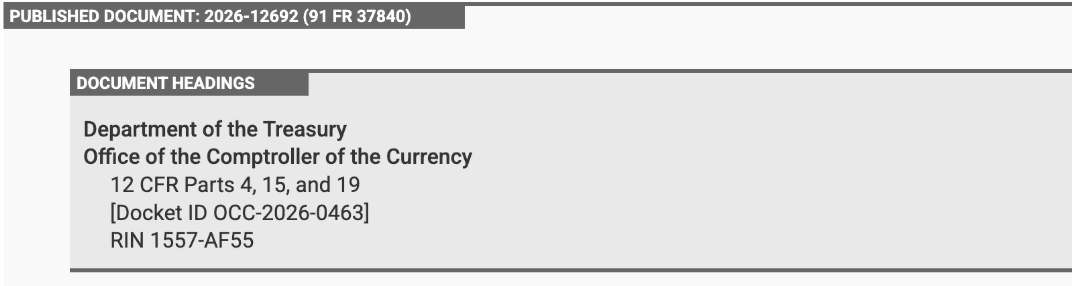
The Fed wants certain stablecoin (digital forms of a dollar) companies to start identifying users just like banks do.
And the scary thing is…
It’s being framed as a consumer protection measure.

It always is… isn’t it?
Like back in 1971, when the dollar was cut from gold.
Americans were told it was necessary and temporary…
And yet, 50+ years later… your dollar has never been backed by gold again.
Now, most people will completely ignore this ruling by The Federal Reserve…
And they’ll think:
“Whatever, it’s just another regulation.”
But this is EXACTLY why it matters.
Because although this may not be the Digital Dollar itself…
It could certainly be an advancement to a Digital Dollar.
One in which every digital dollar is tied to an identity…
And it’ll likely get more regulated through a series of ‘harmless’ rules just like this one.
That’s why I recorded this free presentation on our “Digital Dollar Immunity” System – allowing us to opt out of a digital dollar if it hits.
We do this by moving a portion of our assets into a parallel financial system – one where you actually own the keys to your own wealth.
Click Here To Reveal The “Digital Dollar Immunity” System →
We already have 4,500+ members doing this.
If you have $50k+ saved for retirement…
And you want to protect your family from whatever comes next…
I strongly suggest you watch this now:
Click Here To Reveal The “Digital Dollar Immunity” System →
To your wealth,
Tan Gera, CFA
Decentralized Masters
P.S. By law, a stablecoin issuer must be able to freeze or burn the tokens it issues on a lawful order. That’s in the GENIUS Act itself. An asset where you hold the keys has no issuer carrying that obligation:
Strategy Faces $1.8B in Forced Selling as MSCI Posts Results

Today is the day the uncertainty ends, at least structurally. MSCI is scheduled to post the November 2026 Index Review results shortly after 11:00 p.m. ET tonight, the release that determines whether Strategy (MSTR) keeps its seat in the Global Investable Market Indexes or gets walked to the door at the November 30 close. The stock has been trading the risk for weeks. Now it has to trade the reality.
- MSCI is scheduled to post its November Index Review results on November 11; changes take effect as of the November 30 close
- Strategy flagged as a deletion candidate in MSCI-related simulations since May 2026, using financial data as of September 30
- MSCI-linked passive funds hold roughly 13 million MSTR shares, equal to 3.1% of basic shares outstanding
- At recent prices, that block carries a market value of approximately $1.8 billion; JPMorgan’s upper estimate reaches $2.8 billion
- BlackRock’s IBIT has bled $1.66 billion in net outflows across seven consecutive sessions since October 30
- Bitcoin traded near $73,800 overnight before a modest bounce; the November 10 low was near $72,700
- If FTSE Russell and S&P Dow Jones follow MSCI’s lead, JPMorgan has estimated total passive outflows could reach $8.8 billion
Market Context
Bitcoin is not cooperating with the timing. IBIT posted about $213 million in outflows on November 10 alone, extending a streak that began October 30 and now totals $1.66 billion. The broader spot bitcoin ETF complex shed about $201 million that same session. Bitcoin dipped to $72,689 intraday before staging a brief bounce above $75,000, but the recent run of lower closes signals that buyers are not yet in control. The October CPI release was described as hotter than expected in market coverage, adding another headwind by strengthening the dollar and pressuring risk assets across the board. MSTR closed November 10 near $121, more than 16% below where it traded a month ago.
The Selling Window
Strategy has responded to MSCI’s consultation that passive funds tracking its Global Investable Market Indexes hold roughly 13 million MSTR shares, representing 3.1% of its basic shares outstanding and about 60% of its stated 30-day average daily trading volume. At a share price near $136, that block was worth approximately $1.8 billion. The stock is lower now, so the dollar figure has compressed, but the share count has not.
JPMorgan’s $2.8 billion figure was built on an earlier digital-asset-specific proposal, not the final non-operating company framework MSCI said it would implement as part of the November 2026 Index Review, effective as of the close of November 30. The actual forced selling total will depend on how each fund executes, what market depth looks like in the approach to November 30, and whether discretionary buyers step in to absorb supply. Strategy argued in its letter that the 13 million shares represent less than one day’s MSTR trading volume. That argument did not change the rule.
Critically, passive fund selling of MSTR does not force Strategy to liquidate any of its roughly 849,000 bitcoin. The company’s BTC holdings stay on its balance sheet. What changes is the structural demand that index membership creates, and potentially the ease with which Strategy raises equity capital for future bitcoin purchases.
Technical Framework
MSTR’s moving-average structure tells a consistent story heading into this event. As of early November, the stock was trading below its 7-day, 20-day, 50-day, and 200-day simple moving averages simultaneously, a configuration that reflects sustained distribution rather than a brief pullback. A death cross formed around November 4. Immediate support sits in the $120 to $122 zone; the next meaningful floor below that falls near $113. On the upside, the pivot reclaim at roughly $124 to $125 is the first order of business before any serious recovery conversation. RSI readings in the low 40s signal weak momentum without yet triggering a classic oversold reversal.
Scenario Modeling
Bull Case
MSCI’s final list surprises by excluding Strategy on a technicality of its two-period filing buffer, or the market’s reaction is already fully discounted. Bitcoin stabilizes above $75,000, IBIT outflows stop, and MSTR squeezes back above $140. Analyst targets from B. Riley ($180) and Citi ($260) remain intact. Probability: low given the October simulation data.
Base Case
Strategy is confirmed on the deletion list. Passive funds begin systematic selling over the 15 trading days between now and November 30. MSTR ranges between $110 and $130 as the market absorbs supply. Bitcoin holds $72,000 to $75,000. Volatility stays elevated but no disorderly break occurs.
Bear Case
IBIT outflows accelerate, bitcoin breaks below the $72,000 level that has acted as a floor, and MSTR fund selling compounds into a thinner market ahead of Thanksgiving week. If $113 gives way, the next visible technical reference is well below $100. If FTSE Russell signals it will follow MSCI, the $8.8 billion contagion estimate becomes relevant.
Rate policy is part of the pressure on bitcoin’s floor. ETF inflows alone did not protect bitcoin when the Fed signaled higher rates, and funding rates compressed fast — the same mechanism that can accelerate a break below key support levels.
Active Trader Framework
The event risk is binary but the execution window is not. Traders watching MSTR should treat $120 as the near-term line in the sand on the downside, with $113 as the structural stop reference. Any attempt to fade the selling should wait for the daily volume profile to show absorption rather than continuation. On the crypto side, $72,000 in bitcoin is the level to monitor: a clean break there removes a support that has held across recent weekly closes and materially changes the near-term setup. Position sizing should account for MSTR’s ATR of roughly $8 to $9, meaning the stock can traverse key levels in a single session without signaling a trend change.
Conclusion
Today’s list transforms a known risk into a confirmed calendar. Traders who prepared for this outcome weeks ago are better positioned than those reacting now. The 19-day window to November 30 is the trade’s clock. Discipline, defined levels, and respect for the liquidity conditions around forced selling will matter more than any directional conviction about bitcoin’s long-term value.