Thinking about leaving the U.S. if the midterms don’t go your way?
Millions of Americans are eligible for this overseas opportunity… and most don’t even realize it…
You and your family could already be eligible right now.
Lyft’s Q3 Miss Widens the Gap Between Price and Buyout Value
Six days after reporting Q3 results, Lyft is trading at roughly $17.02 and the Street has converged on a consensus Hold with an average target near $18.89. That gap is narrow. The more interesting gap sits between Lyft’s current enterprise value and what a motivated acquirer from the automotive world would likely pay for what it actually owns.
- Q3 Gross Bookings: $5.6 billion, up 17% year over year
- Q3 Revenue: $1.82 billion, up 8% year over year, dragged by a $69.1 million legal and regulatory reserve impact to revenue
- Q3 Adjusted EBITDA: $203.9 million, up 47% year over year; margin expanded to 3.6% from 2.9%
- Trailing twelve-month free cash flow: $1.13 billion
- Active Riders: 31.6 million in Q3; Q2 set a then-record 30.5 million; Q3 rides grew 10% year over year
- Analyst consensus: 10 Buys, 26 Holds, 2 Sells; price targets range from $16 to $26
- EV/Revenue multiple: approximately 0.7x on 2026 estimates
The Miss That Matters Less Than It Looks
Lyft posted Q3 earnings on November 5, reporting an EPS of -$0.03 against a consensus estimate near $0.20, while quarterly revenue of $1.82 billion rose about 8% year over year but fell short of the roughly $1.92 billion estimate. The headline miss prompted target cuts from Rosenblatt, Evercore ISI, and Scotiabank within 24 hours. What those cuts obscure: excluding the $69.1 million reserve-related impact, the top line would have been approximately $1.9 billion, broadly in line with expectations. The operating business is not broken.
Adjusted EBITDA jumped 47% year over year to $203.9 million, with margin expanding to 3.6% of Gross Bookings from 2.9% in the same period a year earlier. For the trailing twelve months, net cash from operations reached $1.23 billion, and free cash flow came in at $1.13 billion. Those are not distressed company numbers.
What an Automaker Is Actually Buying
The acquisition angle deserves a precise framing. In a world where autonomous vehicles begin scaling, Lyft may move from a mediocre standalone business to a strategic asset for a large technology or industrial player, currently valued at roughly $6 billion on an enterprise value basis. Any legacy automaker that has already committed billions to autonomous driving now faces a build-versus-buy decision. Lyft resolves it cleanly.
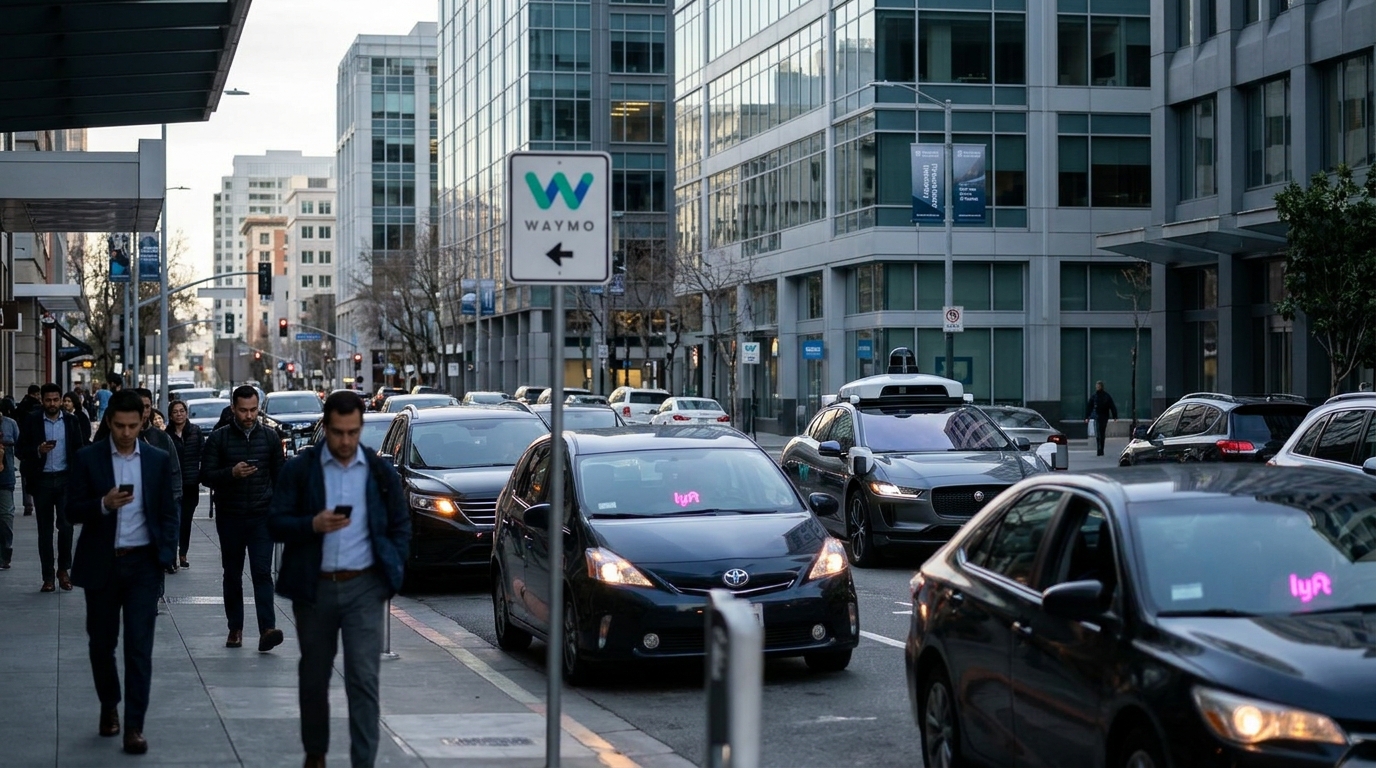
Waymo robotaxis are now live on Lyft’s app in Nashville, with Lyft managing fleet readiness, maintenance, and depot operations through its wholly owned subsidiary Flexdrive. That operational layer, not the app itself, is what makes Lyft structurally valuable. Lyft has emphasized a multi-partner AV approach, and in Nashville it is already performing commercial, end-to-end fleet management for Waymo.
Technical Framework
The stock’s 50-day moving average sits near $16.20 and the 200-day near $15.09, meaning LYFT is trading above both. Volume has moderated from its post-earnings spike, and the price has stabilized near $17. Resistance from the analyst target cluster sits between $18 and $20. Any acquisition speculation would force a re-rating through that band quickly.
Scenario Modeling
Bull Case: An automaker or large technology platform announces a formal approach at a 40% premium to current prices, implying roughly $24 per share. The trigger would be a competing bid for Lyft’s fleet management infrastructure, particularly Flexdrive.
Base Case: LYFT drifts toward the $19 consensus target as reserve-related impacts normalize and Gross Bookings growth stays in the mid-teens. Earnings are expected to grow 43% next year, from $0.81 to $1.16 per share, which at current prices implies a forward P/E near 15x.
Bear Case: Waymo expands its own consumer app aggressively, reducing dependence on the Lyft network. Lyft’s fleet management margin advantage compresses, and the stock revisits $14 to $15 support.
Active Trader Considerations
Traders sizing LYFT need to hold two separate theses simultaneously: a fundamental free cash flow story trading at a low, roughly 0.7x EV/Revenue multiple, and an optionality position on acquisition interest. At current levels, LYFT’s trailing P/E is roughly 2.4x, a reminder that headline earnings are still heavily distorted by large, non-operating items. Size positions to tolerate the gap between $16 downside reference points and $26 upside targets still sitting on the Street. The reserve overhang should clear into Q4. Watch whether Gross Bookings re-accelerate before adding to any long.