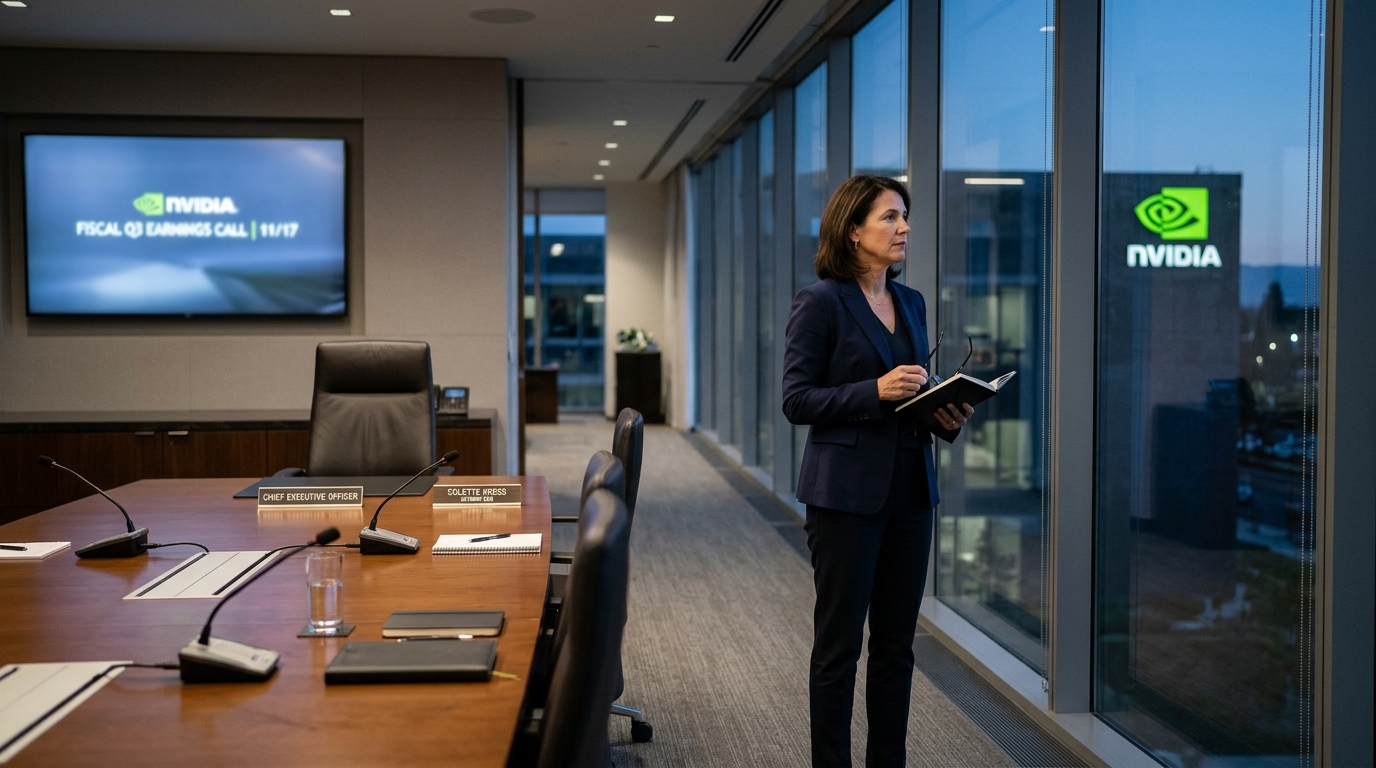
Nvidia faces its fiscal Q3 earnings call on Tuesday, November 17, with a CFO running the company who became its interim CEO less than a week ago. That is not a hypothetical. It is the starting condition for one of the most consequential earnings events in semiconductor history, and traders need to price it correctly.
What Happened and What It Cost
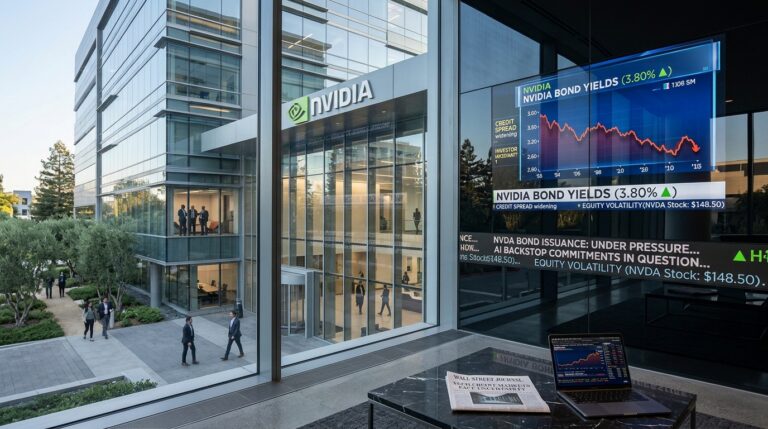
Jensen Huang resigned as president and chief executive of Nvidia after reports of an extramarital affair with a woman U.S. officials suspect is a Chinese spy, thrusting the company into a national security and governance crisis. The board accepted his resignation with immediate effect and named CFO Colette Kress interim CEO. NVDA fell as much as 14% on Thursday, wiping out as much as $601 billion in market capitalization intraday. Shares recovered to close down 4.34%, but the cumulative damage is far larger: Nvidia is down 30.5% since its record high on October 6, a loss of roughly $1.8 trillion in market value.
The governance pressure continues. Members of Congress have sought a closed-door briefing with Huang, with the back-and-forth now extending into next month.
Who Is Running the Earnings Call
Nvidia CFO Colette Kress, a 13-year company veteran, is taking the helm of the chipmaker on an interim basis. She will continue to serve as the company’s CFO. Kress is not an unknown quantity on the earnings stage: on earnings calls, it is usually Kress who walks analysts through the numbers, covering data-center growth, gross margins, supply constraints, and China exposure, before Huang took questions on strategy. Her credibility with analysts, built over roughly 50 earnings calls, is now one of Nvidia’s most valuable assets. What she has never done is lead the call as CEO while simultaneously fielding governance questions, congressional scrutiny, and a stock that hit an intraday low of $148.80 on Thursday before bouncing.
The Numbers Heading In
Consensus expectations for Q3 are elevated, and the bar for guidance is the real trade. Nvidia has a recent track record of beating estimates, and the fundamental business has not changed overnight. The company recorded $96.2 billion in sales last quarter, with Data Center revenue at $89.0 billion, or roughly 93% of the total.
What has changed is the valuation framework around those numbers. Even after shares pared their worst losses Thursday, Nvidia’s forward multiple was about 13.7 times based on current consensus, placing the stock in a very different valuation regime than the last cycle peak. Options are pricing NVDA for an unusually large move around the November 17 report.
Where Thursday’s Money Went
Capital did not leave semiconductors wholesale. It rotated. The clearest beneficiaries were AMD and Broadcom, both of which rose as leadership uncertainty hit Nvidia. Broadcom gained roughly 5.5% on Thursday. AMD also moved sharply higher, and its fundamentals have been improving: AMD’s third-quarter revenue increased 45% year over year to $13.377 billion, and its data-center revenue jumped 97% year over year to $8.5 billion. William Blair analyst Sebastien Naji upgraded AMD to Outperform as the Nvidia situation created an opening for supplier diversification. The rotation reflects supplier-concentration risk being repriced in real time, not a verdict on Nvidia’s product roadmap.
AMD’s upgrade-driven surge did not arrive in a vacuum. AMD’s data-center revenue nearly doubled in Q3, and the question traders are now pricing is whether that momentum holds as supplier-concentration risk gets repriced.
Scenario Modeling for Tuesday
Bull Case: Kress delivers revenue at or above $109 billion, guides Q4 firmly above consensus, and frames the leadership transition as a governance resolution rather than a strategic rupture. The stock, already at a decade-low forward multiple, compresses that discount. NVDA recovers toward the $185 to $195 range as investors separate the scandal from the chip cycle.
Base Case: Results come in line with the $108.8 billion consensus. Kress steadies the call but offers no incremental color on CEO succession or the congressional inquiry. The stock trades range-bound between $160 and $175, with elevated volatility through the week. AMD and Broadcom hold most of their recent gains.
Bear Case: Any guidance cut, margin compression, or unexpected commentary on China exposure confirms the governance discount as a business discount. NVDA revisits Thursday’s intraday low near $148 to $150. The rotation into AMD accelerates toward the $650 level traders are already watching.
Active Trader Framework
Tuesday’s call is a binary event sitting on top of a structurally damaged chart. NVDA’s intraday low of $148.80 on Thursday is now the key downside reference point. Above that level, the stock has held. Options imply an unusually wide move, which pins the post-earnings range at roughly $148 to $185 based on a $166.19 close. Volume Thursday was about 748 million shares, against a much lower typical daily run rate, confirming institutional repositioning rather than retail noise. AMD’s technical structure at $585 sits about 10% below its 52-week high near $649, with strong volume confirmation of the upgrade-driven move.
Preparation here means knowing your levels before the Tuesday earnings release and sizing accordingly. The earnings numbers may be strong. What Kress says about everything else may matter more.