Dear Reader,
Nvidia lost more than $1.6 trillion this fall in its longest losing streak since 2012, and its CEO resigned in a scandal. No wonder so many investors are done with AI.
But while everyone stares at the stock prices, something strange is about to happen to money, and almost nobody has noticed.
Software is about to start buying things.
Not just recommending… actually buying.
An agent that books the appointment, places the order, and pays for it while you sleep.
By 2030, Gartner expects machine customers to take part in $30 trillion of purchases.
But this part is what got me…
An AI cannot open a bank account.
It cannot pass KYC or hold a card in its own name.
Every payment rail we have exists to confirm a human sits on the other end.
So the machines need a way to pay that never asks for ID.
Which raises the obvious question…
Which system do they use instead?
The people with the most money and the most information have already answered it.
Andreessen Horowitz published an essay in February 2026 on a problem AI agents face as they begin buying digital services.
Its answer was not another bank account.
It pointed to a different kind of rail for small, automated payments.
That rail sits inside an asset class most AI-stock buyers have not considered.
It has nothing to do with who runs Nvidia or whose chips win.
Washington had the same thought.
Before he even took office, Trump handed AI policy, and the policy for what’s set to replace those rails, to one man under one title.
A venture firm and a federal government do not reach the same answer by coincidence.
It’s the same asset class.
The one the machines will actually pay each other with.
I’ve put the whole case into a free briefing. It names that asset class, and shows which institutions have already bought in.
Watch The 2027 AI Gold Rush Briefing →
To your wealth,
Tan Gera, CFA
Decentralized Masters
P.S. Gartner’s prediction is for 2030. But rails have to exist long before then. Click to learn all about the AI gold rush →
The Dow Erased a 1,100-Point Drop. What Held, and What Friday’s Thin Session Means for Risk.
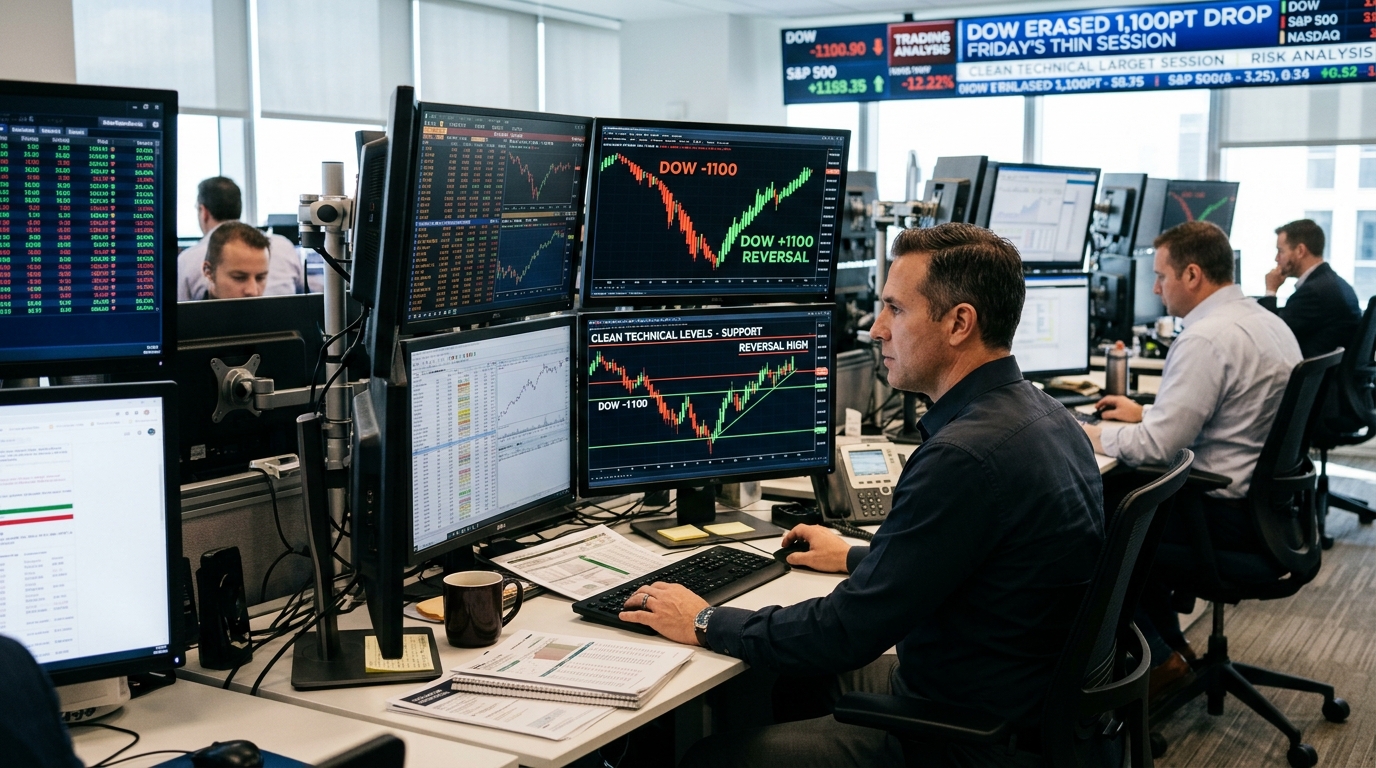
The session that just closed was one of the more instructive reversals of the year. At the bottom, the Dow was down more than 1,100 points, or 2.2%, the S&P 500 was down 3.2%, and the Nasdaq was down 4.6%. By the bell, the picture had flipped materially. The Nasdaq 100 was down as much as 4.7% before staging a late-session recovery that pared the loss to about 0.6%, while the S&P 500 slipped 0.25% and the Dow Jones Industrial Average rose 0.33%.
- S&P 500 close: 7,182.78 (-0.25%), recovered 212 points from an intraday low of 6,970.11
- Nasdaq Composite close: 23,585.80 (-0.62%), off a 4.6% intraday decline
- Nasdaq 100: down as much as 4.7% intraday, closed down 0.64%
- Dow Jones: 50,182.95 (+0.33%), erased a 1,100-point deficit to finish green
- VIX: 28.29 (+6.82%), ran to about 34.95 intraday before pulling back
- Breadth: seven of the 11 S&P 500 sectors closed higher even as the index slipped
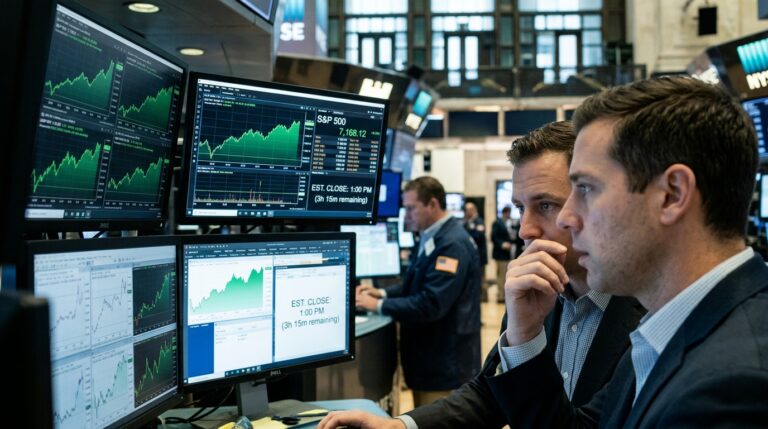
- Friday session: NYSE and Nasdaq open 9:30 AM to 1:00 PM ET; liquidity is typically thinner than a normal day
What Actually Triggered the Rout
The Bureau of Economic Analysis released October PCE data early due to Thanksgiving: headline PCE rose 3.8% year-over-year, while core PCE rose 3.3% year-over-year. That landed on a market already carrying chip and AI headline risk. Nvidia fell about 3.9% after S&P Global Ratings placed its credit rating on CreditWatch Negative. New tariff proposals targeting 14 major trading partners, including China, compounded the opening pressure.
The S&P 500 fell as low as 6,970.11 at 9:45 AM before closing at 7,182.78. That 212-point recovery is the number that matters most entering Friday’s half session: it marks where buyers were willing to step in decisively, and it sets the floor traders will watch if early selling resumes.
Sector Rotation, Not Broad Relief
The bounce was rotation, not relief: outside of mega-cap tech, the market tone improved into the close even as AI-linked names still lagged. That divergence is a critical read. The index recovered, but the factor stress inside it did not.
Nvidia closed down 3.91% at $149.30, having dipped more than 9% intraday. With S&P Global’s CreditWatch action still unresolved, headline risk in the name stays open regardless of Friday’s direction.
Technical Framework: Levels That Held
The Nasdaq 100 found support in the mid-25,000s, rebounding from a 4.7% selloff to close 0.64% lower. The long lower wick on Wednesday’s candle is encouraging, suggesting selling pressure at lower levels was weak.
The Nasdaq 100’s intraday depth is not an isolated event. The Philadelphia Semiconductor Index has shown how a 19% drawdown from its high can pull the broader market into a correlated decline.
On the S&P 500, the 6,970 level held on the first test. The November 20 low near 6,890 is the next meaningful support below that. The VIX ran to about 34.95 intraday and closed at 28.29, with term structure signaling elevated near-term stress. Elevated near-term premium means option hedging remains expensive and dealer flows can stay pro-cyclical.
Friday’s Half Session: Sizing the Risk
On Black Friday, NYSE and Nasdaq trade a shortened session that ends at 1:00 PM ET; many participants are away, so volume is typically lower than on a normal day, and lower liquidity can mean wider spreads and sharper, less predictable price moves.
With the cash market closing at 1:00 PM instead of 4:00 PM, same-day options have less time to expire; with thin liquidity and concentrated gamma, a strike near spot can pin price for most of the session when dealers are long it. Flip that dynamic and thin books amplify any directional break. Portfolio rebalancing and positioning flows can still show up late in the session, so watch for price action into the close.
Scenario Modeling
Bull Case: The 6,970 S&P low holds as a base, semiconductors stabilize in the mid-25,000s on the Nasdaq 100, and Friday’s thin session drifts quietly higher toward 7,250. VIX fades below 26, confirming the dip was absorbed cleanly.
Base Case: Markets open Friday modestly firmer on thin volume, consolidate near 7,180 to 7,220 on the S&P, and close without directional conviction by 1:00 PM. The weekend gap risk is the dominant variable heading into Monday.
Bear Case: Any tariff or Fed headline overnight triggers a gap down at Friday’s open into thin liquidity. A break of 6,970 on low volume accelerates toward the November 20 low near 6,890. VIX spikes above 32 before the half session closes.
Active Trader Strategy Framework
The core discipline for Friday is position sizing. A position sized for a full six-and-a-half-hour session carries disproportionate risk in a window that closes at 1:00 PM. Reduce size accordingly or treat Friday as a monitoring session rather than an initiation day.
Key levels to monitor: S&P 500 support at 6,970 and 6,890; resistance at 7,250 to 7,300. Nasdaq 100 support in the mid-25,000s; resistance near 26,100. VIX above 30 is the signal that Wednesday’s stress has not fully cleared. Elevated implied volatility keeps option premia rich and dealer hedging pro-cyclical into Friday’s thin half-session. Traders carrying long gamma through the holiday are better positioned than those short it.
Conclusion
Wednesday delivered a textbook stress test: hot inflation, new tariffs, and a credit warning on the market’s dominant AI name drove a sharp Nasdaq-led downdraft, then dip buyers carried the index most of the way back. The recovery was real, but it was built on rotation, not a resolution of the pressures that caused the selloff. Core PCE at 3.3% keeps the macro ceiling lower than it was a month ago. Friday’s 210-minute session is not the place to press a new directional trade. Know your levels, honor your size rules, and let the full session on Monday deliver the cleaner read.