
For a while now, I’ve been showing regular traders like you how to take advantage of a specific 60-minute window…
One that lets us go after 50% returns every morning – whether the market opens higher… or lower.
Here’s what I mean…
If you had spotted this 60-minute opportunity yesterday morning… all you would’ve had to do was place a quick trade before 10 am…
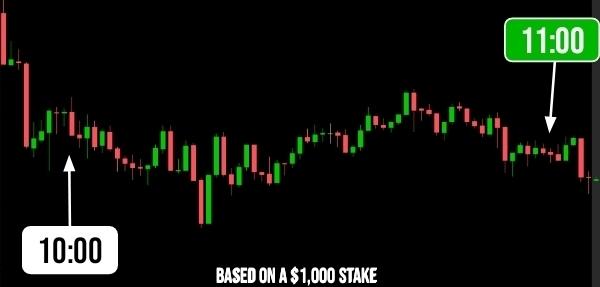
Went ahead with your morning plans and when you return a couple of minutes later, there’s a good chance you’d find $500 in extra income sitting in your account (on a 1k stake)
It wouldn’t have mattered what happened with the overall market… this 60-minute window would have been all you needed to target cash.
Today? Same story.
Place a quick trade, grab your coffee… and let the setup do the heavy lifting.
And just 60 minutes later… come back to what could be a nice $500 in extra income sitting in the brokerage account.
I designed the setup to be that straightforward.
Granted, there will be trades that won’t work out
But if you want in?
Brent Hits $97 After Jazan Strike. OPEC+ Meets Sunday.

Brent for January delivery touched $97.49 on Friday morning, capping a move that began at $89.37 on Monday. That is an 8-percent gain in three sessions, and it arrives with OPEC+ ministers convening online Sunday, November 29, to discuss the production framework for 2027. Traders cannot afford to treat the two events as separate.
What Happened Overnight
The proximate catalyst is a physical one. A hostile aerial projectile struck Saudi Aramco’s Jazan refinery on the Red Sea coast of Saudi Arabia on Thursday, killing a Nepalese worker and forcing a temporary halt in some operations at the facility, according to a Saudi Energy Ministry source. The incident landed a day after Houthi forces also claimed strikes on Ras Tanura, the kingdom’s largest refinery and primary crude export terminal, while the Saudi-led coalition said it intercepted four drones targeting Ras Tanura and reported no immediate injuries.
Simultaneously, Iran-linked drones killed two Italian technicians working for Rheinmetall at an air-defense surveillance station in Kuwait. Tehran denied responsibility. The strike was the latest in a sustained pattern of Iranian-origin attacks on Gulf infrastructure running since February.
Then came the loading numbers. Iraq has delayed between 20 million and 30 million barrels of Basrah crude originally scheduled for November. Some of those cargoes will not load until the first ten days of December. Asian refiners that rely on Iraqi supply are already hunting prompt alternatives across the Middle East. Crucially, Iraq exports almost all of its crude through the Strait of Hormuz, leaving limited rerouting options.
Curve Structure and Why It Matters
The forward curve is not simply reflecting headlines. Brent’s January-to-December 2027 spread has recently been in the mid-teens of dollars per barrel in backwardation, a level that historically corresponds to genuinely constrained prompt availability of seaborne barrels. The Dubai forward spread has also moved from near parity into backwardation this week. When a curve is this steep, adding supply disruption into a thin pre-weekend book amplifies the move in front months far more than it would in a flat or contango structure.
WTI is trading roughly $10 to $11 per barrel below Brent, a historically wide spread consistent with the logistics friction choking seaborne grades out of the Gulf. Diesel cracks remain elevated, keeping refinery demand for prompt crude competitive.
Elevated diesel cracks do not stay abstract for long. Valero’s refining margin tripled year over year as distillate tightness drove the bulk of the spread expansion.
The OPEC+ Dimension
Sunday’s ministerial meeting is the key session where traders expect clarity on 2027 output targets. Two delegates told Bloomberg on November 26 that the group is leaning toward rolling current quotas into January rather than setting new 2027 baselines, citing uncertainty over the conflict’s duration and lasting impact on production and exports. No decision has been confirmed and talks continue.
The internal arithmetic complicates any rollover. Iraq disputes its capacity assessment and is seeking a higher quota, while its own exports are simultaneously delayed. Kazakhstan has also objected to its figures. The UAE quit the group effective May 1 after years of frustration over its production limits. As consultancy Rapidan noted, the most likely outcome is a maintenance of existing targets combined with a deferral of major quota decisions into 2027.
The pattern of deferral is not new for this group. OPEC+ froze October output rather than set a forward baseline, leaving Q4 supply targets unresolved in the same way.
Scenario Modeling
Bull case: OPEC+ rolls current quotas and signals no near-term increase; Jazan remains partially offline through next week; Iraqi loading delays extend beyond December 10. Front-month Brent tests $100 to $102.
Base case: OPEC+ rolls quotas as expected; Jazan restores partial operations within days; Iraqi cargoes begin loading in early December. Brent consolidates in the $94 to $98 range with elevated intraday volatility around any OPEC+ statement.
Bear case: OPEC+ surprises with a quota increase or signals one for February; ceasefire signals reduce the Iran-linked risk premium; Iraqi loadings normalize faster than expected. Brent retraces toward $90, where it traded as recently as Monday.
Active Trader Framework
The energy equity complex, including Exxon Mobil and Chevron, tends to lag spot crude on rapid geopolitical spikes, then catch up as the market assesses duration. With Brent having moved nearly $8 in three sessions on thin Thanksgiving-week liquidity, the more disciplined approach is to monitor Sunday’s OPEC+ communiqué for explicit language on 2027 baseline methodology, specifically whether audited capacity numbers are adopted or deferred. That language, not the headline quota level, determines the multi-month supply ceiling.
Key levels: Brent $97.49 is Friday’s intraday high and the first line of resistance; $100 is the psychological and options-market level above. Support is at $94.70, the overnight low, and $92.50, the November 6 settlement that marked the prior recent high before this week’s rally began. Position sizing should account for Sunday-gap risk in both directions. The meeting is online and a statement could drop before Asian markets open.
Preparation is the edge here. The fundamental picture is bullish on supply, complicated on demand, and unresolved on OPEC+ governance. That combination produces exactly the kind of whipsaw that disciplines size and respects stops.