June 9, 2026
SpaceX’s IPO Will Rebalance Your Retirement Account
Featured: PLAY Reports Full-Year Results
Dear Reader,
When the SpaceX IPO hits, trillions of dollars inside the financial system will move.
Not toward you.
Fund managers liquidate. Institutions rebalance. Wall Street reshuffles to capture the payday of a decade. Your retirement sits inside that machinery. You don’t get a vote on which direction it moves.
You never did.
That’s the part no one is talking about.
Physical gold held outside the banking system works differently. No fund manager can rebalance it. No institution stands between you and it. No IPO frenzy touches it.
We put together a Free 2026 Gold Guide explaining exactly how to move a portion of your retirement outside the system tax-free, penalty-free, and in days.
It costs nothing. Takes 30 seconds to request.
While everyone else is looking at SpaceX, this is the move to protect your wealth from what’s coming.


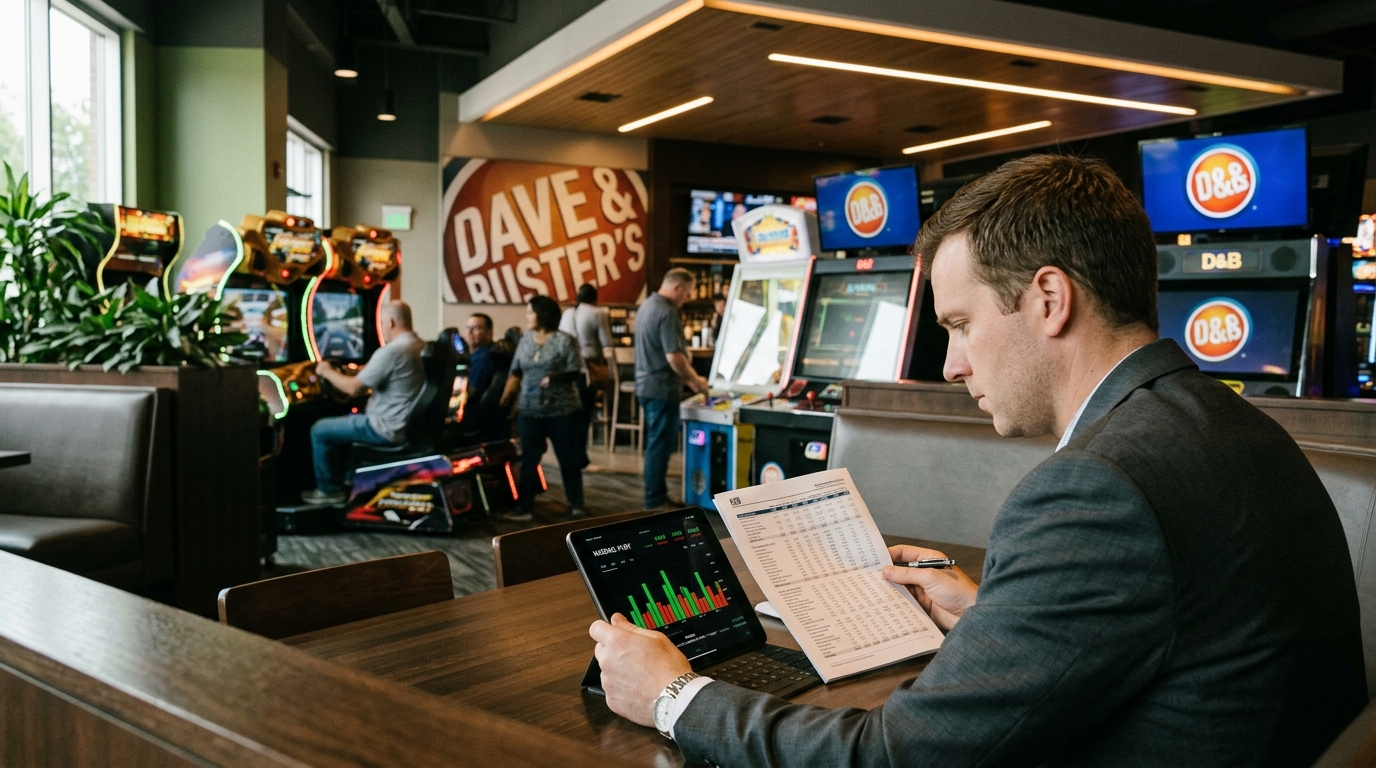
PLAY Reports Full-Year Results
Consumer Entertainment Is Getting Stress-Tested
The question isn’t whether Dave & Buster’s (NASDAQ: PLAY) had a tough fiscal year. It did. The more interesting question is what the numbers say about where middle-market consumer spending is heading – and whether the market is pricing the recovery correctly.
Full-year fiscal 2025 revenue came in at $2.13 billion, a decline of 3.3% from the prior year’s $2.21 billion. Comparable store sales dropped 5.0% versus the same calendar period in fiscal 2024. Net loss for the full year totaled $48.7 million, or $1.40 per share – a stark reversal from net income of $58.3 million, or $1.46 per diluted share, in fiscal 2024. Adjusted EBITDA contracted to $436.6 million from $506.2 million the prior year. That’s $69.6 million in EBITDA erosion over twelve months.
Those are not numbers you wave away.
Key Metrics at a Glance
- FY2025 total revenue: $2.13B, down 3.3% year-over-year
- Full-year comparable store sales: -5.0% vs. fiscal 2024
- Full-year net loss: $48.7M vs. net income of $58.3M in fiscal 2024
- Adjusted EBITDA: $436.6M vs. $506.2M prior year
- Q4 FY2025 revenue: $529.6M, down 0.9% year-over-year
- Q4 comparable store sales: -3.3%; adjusted to -1.5% excluding Winter Storm Fern impact
- Q4 net loss: $39.8M vs. net income of $9.3M in Q4 FY2024
- End-of-quarter liquidity: $482.9M, including $16.6M cash and $466.3M available under $650M revolving facility
- Total liabilities: approximately $4.03B
- 243 total venues across North America; 179 Dave & Buster’s, 64 Main Event branded locations
A little-known decision from the 1930s changed the value of gold overnight.
Now, some analysts believe a similar conversation is quietly resurfacing.
Whether it leads anywhere remains to be seen.
But the history behind it is fascinating.
A new report explains what happened, why it mattered, and why some investors are paying attention again today.
Read The Great Gold Reset here.
What the Quarter Actually Looked Like
The Q4 figure of $529.6 million came in below the analyst consensus of $557.28 million. The adjusted net loss of $0.35 per diluted share missed the $0.41 forecast by a significant margin. On paper, a clean miss. But here’s where it gets interesting – the stock surged 25.2% in after-hours trading following the release, closing at $12.57. The market wasn’t trading the quarter. It was trading the forward signal.
Management pointed to sequentially improving same-store sales trends throughout the year, with February – the final month of the fiscal year – showing roughly flat total company comparable store sales and positive revenue and adjusted EBITDA growth. A one-month data point doesn’t make a turnaround. But it’s the kind of inflection traders watch for when they’re sizing up whether a trough is real.
Worth noting: the Q4 comparable store sales decline of 3.3% was partly weather-driven. Stripping out the Winter Storm Fern disruption in January, management estimates the decline moderates to approximately 1.5%. That’s a material distinction when you’re evaluating underlying demand trends vs. transient disruption.
The Experiential Dining Model Under Pressure
Dave & Buster’s sits in an unusual competitive position. It’s not a fast-food chain. It’s not a full-service casual dining operator. It’s something in between – a venue that combines arcade entertainment with full food and beverage service, operating 243 locations across North America under two distinct brands. The company generates revenue across three consumer behaviors simultaneously: dining, drinking, and entertainment. That bundled model is the thesis. When it works, average check sizes carry significant attach rates. Management noted the Eat & Play Combo promotion was running at an 8–10% opt-in rate, above historical levels, with kiosk deployment helping drive that further.
The problem is the model also requires sustained consumer willingness to spend on discretionary entertainment. That’s the vulnerability right now. Middle-market consumers are feeling margin compression from persistent services inflation, and the decision to spend $30–$50 per person on an experiential outing competes directly against lower-cost alternatives. Pure-play fast food chains – running $10–$15 average checks – are competing for the same consumer wallet. The trade-down risk is real, and the 5.0% full-year comp decline reflects it.
Slight tangent, but relevant: the company’s strategy to lean into major sports viewing events – including structured programming around the Super Bowl with ticketed advanced purchase packages – signals a deliberate effort to convert what used to be dead traffic periods into revenue-generating occasions. Management pointed to the FIFA World Cup this summer as another potential traffic driver. Whether that translates to sustained comp improvement is a different question entirely.
Balance Sheet and Capital Allocation
This is where traders need to pay attention. Total liabilities sit at approximately $4.03 billion against $16.6 million in cash. Liquidity is supported by a $650 million revolving credit facility, with $466.3 million available at quarter end – giving total liquidity of $482.9 million. The net total leverage ratio stood at 3.2x as of Q2 FY2025. That’s a meaningful debt load for a company posting operating losses.
On capital expenditures: the company invested approximately $270 million of net CapEx in fiscal 2025. Management has committed to reducing that to no more than $200 million in FY2026, with a stated target of generating more than $100 million in free cash flow during the upcoming fiscal year. If they execute on that, it changes the cash flow story materially – and likely re-rates how the market thinks about leverage trajectory.
The remodel program is ongoing. The company completed 51 remodeled Dave & Buster’s locations since the program began in the second half of fiscal 2023, with 16 of those coming in fiscal 2025. Management completed three re-remodels of a newer prototype already in FY2026, with another three under construction. The bet is that updated venues drive higher per-location productivity. The comp data needs to confirm that over multiple quarters before it becomes a tradeable thesis.
Porter Stansberry’s Critical New Warning: Trump Is Replacing The U.S. Dollar
“The last time America reset its money, it created 1,300 millionaires every day. This could be bigger.”
Institutional Positioning and Analyst Targets
Institutional flows have been mixed. In the most recent quarter, 97 institutional investors added shares while 121 reduced positions. Vanguard trimmed its stake by 16%, removing approximately 468,520 shares. Several other large holders exited entirely. On the other side, new institutional positions were opened. The divergence suggests the stock is caught between value-oriented buyers who see a trough and holders who are losing patience with the pace of the turnaround.
Analyst price targets reflect the same split. The consensus from 7 analysts carries an average Buy rating, with a 12-month price target of approximately $25.29 – an implied upside of roughly 83% from recent levels. Benchmark upgraded PLAY to Buy with a $30 target. UBS maintains Neutral with a $19 target. Truist raised its target to $23. The spread between the bull and bear analyst targets is wide, which itself tells you something about how much uncertainty is still embedded in the forward estimates.
Three Scenarios Worth Modeling
Bull Case: Comparable store sales stabilize and turn positive in the first half of FY2026, supported by FIFA World Cup traffic, the Eat & Play Combo opt-in momentum, and a simplified marketing message. Free cash flow exceeds $100 million. The remodel program begins showing measurable per-venue productivity gains. Leverage declines. Stock reclaims the $20–$25 range, with the $30 Benchmark target coming into view on continued execution. The key catalyst here is two or three consecutive quarters of positive comp data.
Base Case: Comp sales improvement is gradual and uneven – some months positive, some flat – as the company works through the turnaround with a consumer backdrop that remains choppy. Free cash flow comes in at $75–$100 million. Adjusted EBITDA stabilizes around $440–$460 million. Stock trades in the $13–$18 range, reflecting ongoing execution risk. The debt load stays front of mind for institutional holders until leverage trends lower in a measurable way.
Bear Case: Consumer spending softens further in discretionary entertainment. Comp sales deteriorate again in FY2026, and the $436.6 million EBITDA floor breaks. Free cash flow generation misses the $100 million target. The $4.03 billion liability stack becomes the central conversation. Stock tests prior lows, with downside toward $8–$10 on renewed investor skepticism about turnaround credibility and balance sheet management.
Active Trader Framework
For traders watching PLAY, the levels that matter are straightforward. The post-earnings surge to $12.57 in after-hours established a near-term reference point. The $13–$15 range represents the first real test of whether that move has follow-through or was a relief squeeze on a low-float, high-short-interest name. Volatility expectations remain elevated given the uncertainty around comp recovery timing and the leverage profile.
Risk management considerations: position sizing needs to account for the wide analyst target dispersion ($19 to $30) and the binary nature of the comp recovery thesis. A stock that moves 25% on one earnings release – in either direction – requires tighter stop management than a stable, predictable compounder. The $4.03 billion liability structure means any signal of cash flow deterioration will be punished disproportionately.
What to watch going forward: monthly or quarterly comp sales data, free cash flow generation relative to the $100 million FY2026 target, remodel productivity metrics, and any update on the FIFA World Cup traffic lift. Those are the four data points that will either confirm or challenge the recovery thesis in real time.
Wall Street is calling it the “Warsh Shock.” Here’s how to profit from it…
Nearly half of the world’s biggest money allocators are scrambling to reposition for what they expect to be the most volatile market in years.
Larry Benedict isn’t scrambling. He’s seen this before.
He says the Warsh Shock is setting up the most predictable wealth-building window he’s seen in 20 years… and there’s one ticker right at the center of it.
The market’s 25% post-earnings reaction wasn’t irrational – it was a reset of expectations that had become too negative. Whether that reset was the right size is a question the next two quarters will answer. What matters now is disciplined positioning, defined risk levels, and attention to the data as it comes in rather than the story as it’s being told.
Prepare for the scenarios. Manage the risk. Let the numbers do the talking.
For informational and educational purposes only. Not investment advice. Trading involves risk, including loss of principal.