
August 22, 2026
The Network Layer Is Now the Hottest Trade in AI
ANET just delivered its first $3 billion quarter. AVGO is guiding to $16 billion in AI chips for Q3. September 2 decides whether the gap closes.
AI’s NEXT Magnificent Seven
Dear Reader,
The Original Magnificent Seven Produced 16,894% Average Returns Over 20 Years.
$1,000 in each turned into $1.18 million!

But the Man Who Called Nvidia at $1.10 Says “AI”s Next Magnificent Seven Could Do It Even Faster.”
He says $1,000 in these seven stocks could turn into $1 million+ in less than six years.
See His Breakdown of the Seven Stocks You Should Own Here.
Sincerely,
Rachel Gearhart
Publisher, The Oxford Club
P.S. The first company on his list just signed a MAJOR deal with Apple.
The company’s tech is going to be included in the iPhone and iMac until 2040!
That’s why Alex says this company might be America’s 7th trillion dollar company.
The Layer Nobody Is Watching Is Running the Table
The S&P 500 closed Friday at 7,674, up 0.43% on the session, while the Nasdaq Composite gained the same margin to finish at 26,180. Both indices are up sharply from the April low of 6,316, a V-shaped recovery that has held through two months of consolidation and broke to fresh highs of 7,816 earlier in August. The VIX is hovering near 14.5, a 2026 low. Earnings did the work, and the forward P/E on the S&P now sits near 19.9 against a 10-year average of 18.9. That is not cheap. Every incremental catalyst matters more as the multiple climbs.
The most consequential unpriced event of the next two weeks is not a stock-specific earnings report. It is Federal Reserve Chair Kevin Warsh’s inaugural Jackson Hole keynote, scheduled for Friday, August 28. Warsh assumed the chairmanship on May 22, and this will be his first major strategic address. He has signaled the speech will be about broad policy framing rather than near-term guidance, and has emphasized that the Fed should not be bound by market expectations. That pairing of signals, big picture framing plus independence from market pricing, is unusual and consequential. When roughly 69% of Bank of America-surveyed fund managers already expect a neutral tone, neutral is already in the price. Anything outside that band moves markets fast.
The July FOMC meeting held rates steady at 3.50% to 3.75%, but three policymakers dissented in favor of a hike. July nonfarm payrolls fell 23,000, a significant miss against an 85,000 consensus. September rate-hike odds fell from near 60% to approximately one-in-three. The 30-year Treasury yield was hovering near 5.27% as of August 21. The rates picture is genuinely unclear, and that ambiguity runs directly through the valuation of every long-duration growth stock in the AI complex.
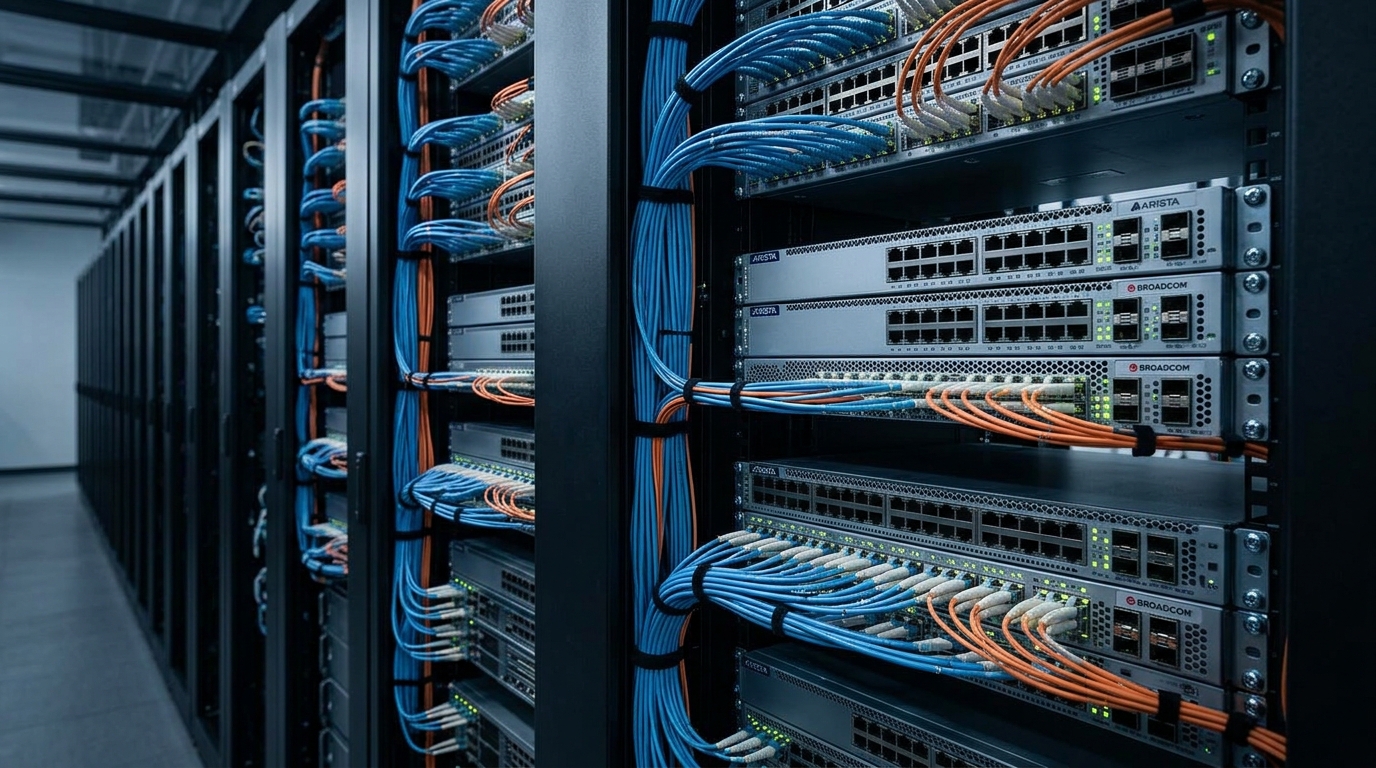
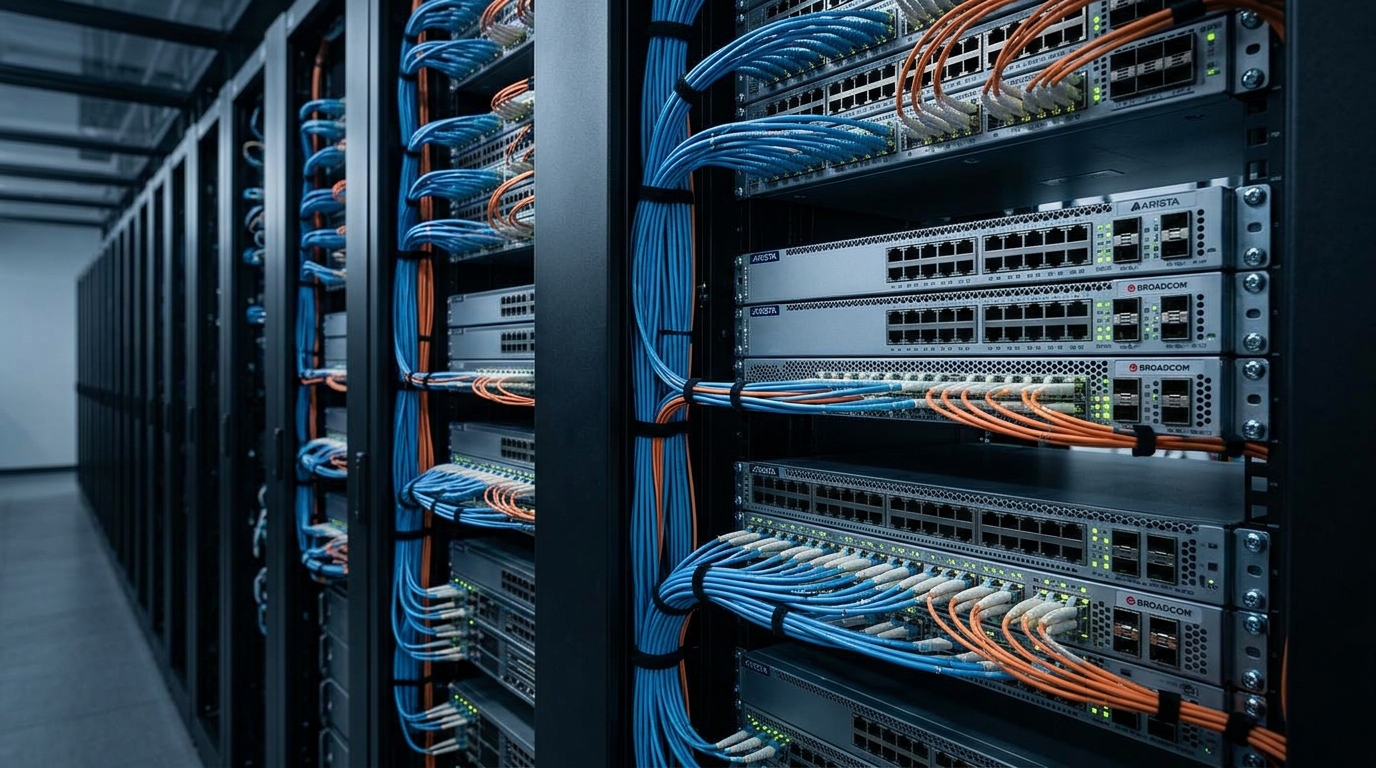
Against that backdrop, the networking layer of the AI infrastructure buildout has posted numbers that demand serious analytical attention. Two companies have separated from the pack in a way the market has not fully priced: Arista Networks and Broadcom. Neither is a passing mention in an AI thematic basket. Both have posted operating metrics that belong in a separate category from the rest of the sector.
Sector Breakdown: Why Networking Is Leading the AI Infrastructure Stack
The common framing for AI infrastructure spending focuses on GPU compute. That framing is incomplete. Every GPU cluster, every hyperscaler data center campus, every AI training run requires switching silicon, custom accelerators, and high-speed fabric to tie compute nodes together. That is the layer where Arista and Broadcom operate, and it is the layer growing fastest right now.
JPMorgan’s equity research team identifies AI as the primary catalyst for above-trend earnings growth across the market, with the investment cycle extending beyond early infrastructure buildout into broad enterprise adoption. The consensus among institutional investors, according to analysis from August 2026, is that AI-linked equities in semiconductors and networking represent the highest-conviction growth theme over the next 12 to 24 months.
Within that category, capital rotation has shifted. Pure-play GPU names captured the first wave of institutional flows. The second wave, which is underway now, is moving into the infrastructure that ties compute together: switching, custom silicon, optics, and fabric management software. Arista and Broadcom are the two largest beneficiaries of that rotation. Both posted beat-and-raise quarters. Both carry consensus “Strong Buy” ratings. Both face the same macro risk from Jackson Hole next week. The positioning question is which one offers a better risk-reward ahead of the next major catalyst.
Stock-Specific Financial Breakdown
Arista Networks (ANET): The Fabric Specialist
Arista delivered its first $3 billion quarter in Q2 2026. Revenue came in at $3.04 billion, up 37.7% year over year, against guidance of $2.8 billion. That 7.22% beat cleared Wall Street’s bar by a wide margin and extended the company’s EPS beat streak to five consecutive quarters. Non-GAAP diluted EPS of $1.02 beat the $0.89 consensus by 14.6% and grew 39.7% from the prior-year period.
The operating margin came in at 49.9% of revenue. Net income was $1.3 billion. To put the quarter in historical context: in 2021, Arista’s full-year revenue was $2.9 billion. The company generated roughly that figure in a single quarter in June 2026.
Management raised full-year 2026 revenue guidance for the third time this year, to $12.6 billion, representing 40% annual growth. Q3 guidance calls for $3.3 billion in revenue with a non-GAAP operating margin of 48% to 49% and diluted EPS of $1.06 to $1.08. Gross margin guidance for Q3 is approximately 63%, and the full-year gross margin target remains at 62% to 64%. The company has discussed securing memory supply and expanding vendor qualifications across multiple manufacturing and distribution partners.
Arista’s Etherlink switches now count more than 100 cumulative AI fabric customers, up from the low single digits two years ago. The Scale-Across segment, which serves inter-data center AI connectivity, carries a TAM management forecasts at $15 billion to $20 billion by 2030. Management expects Arista to maintain a share near 40% in that market, approaching $7 billion in 2030 revenue from that segment alone. Morningstar raised its fair value estimate for the stock to $230 from $190 following the Q2 results. The average analyst price target across 30 analysts is $241.82, with Barclays at $289 and Wells Fargo at $255.
ANET traded near $201.80 as of August 19, up 54% year to date. The stock trades at 60.9 times trailing earnings against an S&P 500 multiple of 23.3. That premium is real and requires continued operating margin expansion and revenue compounding to hold. At the current run rate, the company is on pace to deliver $12.6 billion in fiscal 2026 revenue, which is more than triple its fiscal 2021 annual total.
Broadcom (AVGO): The Custom Silicon and Networking Giant
Broadcom reported Q2 fiscal 2026 results on June 3, delivering record consolidated revenue of $22.2 billion, up 48% year over year. AI semiconductor revenue reached $10.8 billion, a 143% year-over-year increase, above the company’s own forecast. The quarter produced record operating profit and free cash flow. CEO Hock Tan described AI semiconductor demand as “simply insatiable” on the earnings call, and management highlighted large multi-year customer commitments that it says extend visibility into fiscal 2028.
Q3 guidance calls for $29.4 billion in total revenue, up 84% year over year, with AI semiconductor revenue accelerating to $16 billion, a figure management said would be more than 200% year-over-year growth. Management has discussed a fiscal 2026 AI semiconductor revenue outlook around $56 billion and a fiscal 2027 AI revenue target “in excess of $100 billion.”
Broadcom’s customer list for custom silicon includes major hyperscalers, but the specific roster and the details cited here are not fully supported in Broadcom’s public filings and earnings materials. What is clear is that custom accelerators and AI networking are both key contributors to the AI semiconductor line item, and management has positioned its networking portfolio as a competitive differentiator alongside the custom silicon business.
The stock dropped about 14% the day after the June earnings release, despite the record quarter, as investors reacted to guidance and to management keeping the fiscal 2027 AI target unchanged. That selloff created the gap that is now being watched. AVGO traded near $380 to $393 in mid-August, well below its 52-week high of $495 and against an average analyst price target above $516. The Strong Buy consensus is built on 27 Buys, 4 Holds, and zero Sells across 31 analysts. Q3 fiscal 2026 results are scheduled for September 2, after market close. Analysts expect EPS of about $3.21, up approximately 89% year over year.
Technical and Trading Framework
ANET Technical Structure
ANET has returned 36.4% over the trailing three months versus approximately 4% for the S&P 500. The stock trades roughly 10% below its 52-week high after a post-earnings gap-up that pushed it above the prior high of $194.35. The current price range of $188 to $202 sits above both the 50-day and 200-day simple moving averages, each of which is rising. Volume spiked on the Q2 earnings move, confirming institutional participation. The next resistance zone is near the $219 level, which was identified as a ceiling by TradingKey analysis. Near-term support holds at the $180 to $185 zone, which corresponds to the post-earnings base. A flush below $180 would likely test the $161 range, where prior consolidation occurred before the Q2 breakout.
Supply chain constraints running through 2028, as CEO Jayshree Ullal explicitly stated, create an unusual technical dynamic: demand is known, but shipment timing is not. That means positive guidance revisions, not just beat rates, are the variable that moves this stock. Q3 guidance of $3.3 billion is the number to watch on November 3, the next scheduled earnings date.
AVGO Technical Structure
AVGO is consolidating between $388 and $412 ahead of the September 2 earnings report. The stock is currently below its 20-day EMA of $402 and its 50-day EMA of $396, a short-term bearish alignment despite a positive MACD reading of 5.08. The technical signal from TipRanks is neutral overall, with eight bearish and four bullish moving average signals as of August 19. The $380 level has acted as a near-term floor repeatedly since the post-earnings dip. The 52-week high of $495 sits 30% above current levels, while the average price target of $516 implies approximately 35% upside from the mid-August trading range.
The September 2 catalyst is binary. If management raises the fiscal 2027 AI revenue guidance above $100 billion, or introduces new named customers beyond what it has discussed publicly, the stock could test $430 to $450 rapidly. If guidance holds flat or comes in below the implied $29.4 billion guidance, the June pattern repeats. Volume ahead of earnings will be the tell: a contraction in average daily volume into the report suggests positioning is light, which reduces the risk of a sell-the-news reaction.
Scenario Modeling
Bull Case
Warsh delivers a neutral-to-dovish Jackson Hole address on August 28, providing clarity that the September FOMC meeting will hold rates steady. The 30-year yield retreats from 5.27% toward 5.00%, supporting high-multiple growth stocks broadly. AVGO beats the $29.4 billion revenue guide and raises its fiscal 2027 AI target above the $100 billion floor, citing new customer wins or higher per-customer compute volumes. ANET continues executing on its $3.3 billion Q3 guide. In this scenario, AVGO tests the $440 to $460 range by year-end, and ANET breaks $219 resistance to approach $240, consistent with Barclays and Wells Fargo targets. The S&P 500 holds above 7,600 and extends toward the JPMorgan year-end target of 8,000.
Base Case
Warsh’s August 28 speech frames structural questions without signaling a September move clearly, consistent with his stated communication style. Markets absorb the ambiguity with moderate volatility. AVGO meets its Q3 guide and reiterates fiscal 2027 guidance without raising it, producing a muted price reaction. ANET delivers on its $3.3 billion Q3 guide and maintains the 48% to 49% operating margin range, holding the stock in the $190 to $215 range through autumn. The sector consolidates through September as investors await fiscal 2027 guidance cycles from both companies. The S&P 500 range-trades between 7,500 and 7,900.
Bear Case
Warsh delivers a hawkish framing at Jackson Hole, signaling that the Fed’s reaction function requires higher-for-longer rates given still-elevated inflation and supply shocks. The 30-year yield pushes above 5.50%, compressing multiples across growth names. AVGO misses its $29.4 billion revenue guide or provides fiscal 2027 commentary that implies $100 billion is a ceiling rather than a floor. ANET discloses worsening supply constraints that push Q4 2026 shipment timelines into 2027. In this scenario, AVGO retests the $340 to $360 range and ANET gives back the Q2 earnings gap, testing $165 to $170. The S&P 500 breaks below 7,400, with high-multiple tech leading the decline.
Active Trader Strategy Framework
The key calendar points for the next two weeks are straightforward: August 27 through 29 is the Jackson Hole Symposium, with Warsh’s keynote on Friday, August 28. September 2 is AVGO’s fiscal Q3 earnings report. November 3 is ANET’s next scheduled quarterly release.
Traders monitoring AVGO ahead of September 2 should watch whether the stock can reclaim and hold above the 50-day EMA near $396. A close above that level on above-average volume before the earnings date suggests institutional accumulation and reduces the asymmetry of the sell-the-news pattern observed in June. If the stock fails to reclaim the 50-day and drifts toward $375 to $380, the risk-reward for pre-earnings positioning deteriorates materially given the June reaction precedent.
For ANET, the $185 to $190 zone is the key reference. That range has held as the post-earnings base. A break below $180 on volume reverses the recent breakout and exposes the $165 gap-fill level. Traders holding the stock through November 3 need to monitor the supply chain commentary cadence: any management comments between now and the Q3 report about component availability, particularly wafers, optics, or memory, carry outsized price impact.
On the macro side, the Jackson Hole event warrants specific positioning discipline. Warsh’s stated preference for “not being constrained by market prices” and the 9-3 dissents at the July meeting together argue against assuming the speech will be benign. Traders with concentrated growth positions entering the August 28 weekend should consider whether existing hedge ratios reflect the genuine uncertainty in that event, not the consensus expectation of neutral. When the consensus is 69% for one outcome, the tails are underpriced by definition.
Volatility metrics reinforce this. The VIX near 14.5 is a 2026 low. Implied volatility on both AVGO and ANET options heading into their respective catalysts will likely expand as the dates approach. That expansion creates optionality cost but also serves as a gauge of where institutional desks are marking uncertainty. Traders using defined-risk structures around these events can limit the binary downside while maintaining exposure to the upside if the numbers hold.
The Numbers That Define This Trade
Two sets of data points determine whether the current valuation premium on AI networking names is defensible or excessive. The first is margin trajectory. ANET operates at 49.9% operating income as a percentage of revenue. Gross margin has compressed slightly from 65.6% a year ago to 63.4% in Q2 due to component cost absorption. The company has guided to 62% to 64% for the full year. If gross margin falls below 62% on supply cost pressures, the operating leverage story breaks. That is the metric to watch on November 3.
For AVGO, the critical number is the AI semiconductor bookings-to-shipments ratio. Broadcom has provided clear quarterly AI revenue figures, but the specific claim here about $30 billion of quarterly AI bookings against $10.8 billion shipped is not supported by Broadcom’s June 3 earnings release. The more defensible framing is to watch the combination of (1) whether AI revenue continues compounding at the pace implied by the $16 billion Q3 guide and (2) whether management reiterates or raises its fiscal 2026 and fiscal 2027 AI targets. CEO Tan’s framing that demand is “simply insatiable” is a qualitative claim. The quarterly AI revenue trajectory, plus any disclosed order visibility metrics, is the quantitative test of it.
The customer concentration risk in both companies deserves explicit acknowledgment. ANET’s largest customers, including Microsoft and Meta, represent a concentrated share of revenue. AVGO’s hyperscaler customers drive the majority of AI semiconductor revenue. Any capex moderation at even one of those accounts would alter the forward compounding math. The fiscal 2027 AI revenue guide of “in excess of $100 billion” for Broadcom is underwritten by committed compute orders across its largest customers. Those commitments are not revenue until shipments occur. Until then, they are visibility, not certainty.
Preparation Over Prediction
The AI networking layer has earned its premium through execution, not speculation. Arista’s first $3 billion quarter took five years of compounding to build from a $2.9 billion annual base. Broadcom’s $10.8 billion in AI semiconductor revenue in a single quarter compares to $12.2 billion in all of fiscal 2024. Those are not projections. They are reported figures against which the forward numbers can be evaluated.
The macro overlay matters because the VIX at 14.5, the 30-year Treasury at 5.27%, and Kevin Warsh’s unpredictable debut at Jackson Hole are all converging within six days of each other. That compression of risk events into a narrow window is precisely the environment where preparation determines outcome more than prediction does. Traders who understand the support and resistance structure, the earnings calendar, the margin drivers, and the macro sensitivity of these positions enter that window with a decision framework. Those who do not are trading reactions.
The networking layer is the most structurally sound part of the AI infrastructure buildout right now. The numbers from ANET and AVGO say so directly. The question is not whether the theme is real. The question is whether the price is right given the inputs that have not yet arrived.
Position within your risk tolerance. Watch the levels. Let August 28 resolve before sizing up.
For informational and educational purposes only. Not investment advice. Trading involves risk, including loss of principal.