July 3, 2026
The Dow Just Hit a Record. The Nasdaq Fell.
First a note from Behind the Markets
Dear Friend,
In a recent interview, Musk laughed nervously and said seven words most people scrolled past: “You need transformers to run transformers.”
That wasn’t a joke. It was a confession.
His supercomputer runs on power equipment that takes 120 weeks to build.
He built Colossus in 122 days.
The gap between those two numbers is the biggest bottleneck in the entire AI buildout. And it’s where the money is.
For you, that gap is the opening: one small American company closes it faster than anyone alive.
The press is chasing rocket launches and missed it.
Wall Street still prices it like an afterthought. That won’t last.
See the stock Musk’s own words pointed to >>
“The Buck Stops Here,”
Kelly Maguire
Behind the Markets
FEATURED
The Dow Just Hit a Record. The Nasdaq Fell.
Two things happened on July 2 that most people treated as contradictions.
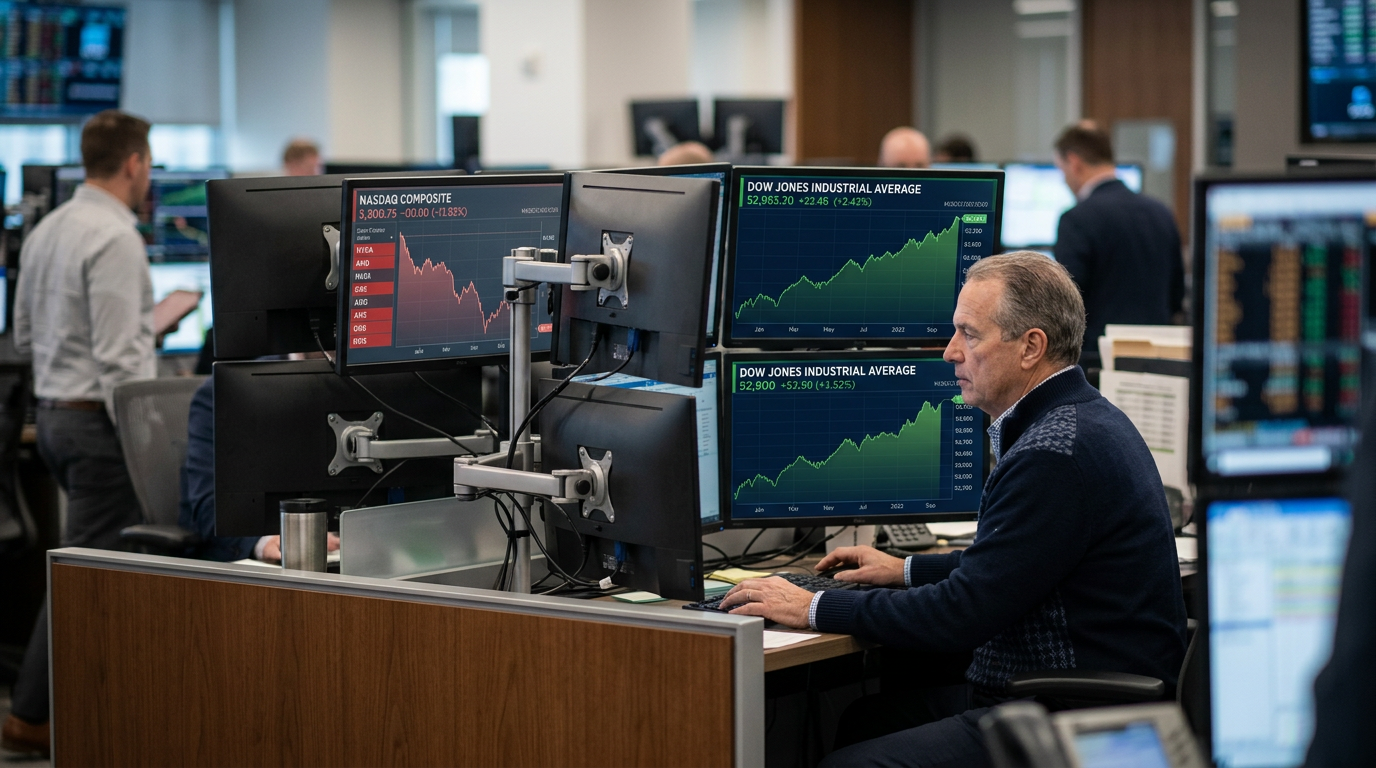
The Dow Jones Industrial Average surged nearly 595 points to a record close of 52,900.07. The Nasdaq dropped 0.8%. The S&P 500 finished basically flat. Chips sold off hard for the second straight session. And yet the headline read: stocks rise.
That framing misses everything.
What actually happened is that a rotation accelerated in a way that is starting to look less like noise and more like a regime change. Financials, industrials, healthcare, and consumer staples outperformed. Banks and insurers caught a bid as Treasury yields pulled back. The Dow hit a new all-time intraday high of 52,903.85. And the index nobody glamorizes just posted its best first-half performance since 2021, up 8.9% through June.
“We’ve Entered Phase II of D.C.’s Strange Plan”
A strange plan, hatched in Washington D.C., is shaking up the wealth of Americans who are not prepared. And if history is any precedent, you could lose nearly half of your wealth over the coming months. One former Goldman Sachs executive (with 40 years investing in the market) recommends you make this one move immediately so you could end up on the winning side of all this.
The trigger on Thursday was a soft June jobs number. Nonfarm payrolls came in at 57,000 against a consensus expectation of 115,000. The unemployment rate ticked down to 4.2% from 4.3% in May, but only because the labor force participation rate fell 0.3 percentage points to 61.5%, the lowest since March 2021. Wage growth of 3.5% year-over-year stayed in line. The Fed’s worst nightmare, a scorching jobs number forcing an aggressive hike, did not arrive. Rate-sensitive names exhaled. And money that had been sitting in overextended semiconductor names found somewhere new to land.
Here’s what I keep coming back to though. This rotation has been building for longer than one jobs number explains.
Over the past month, tech and AI-driven sectors have actually declined while healthcare, industrials, and financials have quietly moved higher. The VanEck Semiconductor ETF (SMH) dropped 4.5% on July 2 alone. Teradyne fell 15.2%. KLA slid 14%. The Philadelphia Semiconductor Index dropped over 7% in a single session. These are not rounding errors. They are signs of real institutional repositioning after chips ran more than 80% in the first half of the year.
The catalyst for the chip unwind had been building for weeks. Reports that Meta plans to sell its excess AI computing capacity to outside customers sparked real fear about AI overcapacity. A Citi analyst publicly questioned whether major cloud platforms could justify continued aggressive AI infrastructure spending if the returns did not show up for investors. When hyperscalers start leasing out spare compute instead of ordering more, markets read that as a signal the buildout may have gotten ahead of itself.
The valuation math is the core of it. Many high-quality companies in industrials, healthcare, consumer staples, and financial services are still trading at multiples well below AI leaders, despite producing consistent cash flows, growing dividends, and stable earnings. When the Fed stays cautious and rates remain elevated, the calculus shifts. A tech company whose profits are years away looks less attractive when you can earn a decent yield on a government bond today. Healthcare and industrial companies generating real profits right now look comparatively better.
PCE inflation came in at 4.1% year-over-year through May, the highest reading since April 2023 and the fourth consecutive month of acceleration. Core PCE, which strips out food and energy, is running at 3.4%. The Iran conflict drove oil prices sharply higher earlier this year, and that energy shock has been seeping into broader consumer prices. That is not a market-friendly backdrop for long-duration growth trades. It is a tailwind for sectors with pricing power and near-term cash generation. And it explains why the Fed, now under Chair Kevin Warsh, is holding the funds rate at 3.50% to 3.75% with nine committee members expecting at least one hike before year-end.
A 64% Dividend from Gold?
One little-known fund tied to gold is quietly delivering 64% Yields – paid monthly. And almost no one is talking about it.
Click here to discover the secret gold income fund before the next payout.
The question investors are quietly debating right now: is this a tactical shift or something more durable?
The Russell 2000 surged nearly 22% in the first half, its best first-half performance since 1991. That kind of move in small caps typically signals broad economic confidence, not a narrow tech bubble. When small caps lead, it often means the rotation has legs beyond a single sector. Industrials specifically are getting a lift from capital spending tied to AI data center construction, electricity capacity, and defense procurement. Real-economy demand that does not require AI valuations to be correct.
What’s interesting is that the Dow’s record is being treated as a sideshow. Most coverage led with chip weakness. But the Dow hitting all-time highs while the Nasdaq falls is not a contradiction. It is a signal. Money is not leaving the market. It is landing somewhere different. And the somewhere different is sectors that have spent three years underperforming a handful of mega-cap tech names.
The risk to this entire trade is straightforward. If economic data weakens sharply, value and cyclicals need a resilient economy to keep outperforming. A real growth scare would send money back to defensive large-cap tech, not to industrials or financials. Watch the next CPI reading and the upcoming Q2 bank earnings for clues on which direction this goes. The Fed’s next meeting is at the end of July, and with payrolls now clearly decelerating, the odds of a September hike have collapsed to roughly 20%.
But right now, the Dow is telling a cleaner story than most investors are reading.