July 3, 2026
Apple Just Went $2,500 Premium. The Real Trade Is Upstream.
The foldable iPhone Ultra is a supply chain event, not just a product launch.
Apple stock added nearly 5% on Wednesday, July 2 in one of its cleanest single-session moves of the year. The catalyst: a Nikkei Asia report confirming Apple raised its foldable iPhone production target to roughly 10 million units and booked parts for approximately 80 million smartphones for the second half of 2026 alone. Markets were closed Thursday for Independence Day. The stock sits at $308.63, within striking distance of its 52-week high of $317.40.
Here is what matters.
The foldable is not a mass-market product. Against IDC’s full-year iPhone shipment forecast of around 240 million units, 10 million foldables represents roughly 4% of the mix. What it is, though, is a halo event at an average selling price that IDC projects around $2,500 per device, with top configurations potentially reaching $3,000. That changes the revenue math in ways that a straight unit-count read would miss entirely.
50+ Millionaire Students. $7M+ in Profits. Now He’s Charging $1.
Tim Sykes started with bar mitzvah money and built an empire. This Fourth of July he’s making his most generous offer ever on his AI trading tool. Results not typical. Trading involves risk.
Apple’s Q2 2026 gross margin expanded to 49.3%, above the 48.4% analyst consensus. Services revenue in that quarter rose approximately 16% year over year to $30.98 billion. The company earned $2.01 per share against a $1.95 estimate, on revenue of $111.18 billion versus an expected $109.66 billion. Total revenue climbed 17% from a year prior. iPhone revenue alone hit $56.99 billion, a March-quarter record. None of that was driven by foldables. The foldable is potential upside sitting on top of an already-solid business.
The Supply Chain Is the Trade
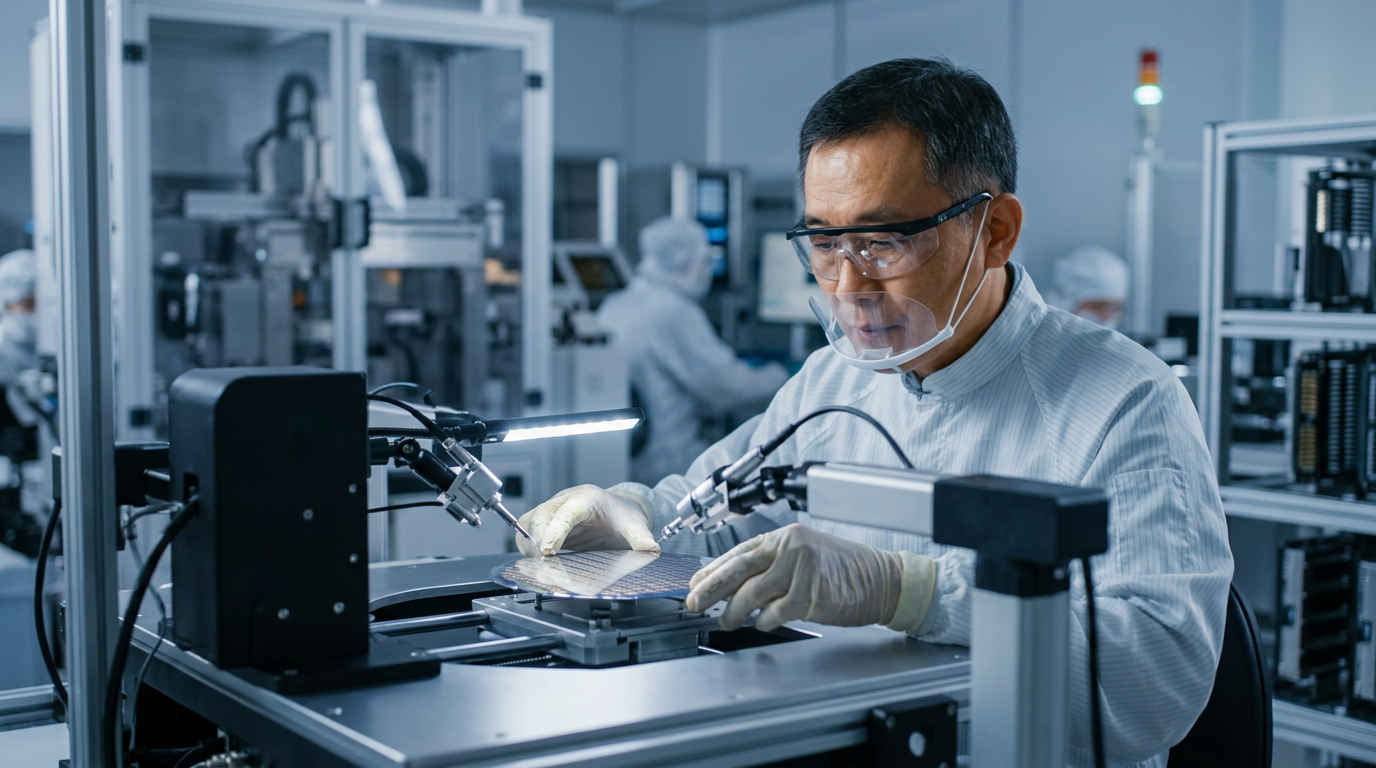
Mass production at Foxconn’s Zhengzhou facility is reportedly on track to begin in late July 2026. Supply chain sources in South Korea and Taiwan cited by The Elec say the hinge issues that had fueled earlier delay concerns are now mostly resolved, with the device entering mass-production preparation after trial production began in April. The foldable uses a 7.8-inch OLED panel supplied by Samsung Display, with hinge components produced through a joint venture between Foxconn and Taiwan’s Shin Zu Shing, which holds roughly 65% of hinge orders, and U.S.-based Amphenol handling the remaining 35%. Those are the names doing the heavy lifting in making this product physically possible.
Counterpoint Research projects foldable panel shipments will grow about 24% in 2026, with Apple expected to capture roughly 29% of the foldable market, just behind Samsung at 31%. When Apple enters a category at 10 million units, it does not just participate. It reshapes utilization rates for every specialized supplier in the stack. A hinge supplier with production lines devoted to this premium design will feel a 10-million-unit order far more acutely than any diversified display conglomerate.
The broader iPhone program is equally significant for the supply chain. Apple has given some suppliers a ceiling of 85 million new iPhone units for H2 2026, which would make the second half of 2026 one of the most component-intensive periods in Apple’s history. Total 2026 iPhone production is expected to exceed 220 million units, a number that puts real pressure on the global memory complex already stressed by AI data center demand.
The Memory Constraint Nobody Is Talking About
Since 2025, the global boom in AI data center construction has continued to absorb upstream memory capacity. Samsung, SK Hynix, and Micron have tilted capacity toward data center customers. The consumer electronics sector has been forced to take a back seat, and Apple is now caught in the crossfire.
Apple has reportedly placed large orders with Samsung for 12GB LPDDR5X chips for the foldable, with procurement prices roughly doubling year over year. The company is simultaneously in talks with two Chinese memory manufacturers, CXMT and YMTC, to procure chips for China-market devices, though both firms appear on the U.S. Department of Defense Entity List. CEO Tim Cook has been engaging the Trump administration on this issue. The outcome of that conversation will materially affect margin trajectory.
This Elon-Backed Startup is Growing Like Crazy
Time magazine called this startup that’s backed by Elon Musk (click here to get the name)…
“The Most Disruptive Company in the World…”
And said that it “holds the keys to perhaps the most powerful technology of all time.”
No wonder its CEO is projecting growth of up to 8,000% for this year.
It just filed the paperwork to go public in what’s set to be the next hot IPO on Wall Street. But you do NOT have to wait until the IPO.
Click here and Jeff Brown will show you how to claim your pre-IPO stake for as little as $50.
Tight memory supplies could constrain production through 2027. Higher DRAM and NAND costs threaten margins even for a company with Apple’s supply chain leverage. Apple is absorbing an estimated $1.1 billion in tariff costs in Q3 2026 alone. The CFO guided Q3 gross margin in the range of 46.5% to 47.5%, reflecting 150 to 200 basis points of memory cost pressure partially offset by Services mix. That would be the steepest single-quarter margin contraction Apple has projected since 2019.
Analyst Targets and What They Imply
One note before the numbers: Dan Ives, who had carried a $400 price target on Apple during his time at Wedbush, departed the firm on July 1, 2026 to launch an AI-focused merchant bank. His exit removes one of the Street’s most visible Apple bulls from the sell-side. Wedbush has confirmed the firm’s technology research will continue under new leadership.
Bank of America analyst Wamsi Mohan carries a $380 target with a Buy rating, raised from $330 on May 26 on the basis of Apple’s agentic AI positioning. Mohan estimates agentic Siri revenue could reach $15 billion to $30 billion in fiscal 2030 under a base adoption scenario, and $40 billion to $65 billion under broader adoption. TD Cowen holds a $335 target. The consensus across analysts surveyed sits at Buy, with the average 12-month price target near $315. The range runs from roughly $215 on the low end to $400 on the high end.
Apple’s Q3 2026 earnings are scheduled for July 29 to 30. That report will provide the first real data on margin impact from tariffs, memory costs, and Services trajectory ahead of the fall launch cycle. Analysts are currently modeling Q3 revenue of approximately $110.77 billion.
Technical Structure
AAPL is trading above all major moving averages following Wednesday’s session. RSI sits around 60, which is neutral to slightly elevated but not overbought. Momentum, MACD, and ADX indicators are constructive. The first support zone sits around the 30-day simple moving average near $299. A denser support cluster follows between $291 and $294. Longer-term support remains at the 100-day EMA near $281 and the 200-day near $270.
A clean break and close above $317 would constitute a move to new 52-week highs. That level is the line the market is watching into earnings and the fall launch window.
Scenario Framework
Bull Case: Q3 earnings show margin resilience despite memory and tariff headwinds, coming in at or above the 47.5% top end of guidance. September launch of iPhone 18 Pro and the foldable Ultra exceeds early demand signals. Foldable yields improve faster than expected, lifting average selling price contribution. Bank of America’s $380 target draws broader Street consensus. Stock approaches and breaks through its 52-week high of $317.40, setting up a move toward $340 to $380.
Base Case: Q3 earnings in line with CFO guidance, with gross margin landing in the 46.5% to 47.5% range and tariff costs largely absorbed. Foldable launches in limited supply with strong demand optics but modest Q4 revenue contribution. Services revenue sustains 14% to 16% growth. Stock trades between $295 and $330 through year-end as the market waits for commercial foldable validation.
Bear Case: Memory cost inflation compresses Q3 margins below the 46.5% floor of guidance. Foldable faces initial supply constraints and consumer hesitation at the $2,500 price point. Macro headwinds in China reduce iPhone sell-through. The CXMT and YMTC supplier talks escalate into a geopolitical friction point. Stock revisits the $270 to $275 range near the 200-day moving average.
The Part Most People Are Reading Wrong
Apple is not entering the foldable market because consumers demanded foldable phones. They did not. Samsung has iteratively improved the Galaxy Z Fold series for seven years without ever breaking into truly mass-market volumes. Apple is entering this category because it needs a new pricing tier above the iPhone Pro Max that justifies a higher average selling price and generates the kind of upgrade urgency a $1,200 phone no longer creates for existing iPhone owners.
Are you a long-term investor? You’ll Want to Hear This…
The President of the United States once went to bat for an American energy company that’s merging energy and AI.
It’s wildly cheap, and one man believes it could be the long-term answer to our AI energy needs.
The foldable Ultra is not a product strategy. It is a margin strategy wearing a product strategy’s clothes.
If it works, the second generation ships an estimated 20 million units in 2027, per analyst Ming-Chi Kuo’s projection, and the premium tier becomes a permanent fixture. If it stumbles, it becomes the next Vision Pro. The supply chain is already pricing the former. The stock has not yet reached a level that fully reflects it. That gap is what traders are watching between now and July 30.
For informational and educational purposes only. Not investment advice. Trading involves risk, including loss of principal.