August 3, 2026
BMY Just Gapped Up. Here’s the Trade.
Featured: BMY Just Gapped Up. Here’s the Trade.
Dear Reader,
I’m writing to share our #1 stock to buy right now as the U.S. power grid cracks.
This company’s new tech is already live in remote fields in West Texas.
It can generate round-the-clock power without waiting years for the public grid to catch up.
This tech is now backed by Elon Musk.
And Meta, Microsoft, and Google are getting in too.
Satellite images have surfaced – that could soon show everyone what’s going on. So before the average person hears about this…
Click here to learn all about the #1 power grid stock to own right now.
Regards,
Joel Litman
Chief Investment Officer, Altimetry
BMY Just Gapped Up. Here’s the Trade.
Market Snapshot
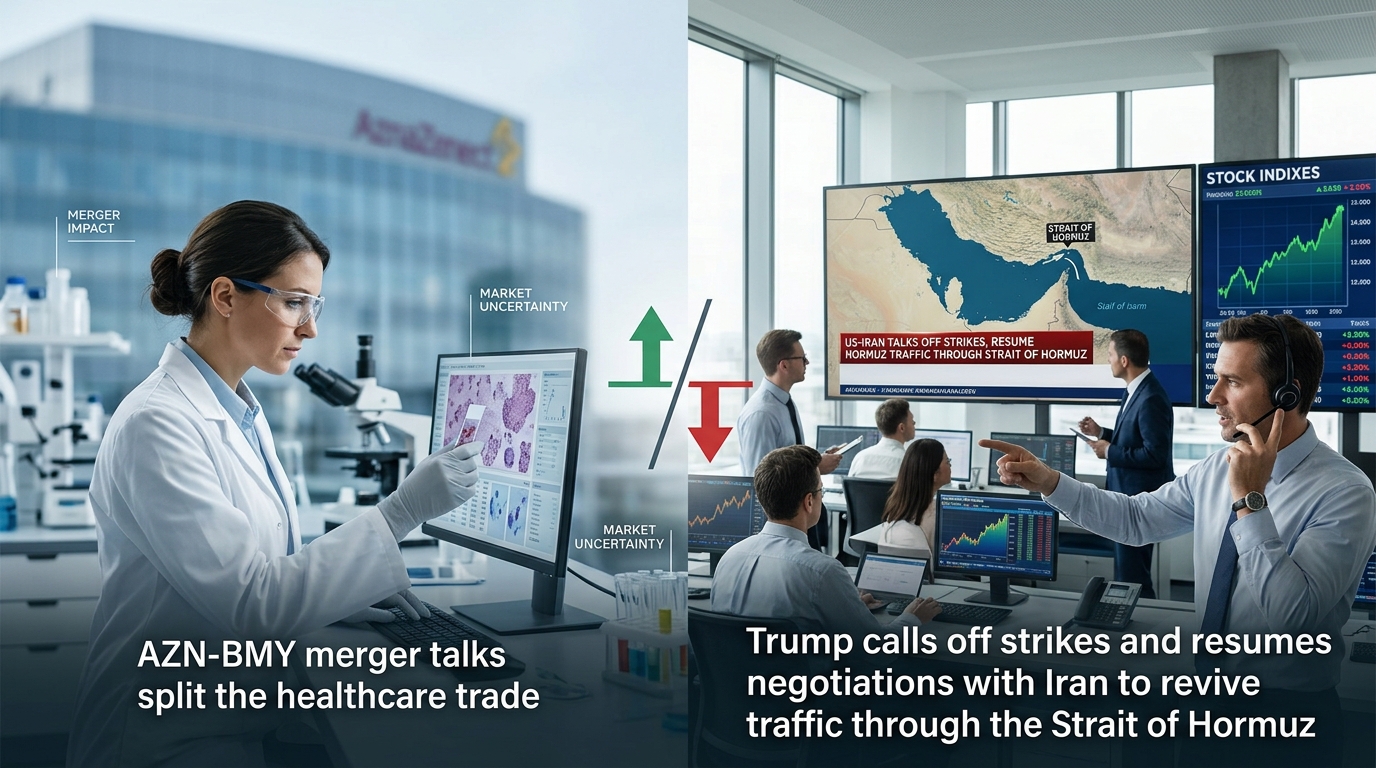
Stock futures edged higher to open the week, with macro sentiment improving on news that US-Iran diplomatic talks are resuming after a planned military strike was called off over the weekend. Oil is pulling back on the development. The broader market is cautiously bid. But the real action Monday morning is concentrated in one sector: healthcare. And specifically, two stocks moving in opposite directions on the same headline.
The Financial Times reported Sunday that AstraZeneca has been in merger discussions with Bristol Myers Squibb, a combination that would create a pharmaceutical entity worth roughly $400 billion. Neither company confirmed the report. But the market responded immediately, and the direction of that response is the entire story for active traders this week.
AZN closed Monday’s London session down approximately 9%, its largest single-session drop since 2020. BMY, meanwhile, gapped up as much as 7% in U.S. premarket, trading around $69.75 before the open. BMY closed Friday at $65.31, just shy of its 52-week high of $65.66. That gap pushed it to its highest level since June 2023.
The asymmetric price action is the signal. The market has already rendered a verdict on who benefits and who pays. The question for traders right now is: how much of the move is already in BMY’s price, and does the catalyst have legs over the next several sessions?
Why BMY Is in Focus
Bristol Myers Squibb came into this week already at a technical inflection point. The stock has gained roughly 47% over the past year. Q2 2026 earnings, reported in late July, came in at $2.04 per share against a consensus estimate of $1.61, on revenue of $12.97 billion versus estimates of $11.71 billion. Both numbers were significant beats. The stock was already building momentum before Sunday’s report broke.
The merger report adds a different layer. For BMY, the strategic logic is straightforward enough that the market priced it immediately. Opdivo and Eliquis, the company’s top two revenue drivers, face potential patent exposure by 2028. Revlimid has already lost protection. The pipeline gap is real and well understood by the market. A combination with AZN’s oncology and solid tumor portfolio would directly address that problem. The 7% gap higher reflects that math being done in real time.
What matters for the next one to five sessions is whether that gap holds, extends, or fades. That depends on two things: deal credibility and how AZN’s management responds publicly.
Anthropic’s Project Glasswing: The AI “Too Dangerous” for the Public
Anthropic’s Project Glasswing gives a select group of companies early access to an advanced form of AI that has been deemed “too dangerous” for the public. With this in their arsenal, these companies could become the most powerful businesses in the world this year.
Technical Picture
BMY enters Monday’s session with significant momentum behind it. The stock’s prior 52-week high was $65.66, touched intraday on above-average volume of 14.58 million shares just last Friday. Monday’s premarket gap to $69.75 represents a clean breakout above that level on a major catalyst. When a stock breaks a multi-year resistance level on a fundamental catalyst rather than noise, that tends to be a more durable move.
Key levels to watch on BMY:
- Immediate support: $65.31 to $65.66, the prior 52-week high range. A break back below this zone would suggest the gap is failing and deal skepticism is winning.
- Secondary support: The $62 to $63 area, which had been prior resistance before the recent earnings-driven breakout.
- Upside resistance: $70 is the near-term level to watch. Clean psychological resistance. How the stock handles that zone in the first two sessions will say a lot about follow-through interest.
- Volume confirmation: Monday’s session volume relative to the 14.58 million share average seen Friday matters. If volume expands meaningfully above that average on the gap, accumulation is likely. If volume dries up quickly, the gap risks being faded by profit-takers.
On AZN, the picture is the reverse. The stock entered Monday at $169.64 on its NYSE listing, already sitting more than $40 below its 52-week high of $212.71. Monday’s 9% selloff accelerates a downtrend that was already in place. The 50-day exponential moving average had been acting as resistance in recent weeks. A move of this magnitude sends AZN decisively below multiple support levels. The nearest area of meaningful technical interest is the $150 zone, which aligns with prior consolidation in late 2025. Worth monitoring for a potential mean reversion trade later in the week if selling volume exhausts.
The Catalyst and How Long It Lasts
The merger report itself came from the Financial Times citing people familiar with the matter, with a clear caveat: talks could be delayed or fall apart entirely. Reuters was unable to confirm whether negotiations are still ongoing. That uncertainty is the key variable.
For BMY, deal or no deal, the underlying business improvement is real. Q2 EPS came in 27% above consensus. Revenue beat by over $1.2 billion. That fundamental backdrop provides a floor even if deal speculation fades. The merger report accelerated a move that the earnings alone had already started.
For AZN, the concern the market is expressing is not simply antitrust. Jefferies noted that AstraZeneca, with its best-in-class pipeline and double-digit earnings growth projected through 2030, is one of the few large-cap names in pharma that genuinely did not need a transformative deal. The selloff reflects the market repricing strategic uncertainty onto a stock that had been trading on execution certainty. That is a different kind of risk than a deal failing. It’s about whether Soriot’s original independent growth strategy is still intact.
Slight tangent: the Iran situation deserves a line here. If US-Iran talks produce a meaningful agreement that reopens Strait of Hormuz traffic, oil falls further and defensive healthcare positioning becomes even more attractive in the rotation. That’s a macro tailwind that could extend the broader healthcare bid beyond the AZN-BMY story specifically.
Elon’s $480 Trillion Currency Masterplan
He’s waited 27 years for this moment. Elon Musk just launched his biggest disruption ever, which could totally reset how millions of people access their money and even pay tax.
Risk Assessment
The primary risk on BMY is a deal denial. If either company issues a statement walking back the merger discussions, BMY gives back most of the gap rapidly. That is not a slow fade scenario. That’s a reversal. Traders holding through the open need to be clear about their exit if a denial crosses the wire. The prior range top around $65.66 becomes the first meaningful support in that scenario.
The secondary risk is antitrust noise. The oncology overlap between the two companies is significant. BMS generated approximately $10 billion in 2025 revenue from Opdivo alone. AZN’s Imfinzi competes directly in lung cancer and other solid tumor indications. Analysts at BMO wrote Sunday that they believe a deal is less likely to materialize precisely because of this overlap. If antitrust commentary from analysts intensifies through the week, the deal premium in BMY’s price will compress.
On AZN, the risk to a potential recovery trade is continued management silence. If Soriot issues no clarification and the market continues to assume the worst about strategic direction, the stock drifts lower into the week. A catalyst for recovery would be either a clear denial from AZN leadership or a broader analyst defense of the standalone growth story.
And then there’s Wednesday. Eli Lilly reports Q2 2026 results before the open on August 5. Consensus sits at approximately $6.06 per share on revenue of roughly $20.7 billion. In Q1 2026, Lilly beat revenue by over 11% and topped EPS consensus by nearly 26%, with Mounjaro and Zepbound the primary drivers. Goldman Sachs holds a Buy with a 12-month target of $1,283. The guidance number matters most at this valuation level. If LLY raises its full-year outlook above the current $82 to $85 billion range, it signals that GLP-1 growth is still accelerating. That would pull capital further into healthcare broadly and could extend the sector bid. A guidance miss, however, would introduce a different kind of headline risk just as the AZN-BMY story is still unsettled.
Trader’s Checklist
Here is what to monitor before acting on any of these names over the next one to five sessions:
- BMY opening volume and price action: Does the gap hold above $65.66 on expanding volume, or does it fade back into the prior range within the first hour? The first 30 to 60 minutes of the session will tell you whether institutions are accumulating or distributing into the move.
- Any statement from AZN or BMY management: A confirmation extends BMY and pressures AZN further. A denial reverses the entire trade. Monitor wires actively through Tuesday.
- AZN stabilization around $150: If selling volume exhausts near that level and price action tightens, a mean reversion opportunity may develop for traders with a shorter time horizon. Not a thesis trade. A tactical one.
- LLY pre-earnings positioning: The stock pulled back to around $1,155 heading into the week. Lilly has beaten estimates for four consecutive quarters. The market is focused on full-year guidance, not the quarter. If AZN-BMY drama keeps capital rotating within healthcare, LLY could see pre-earnings positioning activity through Tuesday’s close.
- Smaller oncology names: Any forced divestiture condition attached to a potential AZN-BMY deal puts mid-tier oncology assets in play as acquisition targets. If deal confirmation comes, watch that space for outsized moves in names holding checkpoint inhibitor programs or hematology assets.
- Sector rotation context: Healthcare’s relative strength versus the S&P 500 this week matters. If the sector outperforms while oil weakens on the Iran talks, that’s a meaningful rotation signal that could sustain the bid beyond the individual deal story.
Louis Navellier: Don’t buy OR sell another AI stock…
Until you’ve heard this urgent AI warning from the man who called Nvidia before its 44,000% rise…
According to Louis, a massive reset is coming in an obscure corner of the AI market.
This $100 trillion disruption could send some of the world’s biggest AI stocks to zero… and one off-the-radar stock soaring… starting now.
The week starts with two large-cap pharma names moving hard in opposite directions, a macro catalyst that is cutting oil while lifting futures, and one of the most closely watched earnings reports of the summer arriving Wednesday morning. That is a lot of moving parts. The traders who do well this week will be the ones who defined their levels before the open, not the ones reacting to headlines mid-session.
Plan the trade. Know your exit. Watch the wires on AZN and BMY through Tuesday. And do not let the LLY setup get lost in the noise.
For informational and educational purposes only. Not investment advice. Trading involves risk, including loss of principal.