
August 5, 2026
SpaceX Is Building a Wireless Carrier
First a note from Stansberry Research
The SpaceX S-1 has been picked apart by nearly every analyst on Wall Street.
Almost none of them got the real story.
You see, buried inside the filing is what I call Elon’s “Hidden Empire.”
It has nothing to do with rockets…
But when it’s all said and done, it could be worth FAR more than the entire launch business, including everything else inside SpaceX…
And it could completely upend the AI economy.
That’s why I went on location at SpaceX’s Starbase headquarters to reveal exactly what I believe is – and the single best stock to own because of it.

It’s not Tesla. Or SpaceX…
Click here to get the full story and my No. 1 recommendation, free of charge.
Regards,
Rob Spivey
Managing Director, Altimetry
P.S. In short, Elon is about to rewrite the rules of AI… but most investors will never connect the dots. Get my No. 1 recommendation free, and the full details on what we discovered, here.
SpaceX Is Building a Wireless Carrier
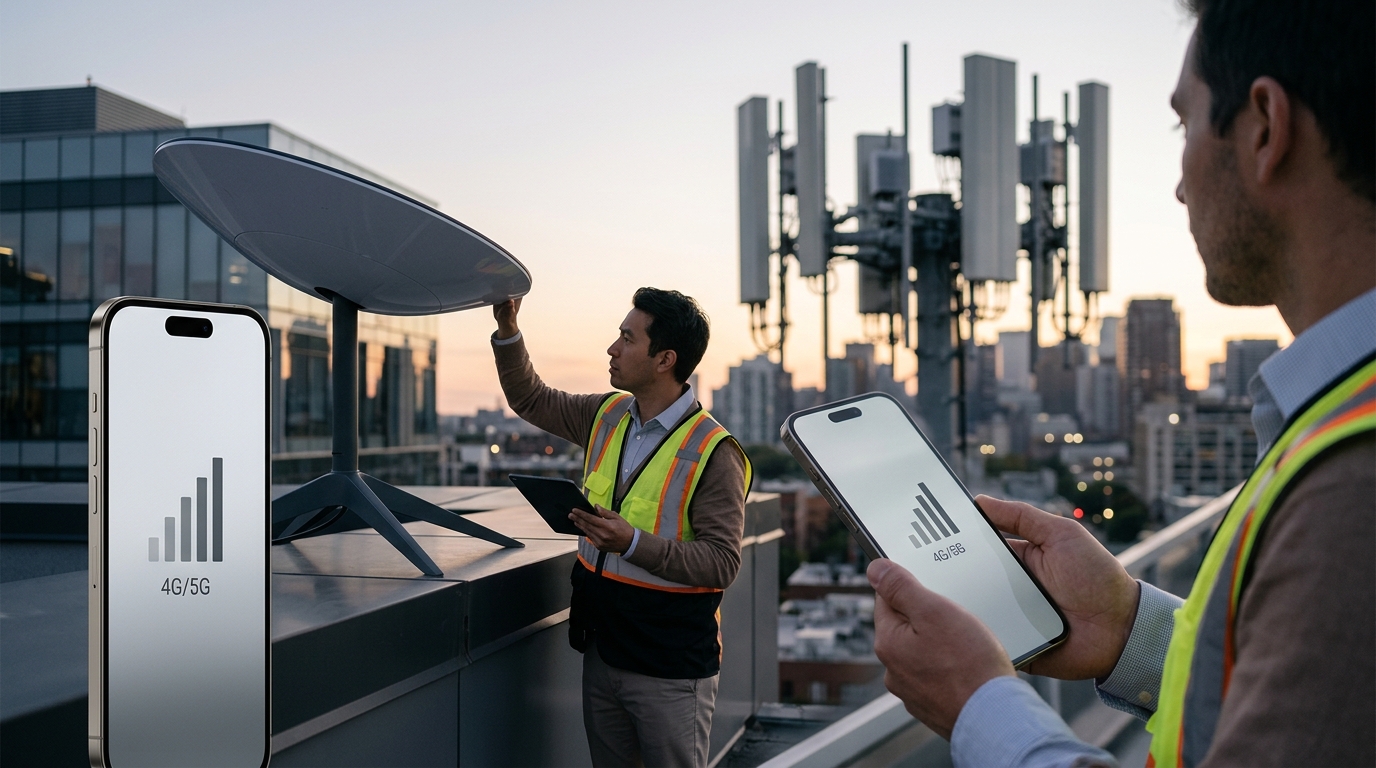
SpaceX spent nearly $20 billion buying wireless spectrum it had no public explanation for. On Tuesday evening, the company finally gave one, and AT&T, Verizon, and T-Mobile stocks dropped more than 4% in after-hours trading.
The angle most coverage has taken is the satellite angle. That is the wrong frame. What SpaceX discussed on its debut earnings call is a ground-up, terrestrial mobile network, cell towers, small cell nodes, land-based spectrum, layered on top of an existing satellite constellation that already serves 12 million subscribers. That is a different competitive animal from the direct-to-cell service T-Mobile has been bundling as a dead-zone backup.
The Spectrum Math Nobody Was Modeling
The foundation was laid quietly. SpaceX previously paid roughly $17 billion for wireless spectrum licenses from EchoStar, along with a follow-on deal worth $2.6 billion involving additional EchoStar spectrum, to support direct-to-cell service. In September 2025, the initial purchase covered AWS-4 and H-block licenses, structured as $8.5 billion in cash and $8.5 billion in SpaceX stock. Two months later, the companies amended the agreement to add EchoStar’s unpaired AWS-3 spectrum for another $2.6 billion, to be paid in SpaceX stock. The FCC cleared the transaction, handing SpaceX exactly the kind of terrestrial spectrum a standalone mobile network would require.
The spectrum quantity matters. The current direct-to-cell system operates using around 5MHz of bandwidth through local telco partners, but SpaceX now has access to roughly 65MHz of bandwidth via the EchoStar transaction. That is a step-change in spectral capacity, sitting unused, until Tuesday.
SpaceX President and COO Gwynne Shotwell was precise on the earnings call. She said the company plans to add land-based infrastructure, including cell towers and small cell nodes, on top of its existing satellite internet service. She added that the service’s capability could improve roughly 100-fold once the company deploys next-generation satellites and the EchoStar spectrum, with commercial service targeted to begin by the end of next year. The ambition has a price target attached to it: she pointed to the trio’s roughly $600 billion in combined annual revenue as a measure of the opportunity.
Who Is Actually Being Threatened
The carriers SpaceX named are not abstract. AT&T reported 109.3 million retail wireless subscribers as of March 31, 2026, and T-Mobile has recently been cited at roughly 143 million customers. Verizon’s commonly cited wireless base is in the same ballpark, putting the combined pool at about 400 million lines, the largest adjacent revenue pool in domestic technology.
T-Mobile, Verizon, and AT&T carried market caps of around $181 billion, $177 billion, and $144 billion respectively in late July 2026. That combined market cap of roughly $502 billion sits against a SpaceX that listed at $135 per share in June, a company whose IPO valued it at roughly $1.77 trillion at the offer price.
The carriers read the threat clearly enough to do something unprecedented. On May 14, 2026, AT&T, T-Mobile, and Verizon agreed in principle to form a joint venture aimed at pooling limited spectrum resources to expand satellite-based direct-to-device connectivity across the United States, a direct defensive formation. Analysts at LightShed Partners were blunt, saying the announcement showed the three carriers are “nervous.” The JV has no definitive agreement and no financial structure yet, but its existence tells you something about the temperature inside each carrier’s boardroom.
T-Mobile occupies the most complicated position. Its existing deal with SpaceX makes Starlink a background provider for T-Mobile’s T-Satellite service, filling dead-zone gaps for subscribers, but T-Mobile owns the customer relationship, with SpaceX operating only the satellite layer. A direct-to-consumer Starlink mobile plan would invert that dynamic: SpaceX would sign up subscribers, bill them directly, and control its own brand. T-Mobile’s CEO noted on the company’s Q2 2026 earnings call that satellite-to-cell service accounts for about 0.0003% of T-Mobile’s network usage during the busiest summer months, a figure designed to minimize the threat. SpaceX’s response to that framing is essentially the next-generation satellite roadmap.
The SpaceX Financials Behind the Ambition
The carrier threat is coming from a company that just posted its first public earnings results, and the numbers reframe what “credible competitor” means. SpaceX’s debut earnings release showed $7.81 billion in Q2 2026 revenue, a 92% jump from the year-ago quarter, clearing Wall Street expectations. The company posted a net loss of $541 million, narrower than many forecasts.
The connectivity segment, the business that funds the carrier ambition, is the financial engine. Revenue from the connectivity segment, which includes the Starlink satellite internet service, rose 66% year-over-year to $4.29 billion. Connectivity was the only segment to generate an operating profit, and Starlink subscribers reached 12 million at the end of the period, doubling from a year earlier. Starlink subscriber ARPU was reported at $66 per month, down from about $86 a year earlier, reflecting international expansion and lower-priced plan introductions, but the volume trajectory matters more here than the per-unit figure.
SpaceX CFO Bret Johnsen said on the earnings call that the company is on pace to reach $100 billion in annualized recurring revenue by the end of the year. In the first few weeks of Q3, he said the company had already contracted an additional $6.7 billion of cloud services revenue over a six-month period that begins ramping in October.
The capex figure is where the stock broke down after hours. Capital expenditures jumped to about $18 billion in Q2, with $15.8 billion of that tied to AI infrastructure. The stock traded sharply lower into August 5 following the release. Some of the analyst target-change specifics cited here could not be verified in primary reporting, and remain directionally true only in the sense that the Street reaction has been mixed on whether the capex ramp is an investment or a warning sign.
Sector Breakdown: Who Bleeds, Who Watches
The immediate market reaction sorted the telecom sector cleanly. Shares of AT&T, Verizon, and T-Mobile each fell more than 4% in post-market trading following Shotwell’s comments. That kind of synchronized drop on a single competitor’s earnings call is uncommon in a sector this mature.
AT&T and Verizon face the structural disadvantage of having already aligned with AST SpaceMobile for their own satellite-to-cell service, which means their hedge against Starlink runs through a third party. Verizon and AT&T have teamed up with AST SpaceMobile to allow their own users to make calls in areas with no cell tower coverage, but AST’s timeline and scale do not yet match SpaceX’s vertical integration. SpaceX holds an advantage that Dish Network, which spent billions on spectrum it ultimately could not turn into a competitive carrier, never had: vertical integration across the full stack. SpaceX manufactures its own satellites, launches them on its own rockets, and operates one of the largest low-Earth orbit constellations in existence.
For the carriers, the MVNO route, the model Charter and Comcast used to rent network access cheaply, is closed. The claim that all three major carriers have publicly declined to offer SpaceX an MVNO deal during Q1 2026 earnings calls could not be verified, so it should be treated as unconfirmed. If the majors do keep MVNO doors shut, it would further incentivize SpaceX to build its own infrastructure, which it now says it will do.
One alternative path has emerged. Bloomberg reported last month that the company engaged Charter Communications in discussions about funneling a portion of its phone traffic over Charter’s terrestrial network. If that arrangement advances, SpaceX gets ground-level density without building towers from scratch, and Charter gets a revenue stream that offsets its own broadband competition with Starlink. Cable names warrant watching if this develops.
Technical and Trading Framework
SPCX was trading below its $135 IPO price in early August. Specific intraday prices, premarket percentages, and a precise 52-week range for a stock that has only been public since June 12, 2026 cannot be treated as verifiable here without a market data feed. The actionable point stands: the post-earnings move widened the gap between where the stock was trading and where many sell-side models had anchored prior expectations.
On the telecom side, T, VZ, and TMUS each slid after hours on August 4. The specific extended-hours quote for TMUS cited here could not be verified in primary reporting, but the relative framing remains: T-Mobile has a commercial relationship with SpaceX that can function as partial insulation, while AT&T and Verizon face a cleaner competitive read-through if SpaceX goes direct-to-consumer at scale.
Key technical levels for SPCX: the IPO price at $135 functions as a psychological resistance level on any recovery attempt. Volume profile and VWAP will be critical on the first post-earnings full session, heavy downside volume with price stabilizing is a different signal than low volume with continued drift lower.
For the telecom names, watch whether the after-hours move gets faded on the open or extended. A continuation lower in T, VZ, and TMUS into the morning session, particularly on elevated volume, would suggest institutional reweighting, not just a reflexive after-hours reaction to a headline.
Scenario Modeling
Bull Case for SPCX
SpaceX executes the Charter network-sharing deal, reducing its terrestrial buildout cost and timeline materially. Next-generation satellite launches proceed on schedule in 2027, Starlink Mobile commercial service launches by end of 2027 as guided, and subscriber additions continue at roughly the recent pace. Connectivity operating income scales from current quarterly levels toward materially higher run rates as capacity expands. The stock recovers as the market re-rates the wireless opportunity.
Base Case
SpaceX builds a hybrid satellite-terrestrial service that captures rural and underserved market segments, the same population the Big Three have historically underinvested in. The carriers defend urban density with 5G infrastructure SpaceX cannot quickly replicate. Subscriber growth at SpaceX continues but at a moderating pace as ARPU stabilizes. The telecom names trade lower as the market assigns a disruption discount. SPCX stabilizes as capex concerns are offset by revenue re-rating.
Bear Case
Terrestrial buildout takes longer than guided. The FCC imposes buildout obligations tied to the spectrum licenses that prove costly and slow. The Charter discussions collapse and SpaceX faces tower acquisition costs that strain the balance sheet alongside the elevated AI infrastructure run rate. Free cash flow turns deeply negative for multiple consecutive quarters. The carriers respond with aggressive promotional pricing in rural markets, defending their subscriber bases before SpaceX reaches commercial launch. Telecom names recover partially as the timeline risk gets pushed out.
Active Trader Strategy Framework
Three distinct positioning frameworks are worth considering here, depending on time horizon and risk tolerance.
SPCX volatility positioning: The implied move post-earnings was realized quickly in extended trading. The question now is whether the initial gap lower holds or gets faded. Traders monitoring SPCX should use the IPO price at $135 as a key reference level. A sustained trade below that level can keep the stock in a “prove it” regime until the next catalyst.
Telecom pair positioning: The T-Mobile situation is structurally different from AT&T and Verizon. T-Mobile has a commercial revenue relationship with SpaceX that can generate value regardless of the competitive outcome. AT&T and Verizon are more cleanly exposed. A relative value framework, long TMUS against short T or VZ, captures the divergence without taking a directional view on the sector as a whole. Monitor the spread, not just the absolute levels.
Charter and cable adjacency: If the Bloomberg report on SpaceX-Charter discussions is accurate, CHTR becomes an asymmetric situation. A network-sharing deal would be a material positive for Charter while also validating its infrastructure. Cable names are worth monitoring for any confirmation of a formal arrangement.
Risk management across all three frameworks: the timeline uncertainty is the primary variable. SpaceX has discussed commercial service beginning as soon as late 2027. Any delay in next-generation satellite launches extends the window for the carriers to defend market position. Position sizing should reflect the 12-to-24-month deployment horizon, this is not a 30-day trade.
What Next?
What happened on Tuesday evening is not a product announcement. It is a capital allocation declaration with roughly $19.6 billion of spectrum consideration now under contract and an elevated quarterly capex run rate. SpaceX told investors, analysts, and the carriers themselves that it intends to become a fourth national wireless provider, built from orbit down, not from the ground up.
The carriers have a two-year window before Starlink Mobile’s next-generation service is positioned to scale. That window is the critical variable. Whether they use it to defend with pricing, spectrum acquisition, or deeper satellite partnerships will determine how much of the roughly $600 billion combined revenue pool SpaceX can realistically access. Shotwell said on the call she anticipated winning “quite a few” of their customers. Both sides are spending to prove their case. Disciplined traders will watch the execution signals, subscriber growth, spectrum deployment progress, and the Charter conversation, rather than the rhetoric. Preparation, not prediction, is the only edge that holds here.
For informational and educational purposes only. Not investment advice. Trading involves risk, including loss of principal.