August 6, 2026
The Next $435B Energy Empire
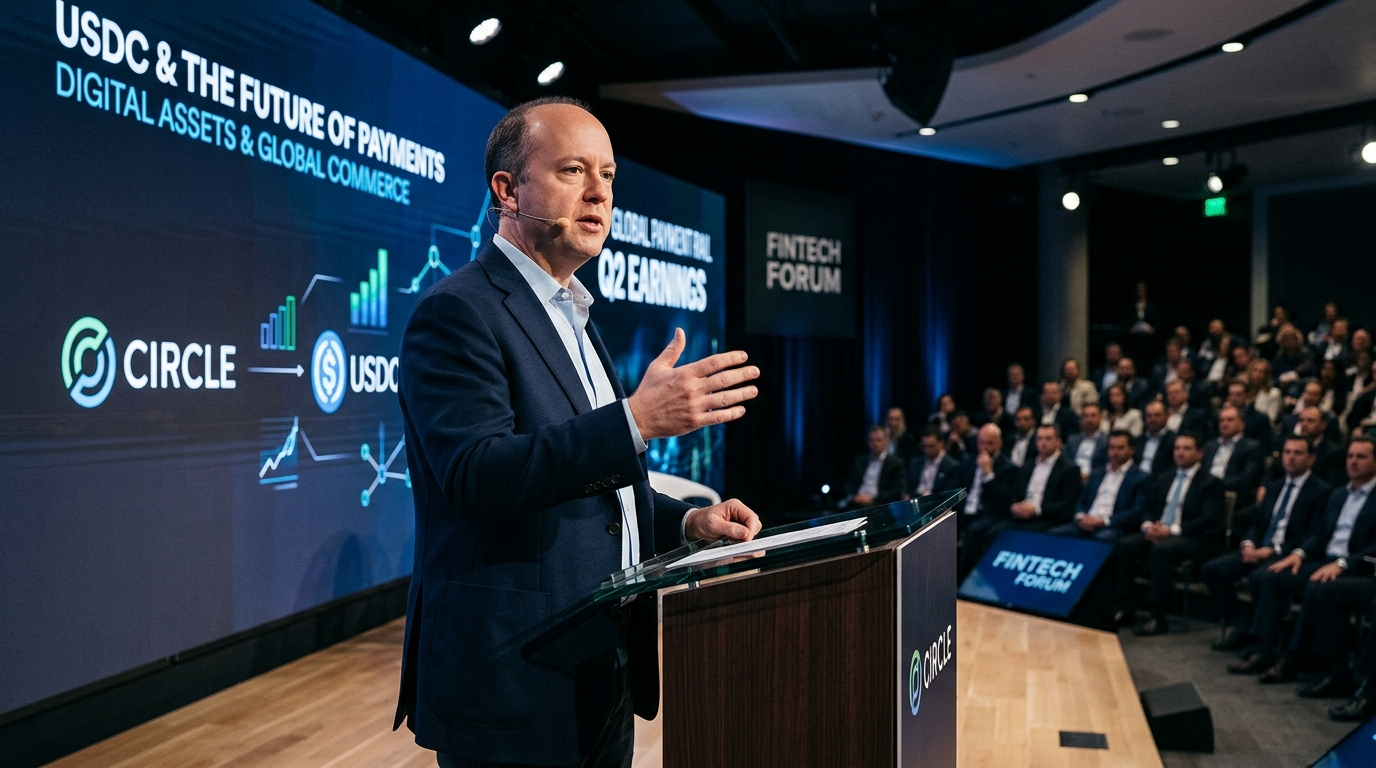
Featured: Circle’s Q2 Numbers Just Hit. The Real Trade Is Arc.
The Next $435B Energy Empire
John D. Rockefeller would be worth $435b today. But “oil money” is old news. Next up? A $2.1 trillion opportunity in “clean” coal. It’s a “Rockefeller” moment for Frontieras, the company reforming coal into hydrogen and other valuable commodities. Their NASDAQ ticker ‘FASF’ is reserved.
Final weeks to join 12K+ people as an early-stage shareholder.
Invest in Frontieras at $9.01/share by 8/6.
Disclosure: This is a paid advertisement for Frontieras’s Regulation A offering. Please read the offering circular at invest.frontieras.com
Circle’s Q2 Numbers Just Hit. The Real Trade Is Arc.
Key Metrics at a Glance
- Q2 Revenue and Reserve Income: $701M, +7% year-over-year; $16M below the Street estimate
- EPS (diluted): $0.18, beat consensus of $0.16 by 12.5%; down from $0.21 in Q1
- Adjusted EBITDA: $143M, +8% year-over-year; down from $151M in Q1
- USDC in Circulation: $73.3B at quarter end, +19% year-over-year; down from $77.0B in Q1
- USDC Onchain Transaction Volume: $14.8 trillion, +151% year-over-year
- Agent Stack: 900+ paid services; 99.3% of x402 agent-payment volume settling in USDC
- Arc Mainnet: September 16, 2026 public launch confirmed; 100+ institutional builders on private mainnet
- Analyst Targets: Morgan Stanley Underweight at $38 / TD Cowen Buy at $82 / Bernstein Outperform at $140 / Consensus (28 analysts) Buy at $113.72
Market Context: Why This Quarter Matters Now
Circle Internet Group reported Q2 2026 results on August 5 against a backdrop that made the print difficult before anyone opened the filing. The Federal Reserve has held the fed funds rate at current levels, but futures markets are pricing at least one cut by September, which creates a direct headwind for a company whose largest revenue line is interest earned on short-term Treasuries backing USDC reserves. Crypto market conditions softened through the quarter, with Bitcoin trading well off its prior highs and broad risk appetite in digital assets compressed relative to Q1. Both dynamics are external. Both suppress Circle’s numbers without reflecting anything about USDC’s structural positioning or the Arc buildout.
The GENIUS Act, signed into law in July 2025, established a federal framework for payment stablecoins and set a compliance clock for large issuers. That legislative backdrop is now live and operational. The OCC’s proposed rules published in March 2026 cover reserve composition, weekly reporting, and custody requirements for permitted stablecoin issuers, making the regulatory perimeter concrete rather than speculative. Circle, which received final OCC approval on July 10 to establish First National Digital Currency Bank, N.A., operating as Circle National Trust, is the first major stablecoin issuer to meet that standard at the federal level. The charter placed USDC reserves under OCC oversight at the same moment the competitive environment is becoming more crowded.
Open USD launched on June 30, 2026, backed by more than 140 companies including Visa, Mastercard, BlackRock, and Coinbase. Its shared-reserve-economics model directly targets the distribution dynamics that currently accrue to Circle. That competitive arrival, combined with Morgan Stanley’s August 3 downgrade to Underweight at a $38 target, drove CRCL to close at $60.41 before Q2 results dropped. The setup entering earnings was: a damaged chart, a fractured sell-side, a revenue miss already partially anticipated, and a September 16 Arc mainnet launch that the market had not yet priced in either direction.
Company Profile
Circle is a global financial technology firm that issues USDC and EURC stablecoins through regulated affiliates. Its business model has, until recently, been straightforward: issue USDC, hold the dollar equivalent in short-term U.S. Treasuries, collect interest on that reserve pool, and distribute a share of that income to distribution partners including Coinbase. The simplicity of that model is both the reason Circle went public at a premium and the reason it is now under pressure from two directions simultaneously.
The company is executing a deliberate pivot beyond reserve income. That pivot has three components. First, the Circle Payments Network, a global money movement layer. Second, the Agent Stack, launched in May 2026, which includes Agent Wallets, a Command Line Interface, an Agent Marketplace, and Nanopayments that enable gas-free USDC transfers as small as one-millionth of a dollar, targeting machine-to-machine commerce at volumes and price points that card rails cannot serve. Third, Arc, an institution-focused Layer 1 blockchain with USDC as native gas, sub-second transaction finality, and embedded privacy controls, designed to function as an economic operating system for internet-native finance.
The concentration risk in the current model is not disputed. When rates fall, reserve income falls with them. When distribution partners extract more economics, the margin between gross reserve income and net revenue to Circle compresses. The strategic rationale for Arc and the Agent Stack is explicit: build a revenue base that does not move with the fed funds rate. The Q2 numbers show that transition is a multi-year project, not a 2026 event.
Stock-Specific Financial Breakdown
The Q2 headline numbers look acceptable year-over-year until you look at the sequential comparison. Revenue and reserve income came in at $701 million for the June quarter, a 7% year-over-year gain but a barely perceptible $7 million improvement over the $694 million Circle booked in Q1. Three months earlier, that same year-over-year growth rate was 20%. The deceleration from 20% to 7% in a single quarter is the number Mizuho flagged immediately after the release, and it is the number that explains why the stock did not sustain its premarket pop.
Adjusted EBITDA fell sequentially from $151 million in Q1 to $143 million in Q2, a decline of roughly 5% quarter-over-quarter even as the year-over-year comparison shows 8% growth. EPS slipped from $0.21 to $0.18 between quarters. Net income from continuing operations was $48 million, a significant improvement versus the prior-year period, though that comparison is distorted by $591 million in IPO-related stock-based compensation charges Circle booked in mid-2025. The clean year-over-year EPS comparison against $1.02 in the year-ago quarter reflects those charges and does not describe underlying deterioration at the operating level.
USDC in circulation closed the June quarter at $73.3 billion, up 19% year-over-year but down from $77.0 billion at the end of Q1. That sequential decline matters because the reserve income model is a function of the balance outstanding multiplied by the short-term Treasury yield. A shrinking balance against a flat or falling rate is a direct revenue headwind with no natural offset unless transaction-fee revenue accelerates faster than the reserve base contracts. That acceleration is not visible in the Q2 numbers.
On the positive side of the ledger, USDC onchain transaction volume hit $14.8 trillion in Q2, up 151% year-over-year. That figure reflects utility, not just passive holding. The Agent Stack already has more than 900 paid services, with 99.3% of x402 agent-payment volume settling in USDC. Arc has over 100 ecosystem and institutional builders on private mainnet ahead of the September 16 public launch. These are pipeline metrics, not revenue metrics. The market’s task is to assign a present value to that pipeline against the visible compression in the core income model.
Analyst targets span a range that captures the entire investment debate. Morgan Stanley’s James Faucette cut his USDC supply assumptions by roughly 33% for 2027 and 44% for 2028, placing his GAAP EPS estimates 3% and 20% below consensus, respectively, and citing McKinsey data suggesting only approximately $390 billion of roughly $35 trillion in adjusted stablecoin volume represents identifiable payments. Bernstein’s Gautam Chhugani maintained an Outperform rating but reduced his target from $190 to $140. TD Cowen’s Bryan Bergin initiated at Buy at $82. The consensus of 28 analysts remains at Buy with a $113.72 average price target.
Sector Breakdown: Stablecoins, Capital Rotation, and the Regulatory Moat
The stablecoin sector is no longer a niche within crypto. The GENIUS Act turned it into a federally regulated financial infrastructure category, and that reclassification has drawn in every major financial institution with a payments franchise. Traditional banks now see stablecoin issuance as a product extension, not an experiment. That shift is constructive for the category and structurally challenging for Circle specifically, because the distribution advantages that made USDC dominant when regulatory uncertainty kept banks out are eroding as that uncertainty lifts.
Open USD’s launch on June 30 with 140-plus corporate backers, including names like BlackRock, Visa, Mastercard, and Coinbase, is the clearest signal of that shift. The shared-governance and reserve-economics model means Open USD’s distribution partners capture more of the reserve income that currently flows to Circle. If that model attracts meaningful adoption, it directly pressures Circle’s USDC supply growth and the margin above distribution costs that defines Circle’s profitability.
The counterargument is regulatory positioning. Circle’s OCC national trust bank charter is, for now, a competitive moat that Open USD and most new entrants cannot immediately match. The GENIUS Act requires large issuers to operate within a federal charter framework, and Circle is currently the only stablecoin issuer that has cleared that bar at the federal level. That first-mover regulatory advantage may prove durable if the compliance burden of the OCC framework is high enough to delay competitors. It may prove temporary if banks obtain equivalent or superior regulatory standing through existing charter structures. The institutional capital flows into the sector favor Circle’s credentialing. The product competition favors Open USD’s economics.
Within the broader fintech and digital asset sector, Circle’s Arc validator cohort, announced on August 5 alongside Q2 results, represents a distinct institutional capital formation. Founding validators include BlackRock, DTCC, Galaxy, Global Payments, ICE, Mastercard, MoneyGram, SBI Group, Standard Chartered, Sumitomo Corporation, and Visa. Several of these names are also Open USD backers, meaning institutional commitment to Circle’s infrastructure does not preclude participation in its competitive threat. The flow picture is complex. Institutions are hedging, not picking sides.
Technical and Trading Framework
CRCL is trading at levels that reflect a stock in structural repair mode. The share price entered August 5 earnings near $60, down more than 50% from its post-IPO peak and more than 20% year-to-date. The Morgan Stanley downgrade on August 3 accelerated a move that was already underway, with the stock having fallen over 8% the prior Friday. That sequence, a sharp pre-earnings decline followed by a mixed print, creates a technical read that is inherently noisy.
The premarket reaction to Q2 results pushed CRCL higher, with the stock trading toward the mid-to-upper $60s before the open. The key structural question is whether the stock can sustain a close above the $65 to $67 zone that capped price action through most of July following the Morgan Stanley downgrade. A sustained close in that range or above would be the first constructive technical development in weeks. Failure to hold the opening move and a close back below $62 reopens the path toward the prior post-downgrade lows near $58 to $59.
The 50-day moving average is declining, consistent with a stock in a downtrend. The 200-day average sits materially above current price, making it a long-term reference point rather than a near-term target. Volume is the variable to watch on any sustained move. The August 3 downgrade session saw volume near the 15 million share average. A post-earnings move on elevated volume signals conviction; a move on thin volume signals a relief rally within a larger distribution pattern.
Implied volatility entering the print was consistent with a 10 to 12 percent expected move. The actual post-earnings move came in toward the lower end of that range. With the event now behind traders, implied volatility will compress, which means directional positioning needs to be built on the fundamental thesis rather than options premium dynamics. The September 16 Arc mainnet date will likely serve as the next event anchor for options activity.
Scenario Modeling
Bull Case
Arc’s September 16 public mainnet launch proceeds on schedule with full validator participation from the institutional cohort announced August 5. Early transaction volume and developer onboarding exceed expectations, giving the market a tangible proof point for the economic OS thesis. USDC circulation reverses its Q1-to-Q2 sequential decline in Q3, returning toward the $77 billion level or above, stabilizing reserve income even if rates move modestly lower. The OCC national trust bank charter creates a compliance barrier that delays Open USD’s adoption curve, preserving USDC’s distribution economics through year-end. Fee-based revenue from the Agent Stack’s 900-plus paid services begins to show up in the Q3 income statement as a meaningful line item. In this scenario, CRCL re-rates toward TD Cowen’s $82 target in the near term and the Bernstein $140 target becomes the discussion point for 2027 positioning.
Base Case
Revenue growth stabilizes in the high single digits through year-end. USDC circulation holds near current levels but does not return to Q1 highs, keeping reserve income roughly flat sequentially. Arc launches on September 16 and attracts builders but generates minimal direct revenue in 2026 as the ecosystem develops. The Agent Stack’s commercial traction remains a 2027 inflection story. Open USD gains share gradually without triggering a sudden USDC outflow event. The stock trades in a range consistent with TD Cowen’s $82 estimate on the upper end and the mid-$50s on the lower end, with volatility clustered around rate decisions and Arc update milestones. The valuation premium for the regulatory moat persists but is capped by the margin structure.
Bear Case
The Fed cuts rates in September, compressing reserve income before transaction and subscription revenue can offset the decline. Open USD adoption accelerates faster than the base case assumes, with its yield-sharing model pulling distribution partners away from USDC and driving a more significant contraction in circulation below $70 billion. Arc encounters delays or disappointing early adoption, removing the primary forward catalyst. Morgan Stanley’s USDC supply estimates, already cut 33% for 2027, prove closer to reality than the consensus model. In this scenario, EPS for 2027 falls toward or below Morgan Stanley’s estimates, putting pressure on a stock that already carries a premium multiple against a compressing earnings base. The $38 Morgan Stanley target implies a low multiple on materially lower earnings, and it is not a theoretical outcome in this path.
Active Trader Strategy Framework
The risk management framework for CRCL has to account for two distinct volatility regimes operating simultaneously. The first is the near-term earnings reaction, where the stock’s position relative to pre-earnings support levels determines whether the initial move holds. The second is the September 16 Arc mainnet, which will function as an event anchor whether or not traders intend it to. Any position carried through September 16 carries event risk on both sides.
- Key Resistance: $65 to $67 zone capped price action through July; a sustained close above this range is the first structural confirmation that the post-downgrade base is forming.
- Key Support: $58 to $59 represents the post-downgrade intraday low. A close below this level on volume opens the path toward the $50 to $52 range, which corresponds to the lower bound of the Morgan Stanley framework.
- USDC Circulation Trend: The most direct leading indicator for reserve income is the weekly USDC supply data. Watch for any reversal of the Q2 sequential decline, particularly in the first four weeks of Q3.
- Arc Validator Participation: The founding cohort includes BlackRock, DTCC, Mastercard, and Visa. Any public withdrawal or reduced commitment from a named validator before September 16 would be a material negative catalyst.
- Fed Rate Signals: September FOMC is the single most important macro event for Circle’s near-term income statement. A 25 basis point cut reduces reserve income directly; a hold buys the model another quarter of breathing room.
- Open USD Market Share Data: There is no real-time circulation figure for Open USD yet. Watch for monthly issuance reports and any stablecoin market-share data from analytics providers showing USDC share trending below 75% of the regulated stablecoin market.
- Volatility Positioning: With implied volatility compressing post-earnings, the cost of optionality around September 16 will be lower in the coming weeks than it was entering August 5. Traders with a directional view on the Arc launch may find the volatility calendar favorable for structured positioning before mid-September.
Wall Street May Be Chasing Yesterday’s AI Winners
While everyone watches the biggest AI names stumble, a new group of companies could be emerging as tomorrow’s biggest winners.
Bottom Line
Two facts define Circle’s position as of August 6, 2026. First: USDC onchain transaction volume grew 151% year-over-year to $14.8 trillion in Q2. The rails are being used. The utility thesis is not hypothetical. Second: the revenue growth rate decelerated from 20% to 7% in a single quarter, adjusted EBITDA fell sequentially, and the largest competitive threat in the stablecoin market just launched with 140 corporate backers. Both facts are real, and the stock price is a function of which one traders believe will dominate the next four quarters.
The OCC national trust bank charter is a genuine structural advantage. It is also a bar that traditional banks can clear through existing charter pathways, which means Circle’s regulatory moat has a clock on it. The Agent Stack’s Nanopayments technology, which enables transfers as small as one-millionth of a dollar, addresses a real gap in financial infrastructure for machine-to-machine commerce. The question is whether that gap becomes a revenue line before the reserve income model is materially eroded by a combination of rate cuts, USDC share loss, and margin pressure from distribution costs.
September 16 is the date that matters most between now and year-end. Arc’s public mainnet launch with a validator set that includes BlackRock, DTCC, and Visa is either the moment Circle proves it has built the second growth engine its valuation requires, or the moment the market realizes the institutional blockchain buildout is a 2028 revenue story dressed in 2026 marketing. Traders who believe in the former should define their risk against the $58 to $59 support zone and manage size accordingly through the September event. Traders who believe in the latter should treat any post-earnings strength as distribution until the income statement shows evidence of transition, not just pipeline.
Prepare for the scenario. Position for the evidence.
For informational and educational purposes only. Not investment advice. Trading involves risk, including loss of principal.