
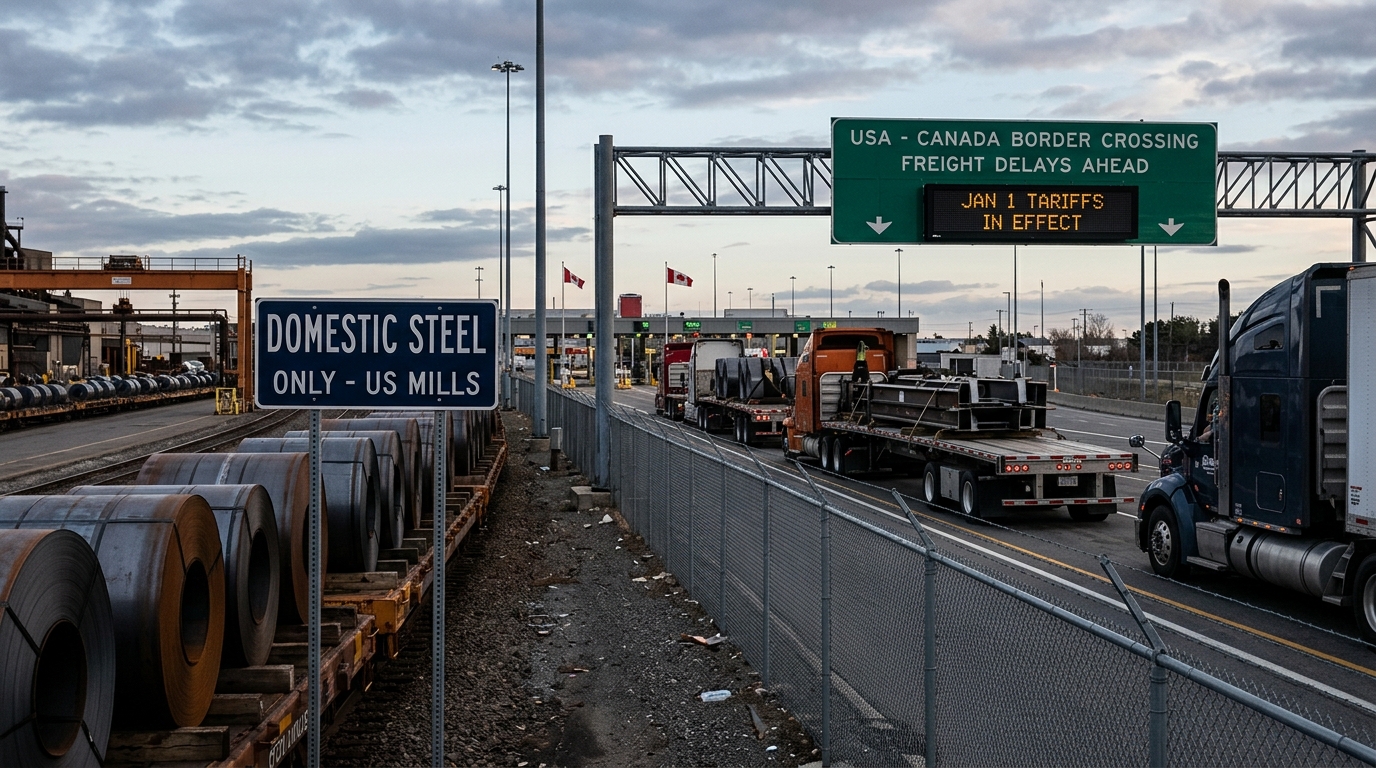
Markets rarely hand traders a catalyst with a fixed expiration date. Monday’s Truth Social post did exactly that. President Trump announced the U.S. will raise tariffs on imports of cars, trucks, auto parts and steel from Canada to 50% on Jan. 1, 2027, following a breakdown in trade negotiations last week. The announcement raises the stated tariff rate, but traders should note a key uncertainty: it is not yet clear whether the new 50% auto tariff would preserve the existing treatment that limits duties to the non-U.S. content of Canadian vehicles. Trump also wrote that companies building in the U.S. would face “ZERO TARIFFS.”
The policy itself is blunt. Parts commonly cross between the U.S. and Canada multiple times before a vehicle reaches final assembly. If tariffs are assessed at each crossing on the dutiable value, the cost impact on automakers can magnify well beyond what a simpler, single-crossing supply chain would face. That compounding dynamic is what makes this announcement qualitatively different from a standard tariff hike.
Where Capital Moved Monday
The market’s first read was clear and internally consistent. Steel stocks outperformed while freight and logistics names sold off. The divergence between domestic mills and cross-border freight carriers is not coincidental. It reflects a real economic wedge: less Canadian steel flowing south means more pricing power for U.S.-based producers, while fewer cross-border automotive shipments mean thinner loads and compressed volumes for truckload and LTL carriers who run Canada routes.
Autos also took the headline in stride, with GM, Ford and Stellantis lower on the day. More than 40% of the vehicles Stellantis sold in the United States were imports, mostly from Mexico and Canada, making the Jeep and Ram parent one of the most exposed. Ford and GM are already managing elevated tariff costs: GM expects gross expenses related to tariffs to cost it $2.5 billion to $3.5 billion in 2026. A 50% rate arriving January 1 reopens that math entirely.
The Pair That Has Legs
The highest-conviction structure here is long domestic steel against short cross-border freight, not a broader macro bet on the trade war outcome.
On the long side, Nucor shares had retreated sharply from their 52-week high of $280.11 after reports of a tentative U.S.-Canada trade agreement that could reduce tariffs on Canadian steel and aluminium exports to 25%, sending the stock into the mid-$240 range. That pullback reversed Monday. Steel Dynamics adds a second leg: revenue reached $6.1 billion in the second quarter, exceeding consensus estimates around $5.6 billion, with net income rising to $534 million from $299 million a year earlier. Both Nucor and Steel Dynamics also carry exposure to data-center construction, a demand driver that exists independently of trade policy. The bull thesis holds even if talks partially resume.
On the short side, J.B. Hunt and Knight-Swift face a structural volume problem, not just a sentiment overhang. Cross-border truckload and intermodal business contracts months in advance. If Canadian automotive production slows in response to the tariff announcement, freight bookings follow with a lag. That lag makes the short position patient rather than speculative.
Levels and Invalidation
For NUE, the trade works while price holds above the mid-$240 support that formed during last week’s deal-talk selloff. A close back below $243 on above-average volume suggests the market is discounting renewed negotiation progress, not the escalation path. The thesis strengthens if NUE reclaims $265 on sustained volume. For STLD, the equivalent zone is around $220.
For the freight shorts, a bounce above Monday’s opening levels on news of talks resuming is the clearest stop. The Jan. 1 start date leaves a window for potential negotiations. Canada’s retaliatory tariffs are slated to take effect Sept. 8, and Canada has vowed to retaliate with its own tariffs on U.S. products. That counter-tariff date is the next checkpoint for the entire pair.
Trader’s Action Plan
The Jan. 1, 2027 date is the anchor. It creates a defined window for the pair to work. Size steel longs to allow for tariff-deal headlines, which will pressure NUE and STLD quickly. Keep freight shorts tight ahead of the Sept. 8 Canadian counter-tariff start date, since that event could accelerate freight-volume concerns. The thesis weakens on any credible White House signal that USMCA-compliant content will receive exemptions, since that would reduce the auto supply chain disruption that drives the freight volume loss. The thesis strengthens on further escalation or if automakers begin announcing Canadian plant curtailments. Watch for production guidance from GM, Ford, and Stellantis as those companies calculate their Jan. 1 exposure through the fall.