September 6, 2026
Bonus Content: One Number Decides the September Meeting. It Drops Friday.
Below is an important message from one of our highly valued sponsors. Please read it carefully as they have some special information to share with you.
Dear reader,
Michael Burry is the famous hedge fund manager who predicted the 2008 meltdown…
And made $100 million during that crash.
He’s now putting his own money on the line…
Betting that this AI company I just exposed in this shocking new interview will collapse.
He said:
“This bubble looks an awful lot like the dot-com bubble.” [This company] is doomed and hemorrhaging cash.”
After correctly predicting the last two major stock market meltdowns…
I have to say… I agree 100%.
I believe this company is about to go bust…
In a meltdown that will be 10 times bigger than Lehman Brothers.
So please click here to get the details because…
While most people are in the dark…
Some of the best investors on the planet…
Are already preparing for this coming AI meltdown.
For example, tech billionaire Peter Thiel recently sold his entire stake in Nvidia, worth about $100 million.
The giant investment firm SoftBank also sold all of its Nvidia holdings for $5.8 billion.
Ray Dalio’s hedge fund has also been dumping shares of some of the biggest AI players.
He recently cut his Nvidia position by 65%, Google by 52% and Meta by 48%.
And over the past few months Warren Buffett sold $177 billion worth of stocks…
And he’s now holding a record position in cash.
I highly recommend you avoid these hyped-up AI stocks…
Regards,
Jim Rickards
One Number Decides the September Meeting. It Drops Friday.
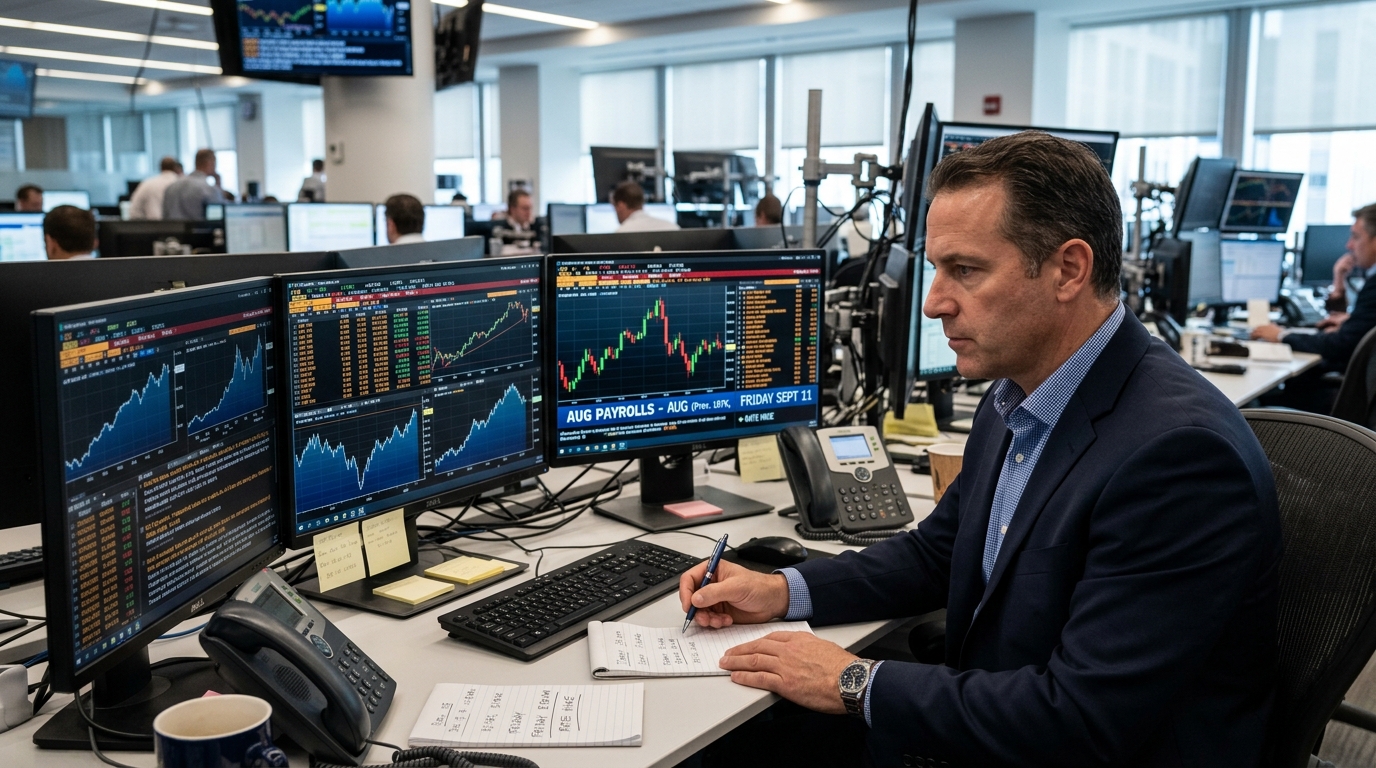
Every Federal Reserve official went quiet at the close of business Saturday, September 5. The FOMC blackout period ahead of the September 15-16 meeting runs through Thursday, September 17, and it arrived at the worst possible moment for traders who spent the past week recalibrating positions in real time. No clarifying remarks, no guidance, no walkbacks. The committee has effectively handed the decision to two numbers: Thursday’s PPI and Friday’s August CPI at 8:30 a.m. Eastern.
The bond market had already passed its own judgment before the silence began. The two-year Treasury yield climbed to around 4.37% on Friday. The 10-year settled near 4.78%. Short-duration yields function as a continuous referendum on Fed funds rate expectations, and at 4.37%, the two-year is signaling that September is genuinely live.
What changed the calculus was Thursday’s payrolls release. August nonfarm payrolls came in at 162,000, against a Dow Jones consensus of 53,000. The unemployment rate held at 4.1%. Revisions added another 55,000 jobs across June and July combined, with July flipping from a reported loss of 23,000 to a gain of 21,000. A single-month print of 162,000 is not a marginal beat. It removes the argument that the labor market was losing momentum.
The payrolls number pushed CME FedWatch hike probability back toward 58%, roughly 9 percentage points above where it stood the day before. That followed a volatile stretch of Fed communication. Fed Chair Kevin Warsh used his Jackson Hole address to say the central bank still has “work to do” on inflation, driving rate-hike odds above 57% on the CME tool. Days later, Governor Christopher Waller offered a more conditional read: his next decision would be “heavily influenced” by August inflation data, and if recent disinflation progress proved durable, he would lean toward holding. Waller’s September 3 speech pulled odds back toward 50-50. Then payrolls arrived and pushed them back up.
That back-and-forth is now frozen. The blackout swallowed Waller’s last word the morning after he delivered it. Traders cannot get another clarifying signal from any FOMC member before the decision. The August CPI on Friday, September 11, is the last fresh data the committee sees before they vote, and the last input markets get before the September 16 announcement.
Scenario Modeling
Bull Case: August CPI comes in below consensus, suggesting the July all-items reading of 3.4% year-over-year is tracking lower. Rate-hike odds collapse. TLT rallies sharply, rate-sensitive equities in SPY recover ground, and GLD adjusts upward as real yields compress.
Base Case: CPI prints in line with estimates. The two-year holds near 4.37%. The September meeting remains a genuine coin flip, and volatility compresses heading into the decision as neither bulls nor bears get the confirmation they need.
Bear Case: A hot CPI reading, particularly in core services, validates what the short end of the curve has already priced. Hike odds jump above 65%. The 10-year tests new highs above 4.78%, and equity positioning in rate-sensitive sectors comes under renewed pressure.
Active Trader Strategy Framework
The asymmetry here deserves attention. Markets have moved decisively toward pricing a hike. A CPI reading that confirms that view produces a limited incremental reaction. A cooler-than-expected print, by contrast, has the potential to trigger a more aggressive repositioning across rates, equities, and commodities, because it runs against the crowd’s current lean.
Sizing into binary data events means acknowledging that the consensus can be wrong, and that the crowd is clearly positioned in one direction. Watch the 4.37% level on the two-year as a live positioning signal into Friday’s release. The 8:30 a.m. number on September 11 is the only data point that matters between now and the committee’s vote. Preparation and discipline, not conviction about the outcome, are what the moment requires.