September 20, 2026
Tehran’s Qatar-brokered ultimatum forces traders to price two radically different outcomes
Iran handed Washington a concrete negotiating position overnight, and the oil market has roughly 72 hours to decide what to do with it. Tehran conveyed seven conditions to the United States through Qatari mediators for starting negotiations, with Mohsen Rezaei, the head of Iran’s Supreme National Security Council, confirming that Qatar had delivered the terms and that Iran was awaiting President Trump’s response. The publicly disclosed demands include an end to the war on all fronts, the release of frozen funds, and an end to the naval blockade. Rezaei warned Tehran is prepared for a “decisive war” if Washington rejects its demands. Trump cut his Camp David weekend short overnight.
What is “The Presidio Initiative”?
A single $20 million check delivered to a former military base may have launched the biggest megaproject in American history.
Brent settled around $103 on September 18. Today’s trading range sits between $101.92 and $105.00. The market is neither panicking nor celebrating. It is waiting on Trump.
The Macro Frame
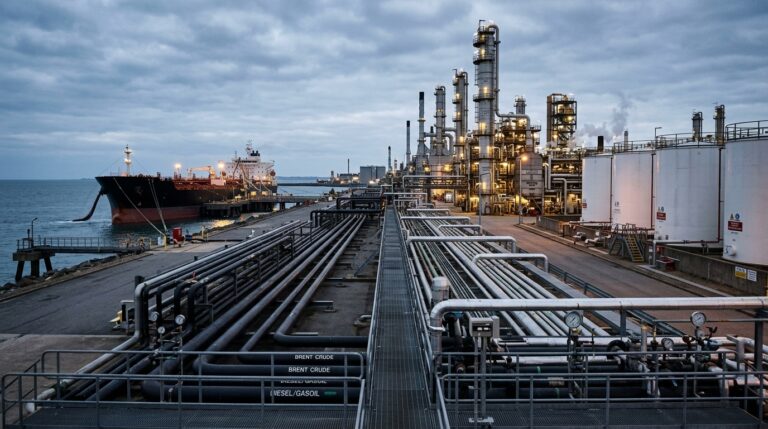
The conflict has caused near-total restriction of traffic through the Strait of Hormuz, leading to what the International Energy Agency characterized as the “largest supply disruption in the history of the global oil market.” Prewar flows through Hormuz were roughly 20 million barrels per day of crude and products, and current flows remain far below that level. U.S. fuel costs have surged in the wake of the war-driven oil shock, with diesel prices spiking to record levels over the Labor Day period.
The diplomatic calendar tightens this further. Trump is expected to meet Gulf leaders on the sidelines of the UN General Assembly in New York next Tuesday to discuss next steps in the Iran war. Those leaders include representatives from Saudi Arabia, the UAE, Qatar, Bahrain, Kuwait and Oman. Iran’s seven conditions land directly ahead of that room.
When Elon Musk ran a Twitter poll in 2021, Tesla lost $30 billion in a single day.
When he changed the Twitter logo to Dogecoin, the coin surged 30% overnight.
No one alive moves markets the way Elon does.
Larry Benedict – the trader who delivered a 279% return on cash in 2025 – says Elon’s next move is his biggest yet.
And there’s ONE ticker, overlooked by almost everyone, positioned to capture it.
Click here to find out what it is before the “Final Phase” begins.
Sector Positioning
The U.S. energy sector has outperformed in 2026, driven primarily by geopolitical-related supply fears, elevated oil prices, and rising demand tied to AI infrastructure buildout. Refiners MPC and VLO have been standout contributors, as crack spreads can widen when supply fears lift refined product pricing faster than crude. MPC currently trades at $424.89 and VLO at $413.28. The integrated supermajors XOM and CVX together represent about 35% of XLE’s portfolio. XOM sits at $163.54, CVX at $209.51, with BMO and Piper Sandler having raised CVX targets to $235 and $243 respectively in early September.
On the tanker side, Frontline sits at the center of a volatile tanker-market cycle, having just reported the strongest quarterly profit in its history. The company posted $943.3 million in second-quarter 2026 revenue and a record $659.2 million in net income, equal to $2.96 per share. Tanker rates have topped $1 million per day for the first time, as the Hormuz crisis creates a shortage of vessels willing to enter the Persian Gulf.
Scenario Modeling
Bull Case (Brent $112-$120+): Trump rejects Iran’s conditions, or the conditions collapse before Tuesday’s Gulf summit. Goldman Sachs has flagged Brent potentially reaching $120 per barrel in an upside scenario where shipping attacks broaden and intensify. XLE, FRO and tanker equities extend their 2026 outperformance; crack spreads sustain elevated refiner margins for MPC and VLO.
Base Case (Brent $95-$105): Back-channel talks continue through the UNGA week without resolution. Sharp selloffs occur whenever diplomatic signals briefly raise hopes of resumed oil flows, but the net result has been a choppy, upward-biased pattern consistent with a market still pricing a substantial geopolitical risk premium. XLE range-trades; FRO holds elevated freight income.
Miss These 10 Stocks… Miss the Rally
What are the “Double Engine” stocks for the rest of 2026? Instead of settling for income or growth, these are stocks that deliver both. Our Top 10 Best Stocks to Own in the Second Half of 2026 report includes companies that are the perfect combination of steady payouts and explosive capital appreciation potential – all in one portfolio-ready list. This is how you position ahead of a market tailwind.
Bear Case (Brent $78-$85): Trump accepts a framework based on Iran’s conditions, or Qatar announces an interim ceasefire before the Gulf summit. Goldman has sketched a downside path toward roughly $80 a barrel if regional exports return to normal. A return toward normal tanker traffic through Hormuz would allow Gulf refineries to increase exports and improved crude availability to East Asian refiners would further compress international crack spreads. MPC and VLO face meaningful margin compression; tanker rates collapse from $1 million per day back toward pre-war norms.
Active Trader Strategy Framework
The asymmetry here is not symmetric. Brent at $103 already contains a war premium; the downside on a deal is sharper than the upside on further escalation. Traders holding long XLE into Tuesday’s Gulf summit carry event risk in both directions. Key levels to monitor: Brent $105 resistance and $100 as a round-number psychological floor. A daily close below $100 on credible ceasefire language would expose $88-$90. FRO and tanker equities are levered directly to Hormuz transit volume; any confirmed acceleration in crossings versus recent averages warrants reassessment of long positions. For refiners, watch crack spread data: today’s margins in MPC and VLO price in limited near-term supply recovery; any easing in distillate premiums is a leading signal before the equities move.
Preparation, not prediction, is the framework. Iran’s seven conditions exist. Washington’s answer does not yet. That gap is where this week’s oil trade lives.