
September 20, 2026
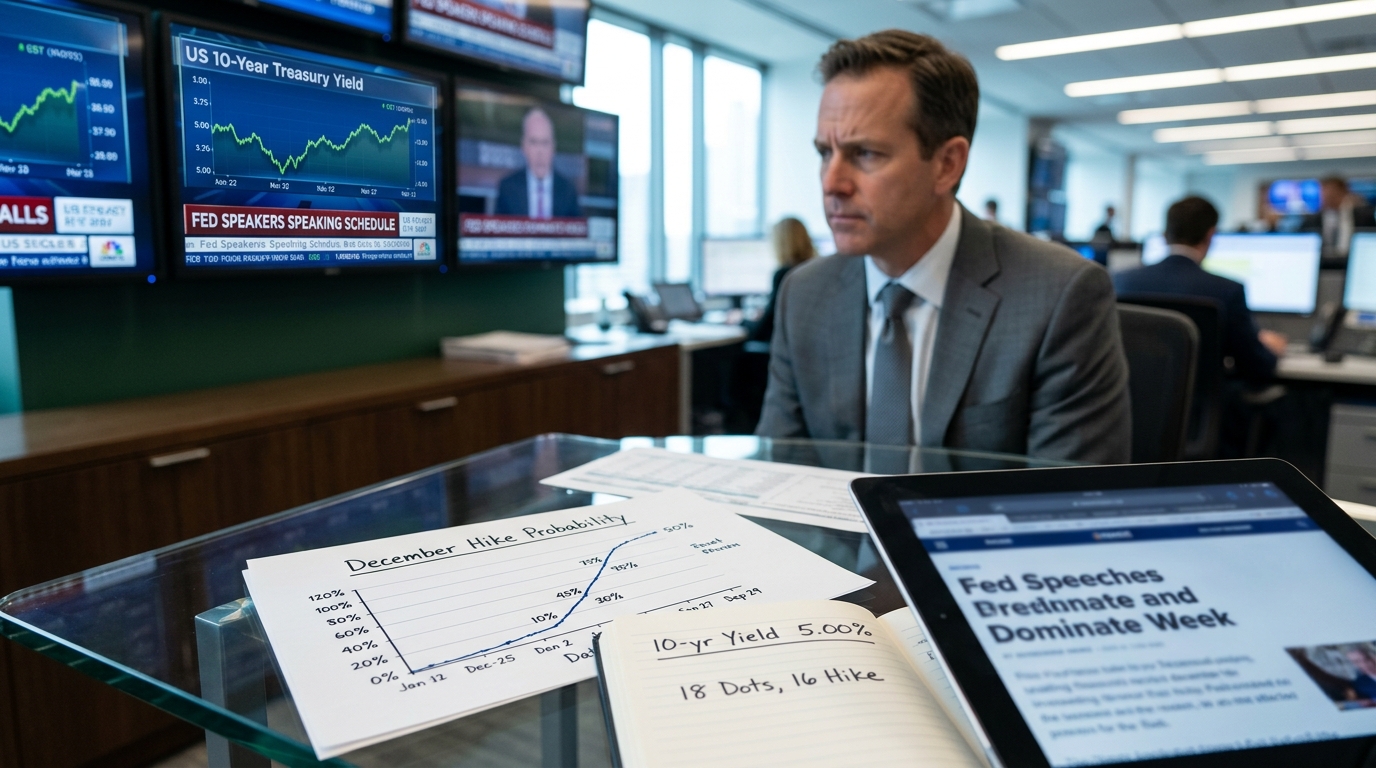
With the 10-year back at 5.00% and 16 of 18 dots calling for another hike, this week’s Fed commentary is the market.
The Federal Reserve hiked 25 basis points on September 16, lifting the federal funds target range to 3.75%–4.00% in a unanimous 12-0 vote. That part was priced. What was not priced with precision was the duration of the sentence: 16 of 18 policymakers saw at least one additional increase in 2026, the median year-end dot settled at 4.1%, and the 2027 median held at 4.1% as well, compared with June’s projection of 3.6% for 2027. The committee did not just hike. It removed the off-ramp.
The Window Is Open. It Won’t Be Open Much Longer.
Some analysts see gold moving above $6,000 if current monetary conditions hold. Others disagree. What is not in dispute is that central banks are accumulating, major banks are recommending, and the policy environment is unusually fluid. Reagan Gold Group’s free guide lays out the case so you can judge it yourself.
- Fed funds target range raised to 3.75%–4.00%, first hike since July 2023; vote 12-0
- 16 of 18 dots project at least one more 25bp hike in 2026; four see two additional moves
- Median 2026 PCE inflation forecast revised to 3.7%; longer-run rate ticked up to 3.2%
- 10-year Treasury yield closed Friday at 5.00%, up 35bp over the past month and 87bp year-over-year
- TLT trades near $81.25, within 1% of its 52-week low of $80.46; 52-week high was $92.19
- XLF closed the post-hike week near $55.86, off its 52-week high of $58.60; IWM sits near $284.10, down roughly 7% from its August peak of $305.18
- 10 Fed appearances this week; no CPI, no payrolls, no PCE until September 30
What the Calendar Actually Means
This week carries no tier-one data. August PCE lands September 30. The next payrolls report is weeks away. CPI is not on the docket. What the September 21–25 calendar does carry is roughly ten Fed speaking engagements, the first public comments from FOMC members since Wednesday’s decision. That makes committee dispersion the only new information available to price.
The pre-meeting public record already revealed a real split. Governor Christopher Waller argued on September 3 that three-month annualized core PCE had fallen from 4.76% in February to 3.05% through July, a trajectory he called encouraging, and said he was inclined to support holding rates. Chair Kevin Warsh pushed back explicitly, saying at the September 16 press conference that softer monthly readings “do not tell me that underlying trends have meaningfully improved.” Warsh prevailed, in the sense that the committee delivered the hike and the dot plot tilted hawkishly. The vote was still unanimous. But Waller and Vice Chair for Supervision Michelle Bowman now speak this week carrying known dovish credibility inside a unanimously hawkish result. The gap between those two things is where the December trade lives.
Goolsbee opens Monday. Waller and Bowman both appear on the Fed’s published calendar for the week. Each appearance should be read as a real-time signal about how firmly the committee will support a December move. A Waller who sounds reconciled to further tightening closes the debate. A Waller who re-emphasizes disinflation progress reopens it and matters directly for long-duration positioning.
America’s Emergency Oil Reserve Is Running Low
The Strategic Petroleum Reserve was built for energy supply shocks, but today, that emergency cushion is at a fraction of its capacity. What happens to retirement savings if the next shock arrives unexpectedly, and the reserve runs to zero? America’s Gold Company created a free, no-pressure guide explaining why some savers use precious metals to prepare for this uncertainty.
Sector and Instrument Framework
TLT, near $81.25 and barely above its 52-week low of $80.46, is pricing a prolonged high-rate environment. The fund’s average duration of 16 to 17 years means any credible signal that December is not a certainty would produce an outsized price recovery. The opposite is also true: a uniformly hawkish speaker circuit would press TLT toward and potentially through the $80.46 floor.
XLF, at roughly $55.86, has underperformed SPY by more than 11 percentage points over the past year despite a steep curve that nominally benefits bank net interest margins. The problem is credit quality, not spread. At 4.0% on the short end with the 10-year at 5.00%, the curve is no longer the issue for financials. Loan books are. IWM, at $284.10 and roughly 7% below its August high, is the instrument most sensitive to whether higher-for-longer becomes restrictive-for-long. Small-cap balance sheets carry more floating-rate debt than large-cap peers; a December hike to 4.25% extends the refinancing stress without a corresponding earnings offset.
Scenario Framework
Bull Case
Waller and Bowman signal that September’s unanimous vote reflected August data rather than a commitment to December. The 10-year rallies from 5.00% back toward 4.75%. TLT recovers toward $84–85. IWM recovers above $295 on reduced refinancing risk. XLF stabilizes near $57 as credit fears moderate.
5 Little-Known Stocks Behind Today’s Defense Tech Shift
Behind the headlines, a major transformation is underway.
Modern warfare is being driven by AI, autonomous systems, and next generation technology. A handful of lesser known companies are helping power this shift.
This report uncovers five stocks quietly playing a critical role in the future of defense.
Base Case
Speakers acknowledge the hike was appropriate but avoid forward commitment, consistent with Warsh’s stated preference for reducing explicit guidance. The 10-year holds 4.90%–5.05%. TLT trades in a $80–83 range. Equity markets digest the rate level without a directional break; IWM consolidates between $280 and $292.
Bear Case
Multiple speakers, including Waller, fall in line with the dot plot and reinforce December as a near-certainty given the Atlanta Fed’s GDPNow third-quarter real GDP estimate of 5.1% and August retail sales that rose 1.2% versus a 0.8% consensus expectation. The 10-year breaks above 5.10%. TLT tests and potentially violates the $80.46 52-week low. IWM breaks below $280. XLF faces selling pressure as the market prices deeper credit deterioration into 2027.
Active Trader Positioning Considerations
The framework this week is asymmetric: ten speakers, each one a binary read. Waller speaks first and matters most given his pre-meeting public tilt toward holding rates. Monitor the exact language on three-month core PCE trends. If he cites that metric favorably again, duration longs in TLT warrant sizing. If he defers entirely to the dot plot, reduce duration exposure and watch IWM’s $280 level as a structural test. Volatility is structural, not episodic. As noted, the Fed under Warsh has deliberately reduced forward guidance, meaning fixed-income volatility will remain elevated regardless of this week’s outcome. Position sizing should reflect that the ten-year at 5.00% is doing economic work that hasn’t fully shown up in credit data yet. Preparation over prediction remains the only durable framework here.