
September 24, 2026
Bonus Content: Refiner Stocks Face Policy Risk From Both Sides
Dear Reader,
President Trump is on a mission:
“I never want Americans to pay higher electricity bills because of data centers.”
“Big Tech must pay their own way.”
And he’s backing it up as seven of the richest companies on Earth are now on the hook for their share of a $1.4 TRILLION power grid upgrade.
30 states are already enforcing it.
More than 300 bills were filed in state houses in the last year alone.
And now, for investors who make one move by November 16th…
You can turn their state-mandated expenses into growing retirement income for decades to come.
Good investing,
Marc Lichtenfeld
Chief Income Strategist, The Oxford Club
Refiner Stocks Face Policy Risk From Both Sides
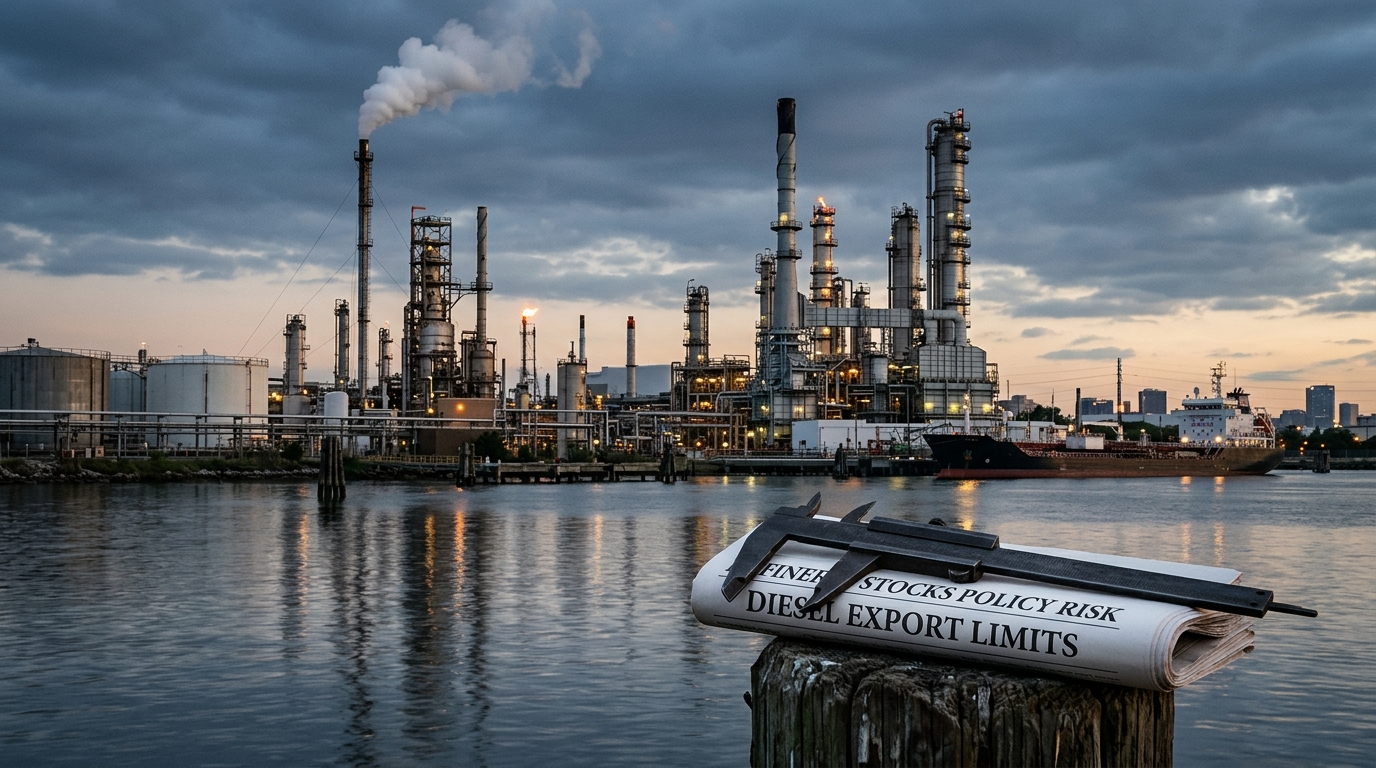
The policy environment for U.S. refiners changed materially on Tuesday, and the equity market has not caught up yet. Two separate developments at the United Nations General Assembly in New York delivered simultaneous pressure on the economics underpinning Valero (VLO), Marathon Petroleum (MPC), and Phillips 66 (PSX). Treasury Secretary Scott Bessent confirmed the administration is examining a diesel export restriction, telling reporters the team is studying “whether it’s feasible in terms of the overall refining capacity and whether a full or partial ban would work.” Trump said a decision would come “fast, one way or the other.” In the same venue, Ukrainian President Volodymyr Zelensky told reporters Kyiv is prepared for “any kind of format of energy ceasefire” if Moscow stops targeting Ukrainian energy infrastructure. Russia’s position remained unclear as of Wednesday.
Both developments point directly at the crack spread. That single variable drove everything.
What Built the Trade
The refiner rally in 2026 is built on one of the more extreme product margin regimes in recent history. The U.S. ultra-low-sulfur diesel crack spread surpassed $100 per barrel this month, reaching a record high around $102 per barrel. Marathon Petroleum posted refining and marketing margins of $36.33 per barrel in Q2, versus $17.58 a year earlier. Valero’s Gulf Coast ultra-low-sulfur diesel margin reached $43.52 per barrel. Phillips 66 reported Q2 adjusted EPS of $9.41, generating $52.04 billion in quarterly revenue.
Valero’s margin expansion didn’t happen in isolation — it was the product of a months-long setup that technical traders began flagging well before the UNGA headlines. For context on how the crack spread story translated into price action for this specific name, the earlier breakdown of Valero’s breakout and what traders were watching captures the conditions that preceded these record margin prints.
The S&P 500 Oil and Gas Refining and Marketing sub-industry group has gained 104% year-to-date and sits 41% above its 150-day moving average, a condition that has appeared only five times historically. Analyst price targets now sit an average of 31% below current share prices across the group.
The supply logic behind those gains is clear: Ukrainian strikes on Russian refineries and the U.S.-Iran conflict disrupted product flows across major global routes. Earlier this month, Bank of America analysts estimated roughly 7% to 8% of global refining capacity was offline. U.S. distillate exports helped fill the gap, with recent levels running around 1.5 to 1.6 million barrels per day.
That offline capacity figure sits inside a broader earnings story that reshaped the entire sector’s profit profile. The scale of the windfall — and the question of whether markets were pricing a peace scenario too aggressively — is examined in the analysis of Big Oil’s best earnings quarter since 2022 and what comes next, which covers Exxon, Chevron, and Shell’s combined daily profit figures alongside the Brent trajectory.
Two Compression Paths
A domestic export restriction is the more immediate threat. U.S. refineries produce roughly 5.3 million barrels of distillates daily against domestic demand near 3.6 million. That surplus is the entire export business. The American Petroleum Institute warned that blocking it would force refiners to flood domestic storage or cut crude runs, with API CEO Mike Sommers stating it would “only compound the problem.” Because diesel and gasoline are co-products of the same refining run, reduced throughput would tighten gasoline supply simultaneously, pushing both prices higher rather than lower. Energy Secretary Chris Wright said Wednesday that an outright diesel export ban would not work and could push up gasoline and jet fuel prices, and the policy question remains live ahead of November midterm elections.
The ceasefire path is softer but structurally similar. Kyiv has relied on deep strikes against Russian refining capacity as leverage in negotiations. If that campaign pauses and Russian throughput recovers, global diesel supply eases and crack spreads compress from the supply side rather than the demand side. Zelensky acknowledged he does not know Moscow’s position; U.S. envoys Steve Witkoff and Jared Kushner have been involved in shuttle diplomacy between Russia and Ukraine, but no confirmed meeting between Secretary of State Marco Rubio and Foreign Minister Sergey Lavrov was scheduled for Wednesday.
Scenario Framework
Bull Case: The export restriction fails Bessent’s feasibility review, the energy ceasefire collapses as quickly as prior attempts, and Russian refinery attacks resume. Crack spreads hold above $100, and the long trade reopens with reduced policy uncertainty. Thursday’s EIA inventory data, with U.S. distillate inventories about 13% below the five-year seasonal average in the latest weekly data, confirms physical tightness as the near-term margin signal.
Base Case: The administration settles on a partial or voluntary framework rather than a hard ban. The ceasefire proposal stalls on Moscow’s non-response. Spreads compress modestly from peak levels but remain structurally elevated. VLO and MPC consolidate; PSX’s midstream and chemicals segments provide relative insulation.
Bear Case: A formal export restriction is announced before October, removing approximately 1.5 million barrels per day from global trade. Crack spreads collapse below $60 per barrel, institutional rotation out of the refining sector accelerates, and a rally that outpaced every Magnificent Seven stock faces its first structural reversal.
Tactical Positioning Considerations
The asymmetry here favors reducing or hedging existing long exposure in VLO and MPC ahead of a formal policy announcement. Both carry the heaviest direct export revenue exposure. PSX’s diversified segment mix makes it the most defensible position in a restriction scenario.
Understanding where VLO’s risk-reward stood before the policy headlines arrived helps calibrate how much the trade has already moved. The setup heading into this week — including the crack spread level that defined the prior entry point and the Q3 earnings catalyst on the calendar — is laid out in the trade framework published when VLO hit its all-time high and crack spreads were near $59, which provides a useful baseline for sizing any hedge against current levels.
Monitor crack spreads in real time. A sustained break below $60 per barrel on confirmed restriction implementation is the clearest institutional rotation signal. Conversely, a failed ceasefire accompanied by resumed Russian refinery strikes reopens the long side with less headline risk attached. The physical market remains tight regardless of Washington’s next move. Preparation for both outcomes, not conviction in either, is the correct posture here.