September 27, 2026
Bonus Content: Data Centers Are Building Power Plants. Permits Are the Bottleneck.
A message from America’s Gold Company
URGENT ALERT
Your Retirement Has a $40 Trillion Problem
America’s debt just reached a level no nation has ever seen, and paper savings sit directly downstream.

If you have a 401(k), IRA, or TSP, and it sits entirely in paper assets, then every dollar of it depends on the strength of a currency now backed by nearly $40 trillion in debt.
According to U.S. Treasury data, the national debt is closing in on $40 trillion. More than any nation has ever owed. And with long term borrowing costs at some of their highest levels in years, Washington is paying real money just to service what it already owes.
But here is what most people are not being told: a government this deep in debt rarely defaults loudly. History suggests it quietly pays its bills with dollars that buy less, year after year. And the savings built on those dollars feel it first.
One bad year. One shock. One crisis of confidence.
History shows how quickly paper savings can give back years of gains, and how long rebuilding can take.
There is a way savers have historically prepared, and it is available to you right now.
Long standing IRS rules generally allow you to move a portion of your retirement savings into physical gold and silver, a time tested store of value, and you may be eligible to do it without triggering taxes or penalties.
Everything you need to know is laid out in the FREE Precious Metals Retirement Guide from America’s Gold Company. Download your free copy here!
Inside, you will learn how the process generally works, who may qualify, and the specific questions to ask before moving a single dollar. The guide is free, with no obligation of any kind.
Yes, Send Me the FREE Precious Metals Retirement Guide!

Free to Claim. Includes Retirement Rollover Basics, Step by Step.
100% free. No credit card. Delivered straight to your inbox.
Or speak with a precious metals specialist at 1-888-691-8238.
Data Centers Are Building Power Plants. Permits Are the Bottleneck.
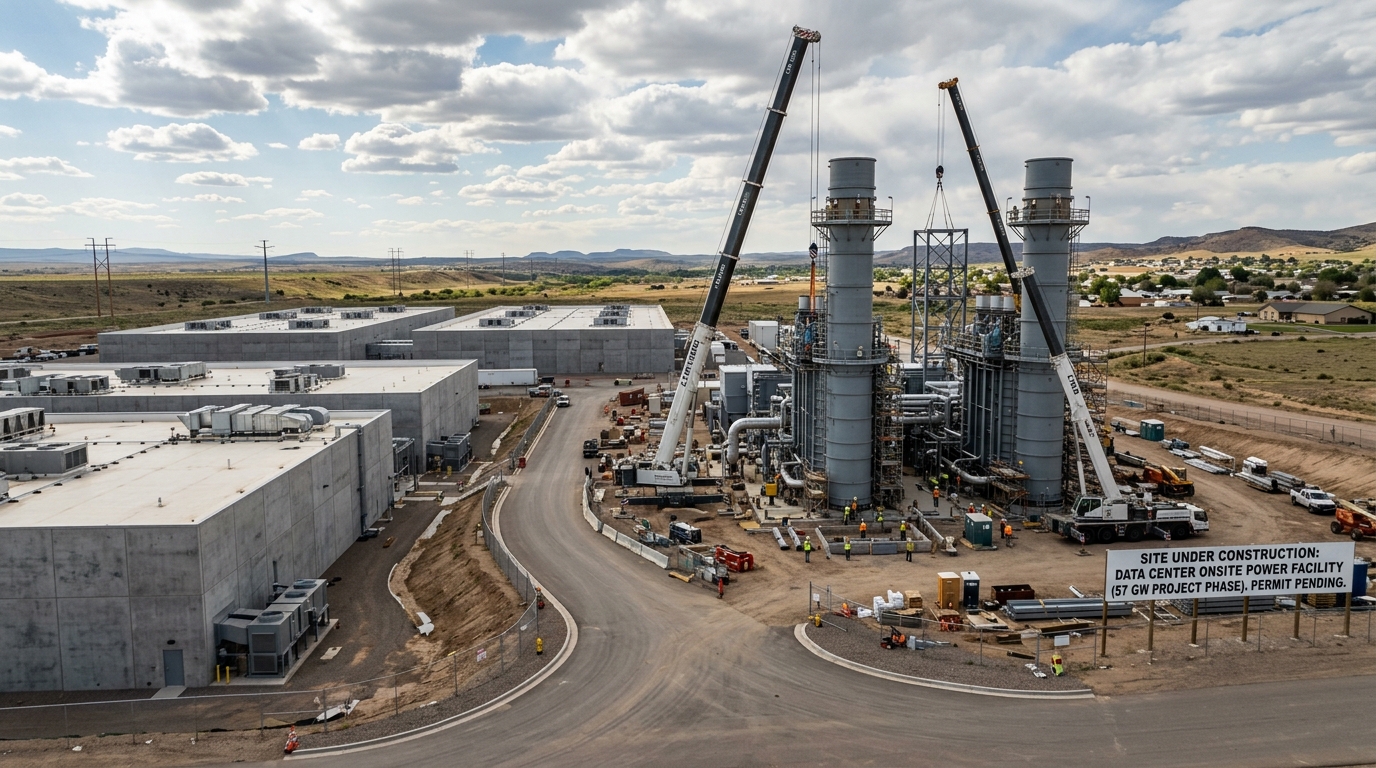
The grid queue is no longer the binding constraint for AI data centers. The air permit is.
The scale of the shift is not subtle. As of 2026, data center developers have announced approximately 101 gigawatts of behind-the-meter natural gas generation capacity in the United States. Over 57 gigawatts have already publicly disclosed equipment orders, and approximately 7 gigawatts are already under construction. That buildout is not happening because developers prefer burning gas on-site. It is happening because the alternative is a five-to-ten-year wait. Data centers can be built in about a year, but transmission projects can take over a decade to complete. A 1 GW microgrid powered by natural gas begins operations within 24 months.
Williams Companies is the clearest proof that midstream is now in the power business. Williams has said its Socrates North and Socrates South projects in New Albany, Ohio target in-service dates in the third and fourth quarter of 2026, with each phase sized at 200 MW. The company now has $5.1 billion committed to modular gas-fired or hybrid plants aimed at serving fast-growing data center loads. Williams’s market cap has been hovering in the mid-$80 billions in late September 2026 and briefly touched about $90.7 billion earlier in September 2026.
But the xAI Colossus situation near Memphis shows exactly where this model breaks. Public filings tied to the Colossus 2 controversy have described dozens of turbines and several hundred megawatts of capacity at the Southaven site, but the specific claim of 1,498 MW of operating gas turbine capacity for Colossus 1 and 2 cannot be verified from the public record available. The problem: much of that capacity ran without permits. Reporting and public documents around the dispute indicate xAI moved to secure permits while turbines were already operating, and Mississippi regulators approved a permit authorizing 41 permanent gas turbines in March 2026 after a public hearing process. xAI planned to run 41 gas turbines at its Colossus 2 site in Southaven, Mississippi, a facility that would rank as one of the largest fossil fuel power plants in the state.
Regulators are now the variable that models cannot price. The penetration of behind-the-meter and hybrid solutions in new-build projects is expected to expand from around 10-20% in 2025 to around 50-60% by 2030. Meanwhile, Microsoft’s partner Nebius signed a multi-year agreement in September 2025 for AI infrastructure capacity delivered from a new data center in Vineland, New Jersey, with deliveries starting later in 2025 and growth planned through 2026. However, the specific claim that the agreement was a $17.4 billion deal and that seven of nine compute tranches depend on a 400 MW on-site gas plant coming online in 2026 cannot be verified from primary disclosures.
Three Scenarios Traders Should Price
Bull Case: Behind-the-meter projects account for roughly 40% of installed capacity and imply approximately 1.3 Bcf/d of incremental natural gas demand by 2030. Williams, Kinder Morgan, and Energy Transfer compound earnings through decade-long fixed-price PPAs as each new permit clears. Midstream multiples re-rate toward utility-scale valuations.
Base Case: Cumulative behind-the-meter capacity reaches 5 GW by end of 2027 if permit delays persist, versus 13 GW if all projects with signed tenants meet their timelines. Execution is lumpy. Capital rotates toward the handful of operators with established permitting track records rather than the sector broadly.
Bear Case: Lead times for certain turbine classes have stretched deep into multi-year territory as OEM backlogs build. Simultaneous permit challenges and equipment scarcity compress the speed advantage that justified the entire behind-the-meter premium. Hyperscalers pivot back toward grid interconnection and SMR partnerships, stalling midstream power revenues before they compound.
What Traders Should Watch
The trade here is not on the data center operators. It is on the companies supplying the fuel and the turbines. Air permit decisions, state legislative sessions, and turbine OEM delivery schedules are the leading indicators. A permit denial in a dense market like Northern Virginia or New Jersey is an immediate negative catalyst for any developer with concentration there. A clean approval accelerates the revenue clock on a decade-long PPA. Monitor those dockets the way equity desks monitor earnings calendars.