October 2, 2026
Microsoft, Google, and Amazon signed the deals. The NRC still controls the timeline.
The announcements read like a done deal. Microsoft, Google, Amazon, and Meta have collectively committed more nuclear capacity in the last 18 months than the United States signed in the previous two decades. Hyperscalers have committed about 9.8 GW of nuclear capacity to AI infrastructure across 13 announced deals as of May 2026, according to third-party deal trackers. The gap between that number and actual electrons reaching a server rack is where traders need to focus.
Elon’s $480 Trillion Currency Masterplan
He’s waited 27 years for this moment. Elon Musk just launched his biggest disruption ever, which could totally reset how millions of people access their money and even pay tax.
As of July 2026, the only clearly contracted capacity that is already generating on the grid is tied to Amazon’s expanded power purchase agreement with Talen Energy for up to 1,920 MW from the Susquehanna nuclear plant, signed in June 2025. But the deal’s “front-of-the-meter” transition depends on transmission reconfigurations that Talen has said it expected to complete in spring 2026, so the key point remains: most announced hyperscaler nuclear megawatts are not yet delivering incremental, traceable, near-term power.
The Regulatory Ladder Is Steeper Than the Headlines Suggest
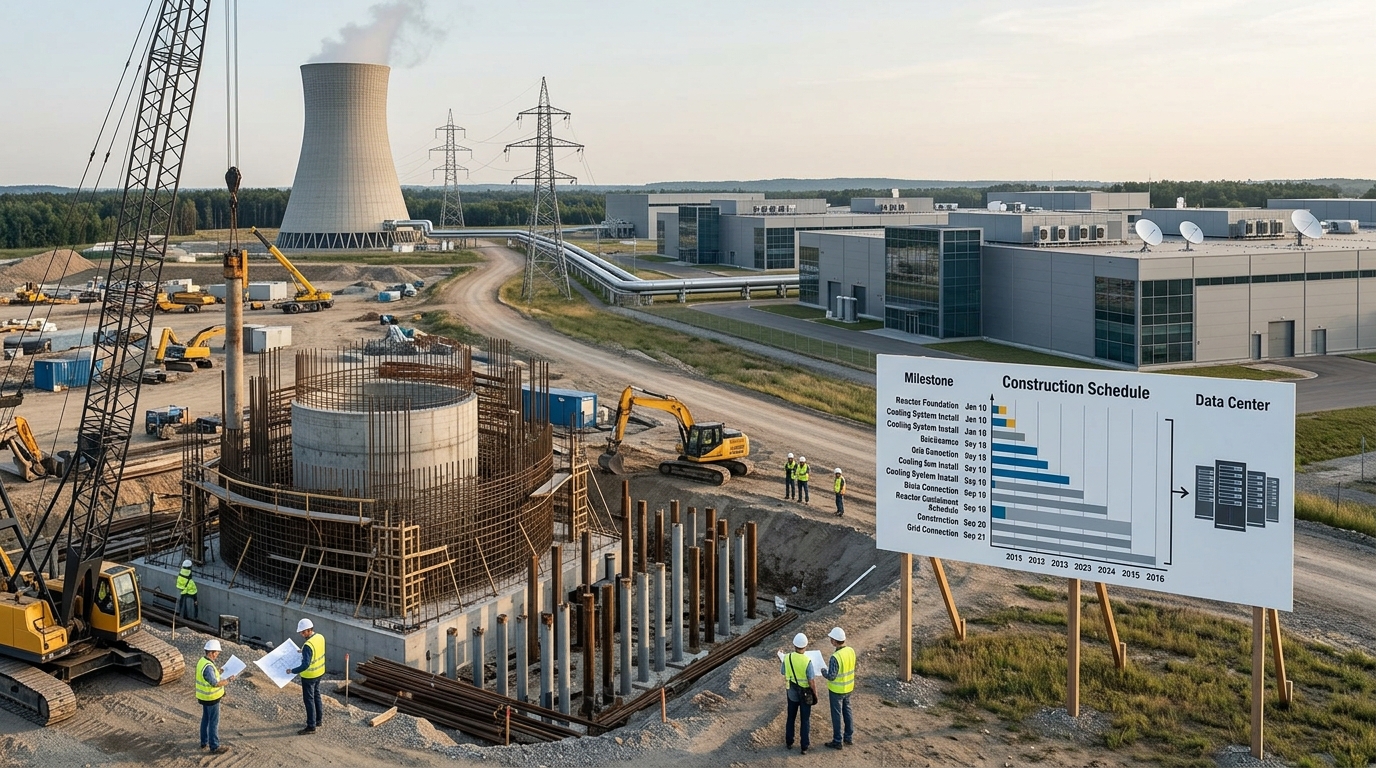
The NRC’s licensing sequence is sequential, not parallel. Design certification, construction permit, operating license, commissioning: each phase adds years. Design certification alone can take several years of NRC review; construction permits can take additional years for site review; construction itself typically runs multiple years; then commissioning adds more time. Taken together, a first-time design without an existing certification can easily be a decade-plus from application to commercial power, even without major delays.
The closest thing to a proof point is TerraPower’s Natrium plant in Kemmerer, Wyoming. The NRC approved the construction permit on March 4, 2026, roughly 22 months after the NRC docketed the application in May 2024. TerraPower then marked the start of nuclear construction activity at Kemmerer on April 23, 2026. Construction is expected to be complete in 2030. That is also four years after permit approval, for a project that still needs a separate operating license before it generates commercial power. The NRC has also been explicit that a separate operating license application must be submitted and approved before the facility can operate, and TerraPower has said it anticipates submitting its operating license application in 2028.
Even the fastest mover in the space is illustrating the gap between construction permit and commercial operation.
Project-by-Project Delivery Math
Microsoft holds the most advanced deal: a 20-year power purchase agreement with Constellation Energy tied to the restart of Three Mile Island Unit 1, now the Christopher M. Crane Clean Energy Center, with output marketed at roughly 835 MW and a targeted restart as early as 2027. That deal works because it involves restarting an existing reactor, not building a new one. The existing infrastructure, cooling systems, and transmission lines reduce deployment time versus new construction.
The Tech IPO Set to Be 41X Bigger Than the Google, Microsoft, and Amazon IPOs Combined
Nvidia, Google, Amazon are all loading up on shares.
Here’s a secret backdoor in for regular investors. [Free Ticker]
Everything else is materially further out. Google’s 500 MW deal with Kairos Power targets a fleet totaling up to 500 MWe by 2035, with the first deployment by 2030. Kairos’s Hermes 1 test reactor received its NRC construction permit on December 14, 2023, with an original latest date for completion of construction of December 31, 2026. In 2026, the NRC amended the permit to extend that completion date to April 30, 2029, pushing the demonstration schedule deeper into the 2029 window. Google’s commercial fleet timeline is therefore still anchored in the early 2030s, with the first fleet deployment starting in 2030 dependent on iterative milestones staying on track from here.
Amazon’s X-energy Cascade project at Richland, Washington tells a similar story. Amazon, Energy Northwest, and X-energy have described the Cascade Advanced Energy Facility as targeting construction by 2030, with operations in the 2030s. The NRC’s environmental review for Dow and X-energy’s Seadrift, Texas construction permit application was completed in May 2026, but that is an environmental milestone for a separate site, not a construction permit for the Amazon Cascade facility itself.
Oklo, which Meta has backed for a 1.2 GW campus in Pike County, Ohio, has publicly described the agreement as supporting plans to develop that 1.2 GW campus. Oklo remains in NRC pre-application engagement for its Aurora powerhouse approach, so the timeline remains driven by when a complete application is submitted and accepted for formal review.
FOAK Economics: The Cost Anchor the Market Ignores
History is instructive here. NuScale’s Carbon Free Power Project at Idaho was terminated in November 2023 after years of development and escalating cost estimates, and the Department of Energy’s Inspector General has documented a $1.36 billion cost-share award associated with that effort. The broader point for traders is unchanged: first-of-a-kind projects regularly arrive with a higher capital intensity than early marketing suggests, and schedules tend to lengthen once licensing, supply chain, and construction realities hit.
The regulatory calendar is also tightening where it matters. The NRC’s new Part 53 technology-inclusive framework was finalized in March 2026 and became effective in late April 2026, making it available to applicants. But shorter pathways still require a complete application, and most commercial SMR designs tied to hyperscaler deals have not yet submitted one in a form that is docketed and moving through a defined review clock.
Scenario Modeling
Bull Case: Part 53 applications from X-energy and Kairos move through accelerated reviews without major revision requests, NuScale secures a new offtaker for its certified design, and TerraPower’s Kemmerer plant reaches commercial operation by late 2030 as scheduled. Nuclear equity premiums across Constellation, Oklo, and Kairos-adjacent names hold or expand. Key level: TerraPower reaching its operating license application by 2028.
AI Breakthrough Could Soon Reorder Stock Market Winners and Losers
For years, we’ve been led to believe the tech firm operating at 500 Howard Street in Silicon Valley is “one of the good guys.” But will the advanced form of AI that just emerged from this location change the way we live, work and invest forever? Marc Chaikin reveals the time-sensitive details of this discovery and offers you a FREE 3-part playbook to protect your future.
Base Case: Constellation’s Crane Clean Energy Center restart delivers roughly 835 MW in 2027 as planned. Google’s first Kairos fleet deployment remains anchored around 2030, with broader fleet scaling paced into the early 2030s as Hermes milestones de-risk. Amazon’s Cascade facility breaks ground around 2030 with power no earlier than the early-to-mid 2030s. Most SMR deployments tied to data center load cluster in the early to mid-2030s. Nuclear names trade on sentiment and contract news rather than near-term earnings contribution.
Bear Case: A first-of-a-kind cost overrun at Kemmerer, echoing the Vogtle experience that ended up more than $35 billion and roughly seven years late, spills into sector-wide multiples. NRC staff requests on Part 53 applications extend review timelines materially. Hyperscalers accelerate their behind-the-meter gas builds as the interim bridge, redirecting capital from nuclear suppliers to turbine makers.
Active Trader Framework
The opportunity in this space is being priced on announcement cadence, not megawatt delivery. Constellation Energy (CEG) is the only name where hyperscaler-linked nuclear revenue has a plausible pathway to materialize before 2030. The Crane Clean Energy Center restart, at roughly 835 MW, is the most visible near-term “permit to power” catalyst tied to a hyperscaler-style contract. Everything else is a 2030-plus option priced today.
Watch the next concrete NRC milestones, not broad timelines. For X-energy, the Dow Seadrift docket is the closest regulatory analog traders can monitor for pace and friction, but it is not the Cascade permit itself. Oklo’s combined license pathway, still in pre-application engagement as of October 2, 2026, is the signal for Meta’s Ohio campus timeline. Until a complete application is formally docketed, the 1.2 GW commitment is contractually real but operationally abstract.
Position sizing should account for the distance between permit and power. A construction permit is not a kilowatt-hour. Disciplined traders will keep that distinction at the center of every nuclear thesis.