October 15, 2026
Bonus Content: Ukraine Is Striking Russian Refineries Again. Diesel Traders Need to Move Fast.
At a time when copper demand is growing, a long-dormant copper property is about to thrust one little-known mining company into the spotlight.
It’s all happening in Canada’s Yukon territory, an area with a rich mining history and the kind of infrastructure and friendly regulatory environment that mining companies fight tooth and nail for.
In the case of copper mining, there is one area that has more than a century of history with past production of over 265 million pounds and yet there’s still more to be discovered.
And it couldn’t have happened at a better time.
Countries need copper to build their power grids and move away from fossil fuels.
Tech giants need copper to power their data centers.
And new mines just aren’t coming online at the pace they need to in order to keep up with that kind of surging demand.
It’s a reality the market is only just beginning to wake up to, and that fact is showing up in the price of copper as it marches steadily toward new all-time highs.
One mining company with assets in that storied Yukon territory is perfectly positioned to seize the opportunity to become a leading name in the copper mining industry thanks to district-scale projects that have produced exceptional results in the past.
Some of these areas haven’t been explored or drilled in over 40 years because of price collapses. But with demand resurging and mining technology having advanced in the time since, now is the time for this area to come back into the conversation.
Results so far have already been promising. Recent results have turned up thick, continuous zones of mineralization that have not only confirmed what past drillers knew, but have expanded beyond that and into new territory.
So this company is only just getting started.
Thanks to its robust treasury, experienced leadership, and ongoing work, it’s well-positioned to profit from rising copper demand into the foreseeable future.
Now’s the perfect time to buy in before more traders become aware of it.
You can learn more about how to do that in our brand-new FREE report where we go over the company, its history, its current assets, and its plans for the future in the unfolding copper bull market.
Click here to access the report now, before time runs out and more people learn about this opportunity.
Ukraine Is Striking Russian Refineries Again. Diesel Traders Need to Move Fast.
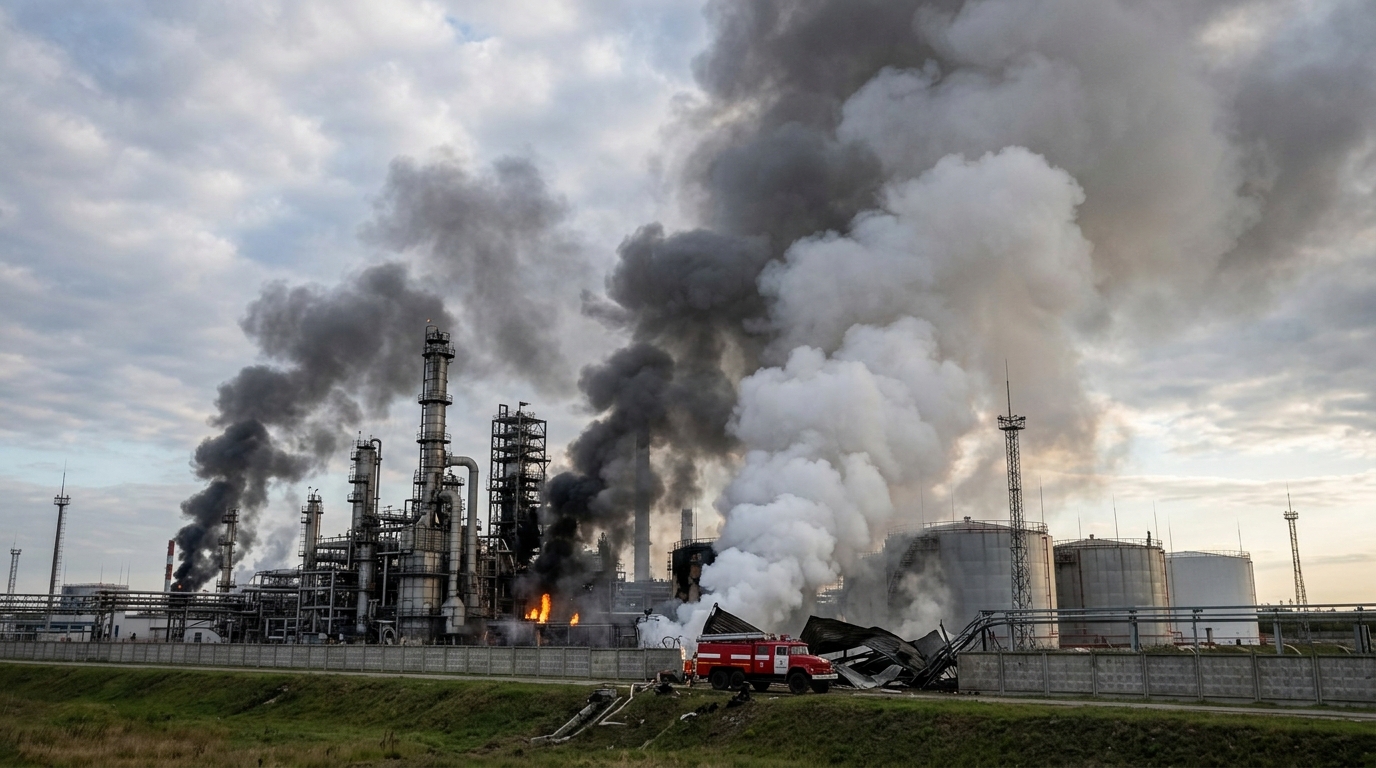
The market spent the last fortnight pricing in a diplomatic solution to the worst refining shortage in a generation. That solution is now void. Ukraine will resume strikes on Russian oil refineries in response to deadly attacks by Moscow, President Volodymyr Zelensky told the Financial Times. “The block [on attacking refineries] is out. We’re done,” Zelensky said in an interview with the Financial Times published Thursday. For distillate traders, this is the only number that matters this morning.
The Macro Backdrop
Brent crude traded near $104.4 a barrel on Thursday October 15, down about $1.63, or 1.5 percent, from Wednesday’s settlement of $106.06. That selloff had nothing to do with supply improving. The trigger was a Reuters report that Washington is weighing easing sanctions on some “shadow fleet” tankers to bring down record freight rates. API data shows a sharp 11.12 million-barrel weekly draw in U.S. crude inventories, contrasting with expectations for a 1.9 million-barrel build. The crude floor is firm. It is the refinery margin where the real volatility is concentrated.
Zelensky told the FT that he had paused energy strikes for three days to comply with an “energy ceasefire” announced by Trump on Sunday, but that Moscow had continued to hit Ukrainian energy infrastructure. The Kremlin said Trump did not specify exactly what the energy ceasefire is supposed to cover. Peskov was asked whether Russian strikes on Ukraine’s energy facilities mean Moscow is dissatisfied with Trump’s statement. He replied that the statement had not been specific. With ambiguity on both sides now replaced by an explicit Ukrainian declaration, any positioning premised on Russian diesel flows resuming materially is exposed.
The Distillate Position
NYMEX ultra-low-sulfur diesel futures closed at $4.696 a gallon on October 12, putting the diesel crack over Brent at $91.16 a barrel. That was already off the September average. The diesel crack averaged $110.84 a barrel in September 2026, an all-time monthly high. Principal Asset Management flagged record distillate crack spreads, citing tight refined-product supply as well as Strait of Hormuz risks. Over 12 months, the WTI 3-2-1 crack spread climbed about 183%; the NYMEX ULSD crack spread stood 4.5 standard deviations above its 10-year mean.
The crack gave back ground on October 9 when the Trump-Putin diesel deal first crossed. The NYMEX front-month ULSD crack tumbled October 9 after Trump said Russia would supply additional diesel to the market. At 1933 GMT, the NYMEX ULSD crack was down $6.45/barrel on the day to $96.80/b. Zelensky’s statement this morning reopens that $6-plus gap as the likely direction of travel. Without a ceasefire with Ukraine on attacking each other’s energy infrastructure, the diesel agreement between Putin and Trump is largely for show, rather than representing a genuine increase in the volumes of Russian diesel on the global market.
Russian Refining: The Supply Picture
In June, Russian refinery throughput fell to 3.8 mb/d, its lowest level in more than 20 years and roughly 30% below a year earlier. Diesel production is estimated to have fallen by nearly 30%, prompting the government to restrict fuel exports to protect domestic supplies. In the first eight months of 2026, a Russian refinery was hit on average once every three days. The three-day ceasefire changed none of that structural damage. Strikes resuming today simply accelerate the timeline for the next leg of disruption.
Refiners capture the margin; airlines absorb it. Delta’s management has already been pressed to explain how a $6-a-gallon diesel environment fits inside full-year earnings guidance.
Refiner Equities: VLO, MPC, PSX
U.S. refiners are the direct beneficiaries of elevated crack spreads, and each has Q3 earnings approaching. Valero reports October 22, 2026. MPC reported Q2 2026 net income of $5.1 billion, while VLO posted $3.7 billion. MPC’s R&M margin reached $36.33 per barrel in Q2, compared with $17.58 a year earlier, while crude throughput averaged 2.9 million barrels per day. Analysts lifted Valero’s price target to $467.00, citing higher modeled revenue growth, firmer profit margins, and Street price target increases driven by stronger refining margins. With the ULSD crack set to reprice higher on Zelensky’s announcement, Q3 realized margins for all three could exceed Q2 levels if the crack holds through the reporting period.
Scenario Modeling
Bull Case
Ukrainian strikes disable additional primary distillation units at Omsk or Ryazan. The ULSD crack re-tests September’s $110/bbl average. Brent holds $104-106 on Hormuz risk and the inventory draw. VLO, MPC, and PSX each gap higher into earnings. ULSD futures re-approach $5.20/gal, the mid-September peak.
Base Case
Strikes resume but initial targets are secondary facilities, limiting near-term throughput impact. The ULSD crack recovers to $96-100/bbl within 48-72 hours as Tuesday’s diesel deal premium bleeds back out. Brent oscillates in the $102-106 range. Refiner equities add 3-5% ahead of earnings.
Bear Case
Washington intervenes again, with a credible intelligence-sharing or Starlink restoration offer that pauses strikes within 48 hours. Goldman Sachs estimated the initial Russian release would only reduce wholesale diesel prices by $1 to $2 per barrel, meaning any diplomatic re-engagement would cap crack upside quickly. ULSD retraces toward $4.50/gal. Refiner stocks surrender this morning’s gains.
Trader Framework
The asymmetry this morning favors distillate bulls and refiner longs. The three-day ceasefire gave bears a brief window; Zelensky has closed it. Watch the NYMEX ULSD front month for a re-test of $4.85-5.00/gal as the immediate decision zone. In refiner equities, the October 22 VLO release is now a catalyst with a fresh tailwind. Manage position size relative to headline risk: any indication of a renewed diplomatic pause would be a sharp reversal signal. Earnings-related implied volatility in VLO makes options a legitimate tool for traders who want crack-spread exposure without holding futures outright through a volatile geopolitical week.
Preparation is the only edge in this environment. The market mispriced Russian refining recovery once in the last fortnight. The data, the IEA’s own assessment, and now Zelensky’s explicit statement all point the same direction. Discipline in entry levels and defined stop placement around the key geopolitical pivot points is what separates a structured position from a reactive one.