Gold and silver are in a powerful bull market – and one ultra-low-priced small-cap precious metals company has quietly built a unique way to capitalize on this historic uptrend.
The company is already generating record revenue from producing gold and silver mines.
It has attracted some of the biggest names in the resource arena.
And it just announced the largest transaction in its history.
Yet incredibly… shares remain largely undiscovered below $1.
That creates an intriguing opportunity to get in early and low as this fast-emerging company enters its biggest growth phase yet.
What makes this story especially compelling is the business model.
Unlike the typical mining firm, this company doesn’t have to build or operate a single mine.
Instead, it puts its capital to work in carefully selected mining projects in exchange for a share of the gold and silver produced:
✔ Exposure to multiple producing mines without operating them
✔ Exploration upside and mine-life growth funded by mine operators
✔ Diversification across multiple metals and jurisdictions
✔ Growing cash flow to be deployed into new royalties and streams
✔ Powerful leverage to rising gold and silver prices
In other words… put capital to work once… generate cash flow… reinvest that cash flow into the next opportunity… rinse and repeat.
That’s the power of the royalty and streaming model – and this soon-to-be-known sub – $1 company is reaching a critical inflection point as you read this.
And there’s another piece of this story you absolutely need to know.
Behind the company is a longstanding strategic relationship with a major mining-focused investment firm – giving it direct access to a steady pipeline of deals across the global mining landscape.
And we’re already seeing that secret weapon hard at work.
The company has just inked a new gold streaming deal on an established producing gold mine – by far the largest transaction in its history – signaling just how much bigger this story is becoming.
And the smart money is already paying attention.
One of the sector’s best-known financiers has put his own money behind the firm and believes it has a durable competitive advantage in the royalty and streaming space.
Better still, he joins the company’s CEO in our exclusive interview.
We’ve put together a FREE online report revealing the full story – including:
✔ The royalty and streaming advantage
✔ Producing assets already generating cash flow
✔ Largest transaction in company history
✔ The secret weapon driving the deal flow
✔ Our exclusive in-depth interview with the CEO and special guest
And with shares still below $1, the opportunity to get in early is right now.
Click here for instant access… and discover this fast-emerging gold-silver royalty firm before the rest of the market catches on.
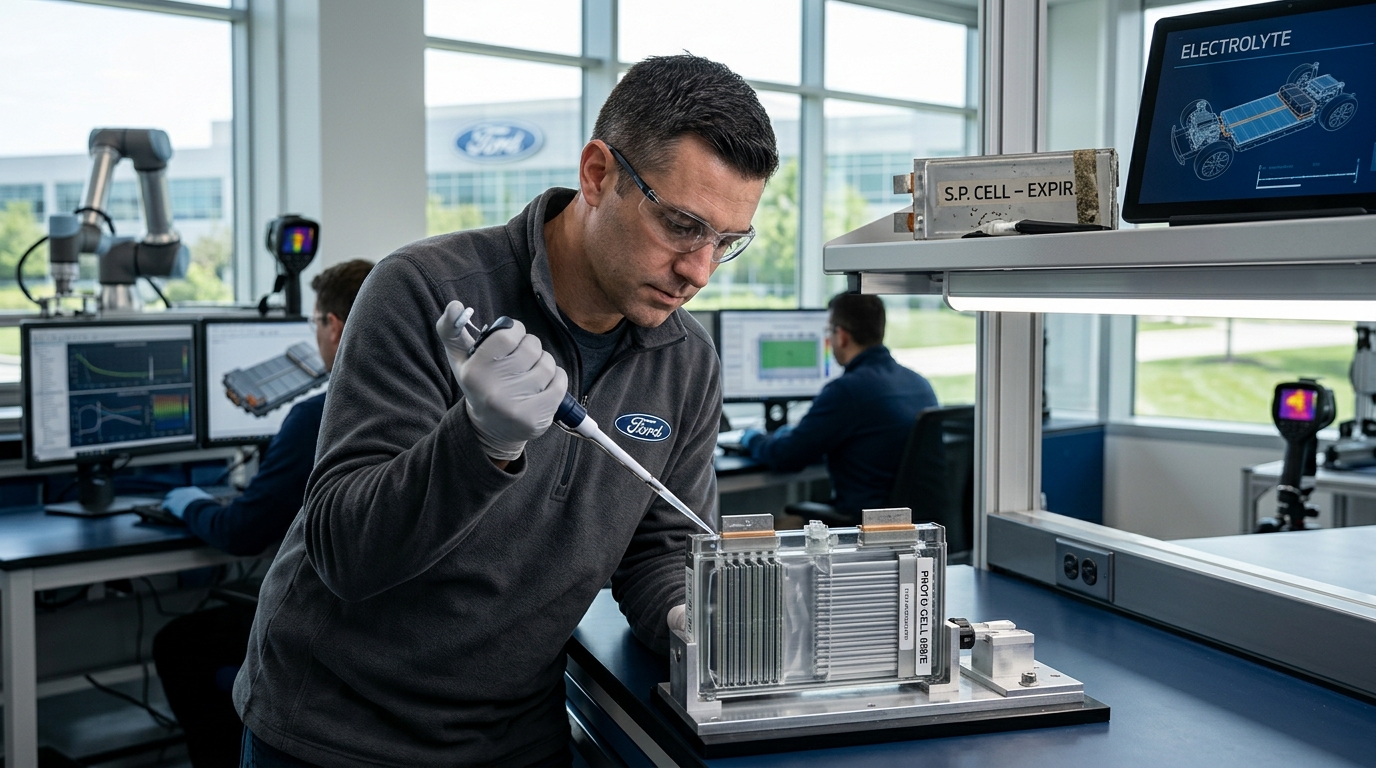
Ford’s Solid Power Cell Deal Expired. Watch the Electrolyte Bet.
Ford is expected to report Q3 earnings on October 28, with analysts expecting about $0.41 per share, down from roughly $0.45 in the year-ago quarter. Model e losses are guided at $4.0 billion to $4.5 billion for full-year 2026. That number dominates the EV conversation around the stock. It should not be the only one traders track.
The more telling structural event landed quietly in a 10-K filing. Effective December 31, 2025, Ford wound down its cell development activities with Solid Power, extended the joint development agreement only through March 31, 2026, and received a license to certain background technology. Following that expiration, Solid Power aims to pursue opportunities to supply Ford with electrolyte material. The cell collaboration is finished. The supply relationship is the open question.
That distinction matters because the electrolyte is the actual bottleneck. Solid Power has said it produces electrolyte on two pilot lines using a batch process and expects to commission a continuous manufacturing line by end of 2026 as proof-of-concept of production-intent manufacturing ahead of any mass production. Solid Power materials describe a plan to grow electrolyte capacity to 75 metric tons per year by end of 2026, tied to that continuous manufacturing pilot line.
Seventy-five metric tons sounds large until you benchmark it. Lithium-ion pack-level costs have been reported around $108 per kWh in BloombergNEF’s latest annual survey. Solid-state cost estimates vary widely across studies and depend on whether you are talking cell-level versus pack-level and pilot versus scaled production. A recent peer-reviewed analysis put current solid-state costs in a much higher band and argued they likely need to fall below roughly $100 to $150 per kWh to be cost-competitive. The cost curve must compress sharply over the second half of this decade. That compression lives or dies on whether electrolyte manufacturing scales from tens of metric tons to much larger volumes.
China’s sulfide electrolyte output from January through August 2026 reached 70 tons, up 119.7% year-on-year and already exceeding all of 2025’s output, but representing only 19.6% of the full-year forecast target of 360 tons. Even the most aggressive Asian producers are running well behind schedule. Western supply chains, including Solid Power’s Colorado facility, face the same physics problem at a smaller base.
Industrial pilot lines, prototype cells, and vehicle demonstrations show clear progress, but announced production dates and capacities remain corporate targets rather than proof of commercial-scale manufacturing. That single sentence from a peer-reviewed assessment published this year is the most important framing any trader can apply to this space.
What the Q3 Print Won’t Say
Ford’s Model e unit is guided to lose $4.0 billion to $4.5 billion for full-year 2026, while capital spending runs $9.5 billion to $10.5 billion. Ford has said that capex range includes about $1.5 billion for Ford Energy. None of that capex is earmarked for solid-state cells, because Ford exited that development lane. What it retained is a technology license and the option to become an electrolyte customer, which is a lower-cost, lower-risk posture.
Three Scenarios Into Earnings
Bull case: Ford Pro margins hold above 10%, Model e losses narrow sequentially, and management signals that the Universal EV platform timeline is intact. Solid Power commissions its continuous line on schedule in Q4, giving Ford a credible domestic electrolyte source to cite in future roadmap communications. F trades toward the $14 to $15 range.
Base case: Ford beats the ~$0.41 consensus modestly as it has in three of the last four quarters, but Model e losses remain near $1 billion for the quarter. Solid-state timelines stay 2029 to 2030 for any Ford vehicle integration. The stock holds near current levels with no re-rating catalyst.
Bear case: Tariff-related cost pressure bleeds into Q3 margins. Ford’s estimate for restructuring charges in 2026 proves too low. Solid Power’s continuous line slips past Q4, removing a key data point that supports the longer-term electrolyte supply thesis. F tests the low end of its 52-week range.
Levels and Framework
Ford trades at about 7 times forward earnings, and that multiple moves with price and estimate revisions. The battery technology option embedded in the stock is effectively unpriced at this multiple, which is both the opportunity and the risk: if the electrolyte supply path converts to a commercial agreement, the market has not paid for it. If the 2029 integration timeline slips further, the current valuation already reflects low expectations. Watch the Model e loss figure and any forward guidance language on battery sourcing. Those are the two data points that move the solid-state angle from optionality to conviction.