
October 26, 2026
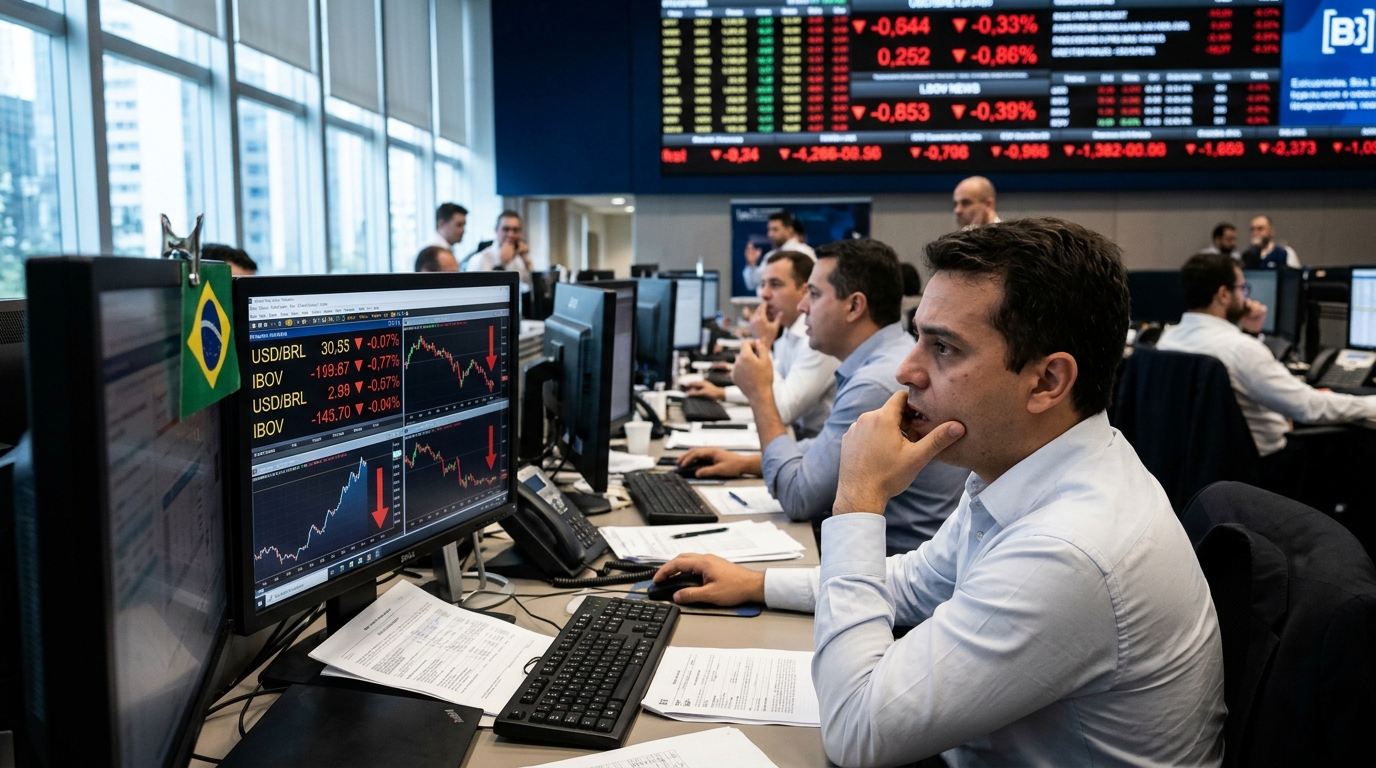
CME USD/BRL futures implied ~R$5.56 overnight. B3’s first session since Sunday is the verdict.
Lula won. The market was positioned exactly the other way. That gap is what traders are managing as B3 opens Monday morning in São Paulo.
He went 11-for-11 during the last Fed shock. Another one is about to hit.
In 2022, when the Federal Reserve made its most dramatic pivot in history and the S&P lost nearly 20%, Larry Benedict didn’t lose a single trade.
He knew where the money was going and positioned his readers to profit.
Trump is now installing his own Fed Chair, something Wall Street is already calling a generational shift.
Larry says his readers will be ready for it.
Click here to find out the one ticker he’s positioning in, completely free.
- Lula took 51.79% to Flávio Bolsonaro’s 48.21%, reversing a first-round deficit in an outcome that shocked markets positioned for a right-wing victory.
- CME dollar/real futures fell roughly 10% in Sunday evening trading, implying approximately R$5.56 per dollar against Friday’s spot close of about R$4.97.
- The Tokyo-listed Nomura NF Ibovespa Linked ETF fell 15% intraday in Asian hours, the steepest single-session drop since 2020.
- Ibovespa reference: 205,083 at Friday’s close, the only hard local anchor before B3 opens.
- Monte Bravo estimated an 11% Ibovespa decline in the first hour of trading under a Lula outcome.
- Brazil gross debt stands at 82.9% of GDP, with the Selic at 13.75% after five 25-bp cuts from a 15% peak.
- Flávio Bolsonaro has rejected the result and signaled legal challenges, citing what he called last-minute changes by the Supreme Court, though legal analysts rate the effort a long shot.
Market Context
Lula took 51.79% of valid votes against 48.21% for Flávio Bolsonaro, with 99.99% of polling sections counted. Prediction markets had priced a Bolsonaro win at roughly 80% on the morning of the vote, which means Sunday night’s result produced one of the sharpest EM political-risk resets events of the year. CME real futures plunged about 10%, with the exchange rate implied by futures prices around R$5.56 per dollar.
On Friday, October 23, the Ibovespa closed at 205,083 points and the real at about R$4.97 per dollar. Whether that level holds once domestic liquidity arrives is the central question for Monday’s session. The central bank’s Focus survey put 2026 inflation at 5.22%, above the 4.5% ceiling, with the Selic expected at 13.25% by year-end.
Gross debt is 82.9% of GDP, and inflation rose to 4.58% in September, just above the 4.5% ceiling of the target band. Goldman Sachs analysts expect modest measures to contain spending growth, alongside further tax increases, while major structural reforms remain unlikely.
Sector Breakdown
Three channels matter most for sector positioning. First, the real itself: dollar-based holders of Brazilian stocks and bonds lose twice when the real falls, once on the asset and once on the currency. That double hit lands hardest on exporters like Vale (VALE) and commodity producers with dollar revenues, while domestic banks and consumer names face the tightest local credit conditions.
Second, Petrobras (PBR). The state-controlled oil major posted net income of R$110.1 billion for 2025 and its shareholder remuneration policy has used a 45% of free cash flow formula, with a gross debt limit as part of its financial guardrails; for Q2 2026 it approved R$17.4 billion in dividends and interest on equity. A new government can change policy through the board, and Petrobras policy on prices, dividends, and investment has changed with almost every administration. That uncertainty is the premium the market will price into PBR on Monday.
Third, financials. Traders will unwind bets on interest-rate cuts that had gained momentum after Bolsonaro overtook Lula in the first round. Itaú (ITUB) and Nubank (NU) both rallied sharply post-first round; the unwind of those positions is Monday’s most direct institutional flow.
Are you prepared for… Trump’s Dollar Reset?
How Executive Order 14241 Could Unleash A Radical Repricing Of Goods And Assets Across America – And The Critical Move To Make Before December 14.
Stock-Specific Framework
Dollar investors in Brazil’s ADRs, such as Petrobras (PBR), Vale (VALE), Itaú (ITUB), and Nubank (NU), or in the iShares MSCI Brazil ETF (EWZ), face gap risk when markets reopen on Monday. After the first round, EWZ surged 14% and PBR jumped 11.59% to US$24.16. Those post-first-round gains are now directly in scope for reversal. The iShares MSCI Brazil ETF (EWZ) plunged nearly 20% in overnight trading following election results.
For PBR specifically, the fiscal concern is layered: a government seeking revenue will look at Petrobras dividend flows, which the 45%-of-free-cash-flow framework has protected, but only through board composition. VALE faces a weaker real that numerically helps its dollar-priced iron ore revenues in reais terms, partially buffering the equity shock. ITUB and Banco do Brasil (BBAS3) trade on the rate path; swap rates are expected to climb by more than one percentage point as traders reassess rate-cut bets.
Brazil is not the only emerging market where a single political event has forced a rapid reassessment of the entire asset class. Indonesia’s circuit-breaker session showed how thin EM equity bids can become when foreign investors decide the risk premium no longer compensates.
Technical Framework
The Ibovespa enters Monday at 205,083 with no futures indication available pre-open. R$5.00 on USD/BRL is the psychological level to watch; a clean break above opens the R$5.10 to R$5.20 band. On the index, 205,000 is the immediate reference: a break below puts 200,000 in view.
For EWZ in New York, the 9:30 a.m. ET open is the next clean liquid level after overnight dislocation. Volume on the open will clarify whether institutional sellers are forcing the move or whether some buying emerges on the gap. VWAP from the first hour will set the anchor for the rest of the session. Any close well above or below Monday’s opening range carries significant positioning information.
Scenario Modeling
Bull Case
Lula announces a credible economic team with a recognized fiscal anchor within 48 hours. Goldman modeled a scenario where a Lula victory accompanied by moderate fiscal discipline produces a 2% decline in USD/BRL, a far cry from the overnight futures move. Circuit breakers at B3 fire once, sellers exhaust intraday, and the Ibovespa stabilizes above 195,000 by close. EWZ recovers toward US$38 to US$40 range by week’s end.
One idea. Backed by the analysts.
Join 130,000+ self-directed investors who get one trade idea a day, sourced from top Wall Street analysts and explained in plain English. Free, and a five-minute read.
Base Case
Warren Investimentos’ head of macro strategy expects aggressive resetting, a selloff in assets, and interest rate futures likely to hit their upper limit shortly after the open. The Ibovespa falls 8% to 12%, the real trades in the R$5.05 to R$5.20 range in spot, and the market spends the week waiting for cabinet signals. EWZ absorbs the gap lower and grinds through the week with elevated realized volatility.
Bear Case
No economic team announcement, Bolsonaro’s challenge creates institutional uncertainty, and global risk-off conditions amplify the move. Goldman Sachs warns of a potential 10% rise in USD/BRL under an extreme market scenario. The Ibovespa tests 185,000 to 190,000. PBR and VALE ADRs trade at levels not seen since before the first round.
Active Trader Strategy Framework
The first 30 minutes of B3 trading will likely be the most informative data point of the week. Circuit breakers are at 10%, 15%, and 20% for the Ibovespa; if any trigger, expect a pause that will reset intraday positioning for US-listed names. Overnight futures trade with few buyers and sellers and often overshoots. The domestic spot market is the authoritative level, not Sunday evening’s CME level.
Traders holding EWZ, PBR, VALE, or ITUB should define their tolerable drawdown levels before the New York open at 9:30 a.m. ET. Spreads will widen at the open; limit orders rather than market orders preserve execution quality. BRL options volumes will spike; implied volatility will be elevated across EM for the session. The Fed decision Wednesday adds a second catalyst: a hawkish outcome compounds BRL pressure, while a hold or dovish statement would narrow the damage. Manage size accordingly.
Currency and rate pressure rarely travel alone in emerging markets. Commodity headlines that move oil can reprice EM currencies and sovereign spreads within the same session.
Conclusion
The market had a clear position. That position was wrong. What follows is not a verdict on Lula’s presidency but a forced reassessment of every Brazil trade put on since October 4. The traders who navigate Monday best will be those who wait for B3’s domestic open to confirm the real level before acting, define their risk precisely, and do not mistake early overseas price action for the final word. Goldman Sachs estimates Brazil needs a primary surplus above 2.5% of GDP to stabilise its debt trajectory; if fiscal credibility erodes, long-term rates rise and the real weakens. That structural issue does not resolve in a session. Preparation, defined levels, and patience are the framework for the week ahead.