October 26, 2026
FPL’s edge-intelligence layer proved itself against a hurricane
Hurricane Isaias gave NextEra Energy (NEE) an unplanned live demonstration of its distribution intelligence platform. Smart grid technology avoided approximately 18,000 outages during the storm, underground lines performed 14 times better than overhead infrastructure, and not a single hardened pole failed. Management cited those figures on the October 21 Q3 earnings call, and the market largely shrugged, focusing instead on the revenue miss and Barclays cutting its price target from $84 to $79.
For Traders Protecting a Nest Egg
If you’re trading with money you spent decades saving, one bad options trade hurts more than it should.
The first few checks on this list are all about protecting your account before you think about anything else.
The Smart Trade Options Checklist.
Normally $29.97. Free today.
That reaction misses where the real structural argument lives.
Hurricanes arrive with 72 hours of warning. EV charging ramps and midday solar injection do not. As distributed energy resources scale across FPL’s 80,000-plus miles of distribution lines, the volatility problem shifts from episodic storm events to something continuous and harder to model. A residential neighborhood that draws 1 MW at 6 p.m. today may draw 2.8 MW by 2028 once EV penetration crosses a threshold. That delta lands on distribution transformers with no advance notice and no centralized system fast enough to respond in real time.
Power Bill Revolt Could Hit the Ballot Box Nov. 3: ‘Dark Energy’ Stocks Set to Soar
Power bills have doubled and even tripled across America, and furious voters are about to send a clear message on November 3: get AI off the grid. The only way to get AI off the power grid… without losing to China and crashing the economy… is a criticaltech now being deployed by Elon Musk. One expert calls it “Dark Energy.” Washington has already greenlit it on an emergency basis, it comes online almost instantly, it’s already sold out through 2028… and one small group of companies hold the keys to it.
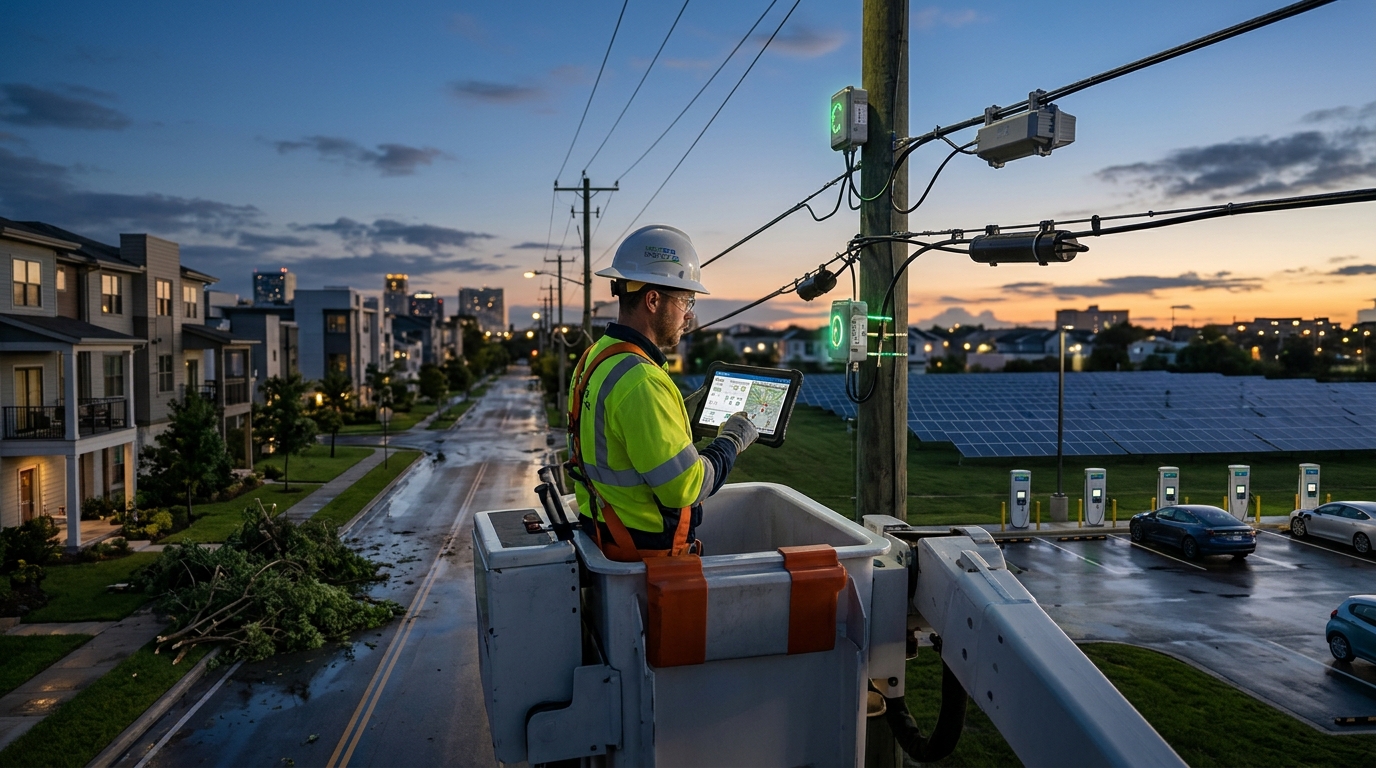
This is precisely the problem edge-computing sensors embedded at distribution nodes are designed to solve. IEEE 2800-2022 requires inverter-based resources to achieve step-response times within roughly 40 to 50 milliseconds, faster than most cloud-round-trip latencies. Processing has to happen where the data originates: at the transformer, the feeder, the meter. One published deployment using NVIDIA’s Jetson platform at the meter level produced a reduction in peak demand. FPL’s version of this architecture, which management describes as a “stronger, smarter grid,” is what converted storm preparation into avoided outage counts.
The financial read-through is underappreciated. FPL expects 2026 capital investments of approximately $12 billion, with regulatory capital employed growing about 9% year-over-year. Every dollar of that spend that prevents outages is a dollar that also strengthens the rate-recovery case with Florida regulators. The 12-month regulatory return on equity sits around 11.7% to 11.8%, a number that depends on demonstrated reliability. Fewer outages, faster restoration, and sensor-documented performance data are the inputs that sustain that ROE in future rate proceedings.
The backlog adds urgency to the distribution challenge. Energy Resources closed Q3 with 36.7 gigawatts of renewables and storage in backlog, adding 3.7 GW during the quarter alone, including 2.4 GW of battery storage. As those assets come online, the variability they inject into local distribution circuits increases. The micro-transformer sensor network is not a peripheral initiative, it is the prerequisite for safely absorbing that backlog into the grid without cascading failures at the neighborhood level.
Miss These 10 Stocks… Miss the Rally
What are the “Double Engine” stocks for the rest of 2026? Instead of settling for income or growth, these are stocks that deliver both. Our Top 10 Best Stocks to Own in the Second Half of 2026 report includes companies that are the perfect combination of steady payouts and explosive capital appreciation potential – all in one portfolio-ready list. This is how you position ahead of a market tailwind.
Three scenarios frame the positioning logic. In the bull case, the Dominion Energy combination closes on schedule in the second half of 2027, FPL’s grid intelligence platform becomes a replicable model across Dominion’s territory, and NEE’s 8% plus EPS CAGR through 2032 proves conservative. In the base case, the Dominion regulatory process extends into late 2027, the distribution edge platform continues generating rate-case evidence in Florida, and adjusted EPS lands at the high end of the $3.92 to $4.02 guidance range for 2026. In the bear case, interconnection backlogs slow backlog conversion, EV adoption outpaces sensor deployment timelines, and a regional grid event draws regulatory scrutiny before the infrastructure is fully hardened.
The stock trades at roughly 14.8x trailing earnings with a roughly 3% forward yield. Barclays is not wrong that near-term catalysts are thin. But the distribution intelligence build-out is not priced as a strategic asset. Watch FPL’s outage-avoidance data in future quarters: that number is the leading indicator of both regulatory goodwill and the grid’s capacity to absorb what the 36.7-gigawatt backlog is about to deliver.