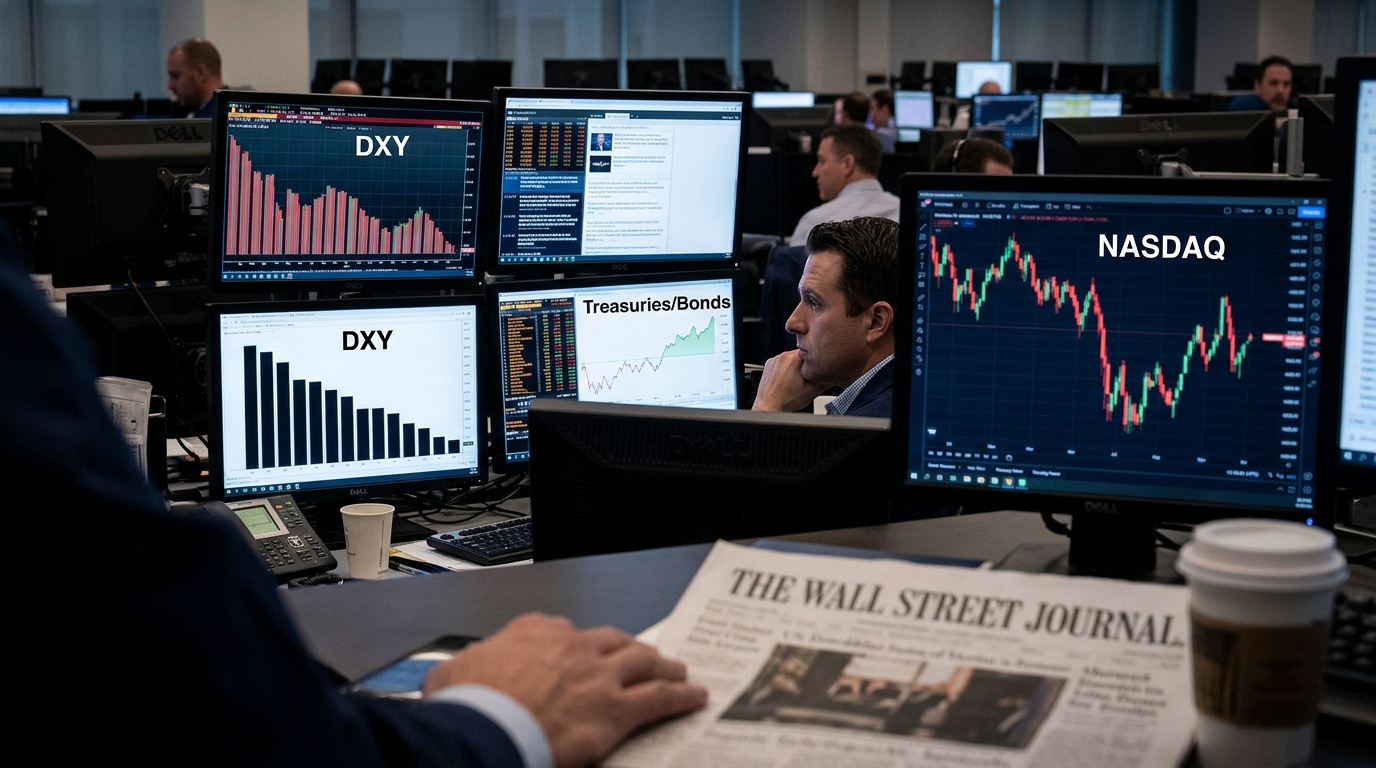
The scorecard from election night reads like a stress test run on three different hypotheses. DXY fell to a one-month low. Treasuries rallied. Nasdaq-100 futures dropped 2.4% before clawing back to modest gains. Each move has an argument behind it. Only one of them holds up against the full picture.
What the scoreboard showed
Democrats won a majority in the Senate and took back the House by a wider margin than polls had suggested, flipping Senate seats in Iowa, Kansas, North Carolina, Ohio, South Carolina, Maine and Texas, according to Associated Press race calls. The euro climbed 0.6% to $1.1258, while the dollar index dropped 0.6% to 101.27, its lowest level in a month. The 10-year Treasury yield fell about 5 basis points to roughly 4.915%. S&P 500 futures reversed a knee-jerk decline and were modestly higher by mid-morning; Nasdaq-100 futures erased a drop that had reached 2.4% and turned positive.
Three moves, three stories
The Nasdaq-100’s overnight plunge was the loudest signal and very likely the least informative one. JPMorgan Chase analysts cautioned that this result could trigger an AI sell-off on assumed higher regulation, with possible new data-center restrictions and higher taxes on corporations presenting potential headwinds for tech. That fear is real, but the follow-through was quick. Saxo’s chief investment strategist Charu Chanana noted investors appeared to be buying the dip after the initial knee-jerk selloff, adding that markets may be recognising that political gridlock does not necessarily mean weaker corporate earnings. A move that fully reverses before New York’s open is not a verdict. It is volatility looking for direction.
The Treasury rally is a sharper read. Treasuries rallied as investors expect gridlock in Washington to cut government spending, and AI regulation could also slow growth and reduce the need for rate hikes. On average, 10-year Treasury yields have fallen by about 20 to 25 basis points in the three months after midterm elections, according to a recent note from Lombard Odier; this time, divided government should ease upward pressure on longer-dated yields. That is a coherent, historically grounded position. Gridlock limits the fiscal expansion that has pressured long-end yields all year.
The dollar move, though, is the one that integrates all three inputs at once. ING strategists have argued that a Democratic Congress could be a mild dollar negative in the near term, partly through the AI channel and partly through higher odds of fiscal and funding standoffs. Lower growth expectations reduce the Fed’s urgency to hold rates high. Gridlock limits the spending that has demanded dollar-denominated borrowing. AI regulation specifically threatens the investment cycle that has attracted foreign capital. The dollar is not just reacting to one of those forces; it is reacting to all of them simultaneously.
Where it shows up
The sector rotation overnight was unusually clean. Renewable-energy and healthcare stocks were among the biggest premarket movers, trading higher after Democrats took control of both chambers, while AI-adjacent data-center names and other politically exposed groups lagged. First Solar rose about 8% and Sunrun gained around 8% in U.S. premarket trading, with gains following similar moves in Asia where South Korea’s Hanwha Solutions closed sharply higher. Health insurers and hospital operators also advanced, with Molina Healthcare, Centene and HCA Healthcare all moving higher in early trade.
Data-center-related shares including IREN, Hut 8 and Applied Digital declined in premarket trading, while major hyperscalers were mixed. Texas and Georgia, where Democrats made electoral gains at the governor level, are among the states attracting major data-center projects. Those two states are frequently cited by researchers as accounting for roughly a third of planned U.S. AI data-center spending and projects, which is why even a modest policy slowdown would cascade through the rest of the AI sector.
The countercase
Trump retains veto authority, control over trade policy and wide latitude through executive action. An AI law that passes both chambers and survives the White House is unlikely in the next two years; investigations, debt ceiling fights and gridlock are more probable. JPMorgan Asset Management’s Asia-Pacific chief market strategist Tai Hui noted that AI-industry valuation concerns accumulated over the past three to four weeks had exerted greater downward pressure on the market than the election variable itself. The election gave the market a catalyst to reset what was already overextended.
What to watch
Three things will confirm or challenge the read in the coming weeks. First, any Democratic committee announcement targeting data-center oversight would validate the AI regulation fear and pressure QQQ again. Second, the next government-funding deadline, now carrying new political weight, will test whether the Treasury rally has legs. Third, watch the dollar against the yen closely: USD/JPY has already dropped below 158.00 as the dollar slumped to a one-month low amid heightened political uncertainty. A sustained break lower there would confirm that the bond market, not the equity futures, is the one reading this result correctly.