Dear Reader,
Democrats have won both the House and the Senate.
That could make things a lot harder for President Trump.
Obviously, now comes the debate over what he can get done in the remainder of his term, and what it means for your money.
But before you make any changes to your investments, there’s something else worth thinking about.
What if the next big financial problem starts OUTSIDE Washington?
As you probably already know, companies are spending huge sums on AI data centers… counting on future revenue to justify the current expenditure.
But what happens if that revenue falls short?
The losses could hit not just AI stocks but also banks and retirement funds. And Washington could face pressure for another bailout.
Our new briefing explains all our concerns and also the steps you can take to prepare.
You’ll also find out how to get our reports on buying gold and silver in a crisis.
As Washington adjusts to the election results, take a moment to check how prepared your money is for what comes next.
Eliza Lasky
Weiss Advocate
Brent Keeps Falling While Tankers Burn. Here Is Where the Real Trade Is.
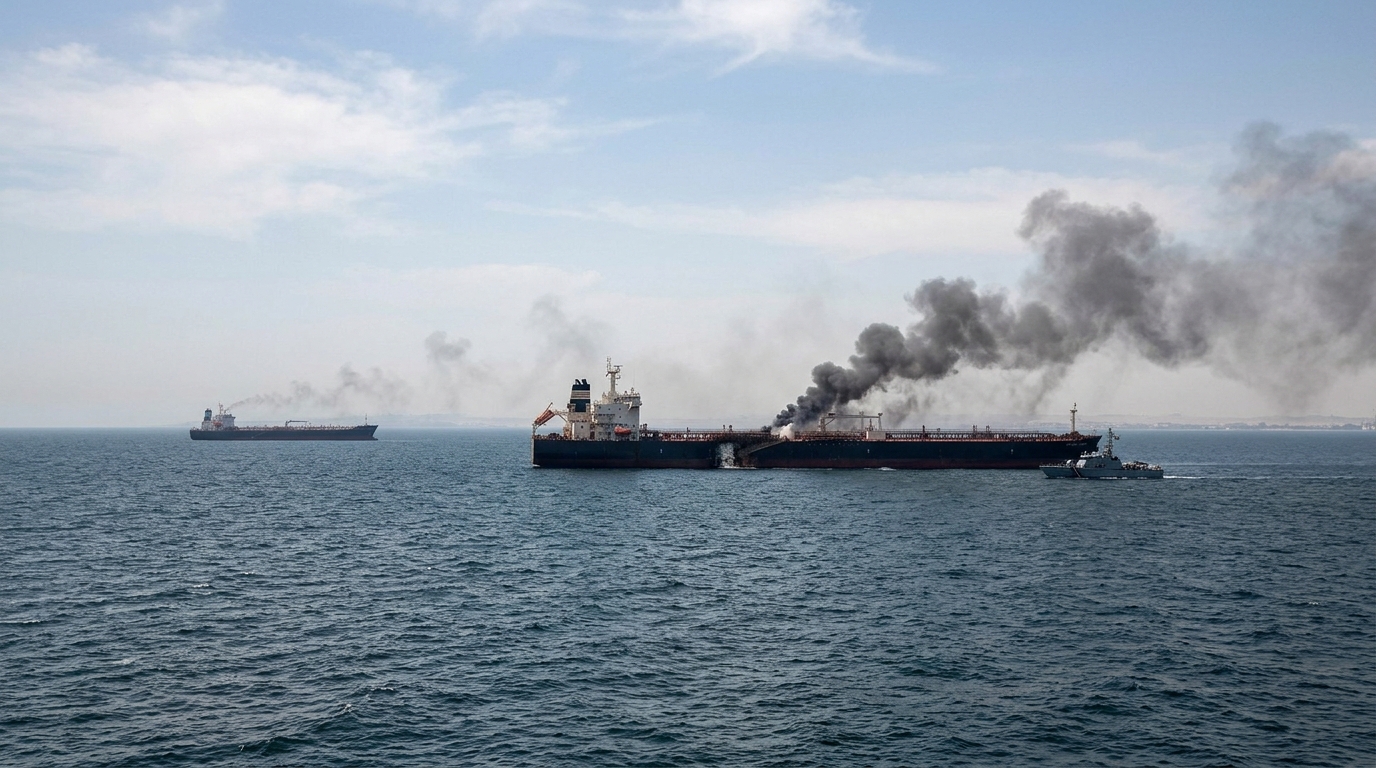
Three tankers exploded and caught fire in the Strait of Hormuz on Saturday alone. Iran’s navy said the tankers caught fire after hitting naval mines, with one struck in the morning and two more later in the day. The IRGC Navy stated that the vessels were “attempting to covertly transit through an unauthorized route” with their navigation and automatic identification systems switched off. Combined with an incident on November 13 and earlier strikes on November 8, this week has produced a concentration of mine-related shipping casualties near a single chokepoint that the global oil market has not fully priced.
The Divergence That Matters
Brent settled at $95.84 on November 13 and has fallen 9.64% over the past month. Over five trading days, it lost another 2.5%. That is a second consecutive weekly decline during a period when Hormuz has been severely disrupted as a transit corridor. IMF PortWatch counted just 3 transits through the Strait of Hormuz on November 8, with the 7-day average running at 3.9 a day, about 5% of the roughly 73.7-a-day average for the same week a year earlier.
The crude price decline reflects a market focused on demand softness and alternative supply routing, not on the structural damage being done to insurance economics and tanker availability. War-risk premiums have risen from roughly 0.25% of a ship’s hull value before the Iran war to between 6% and 10% by October, according to insurance brokers cited by the Financial Times. Lloyd’s List put Gulf transit rates at 7-9% of hull value in early November. A tanker with a $100 million hull value that previously incurred a $250,000 war-risk cost now faces premiums of $6 million to $10 million for a single voyage.
Where the Numbers Point
The disconnect between deteriorating physical conditions and a falling crude price has one clear implication: tanker operators are capturing the risk premium that oil producers are not. In Q2 2026, Frontline alone earned $659 million in a single quarter.
Scorpio Tankers (STNG) illustrates the momentum. Q3 2026 revenue rose 14.4% year on year to $266.5 million. The company raised its quarterly dividend 67% to $0.75 per share and held $2.1 billion in cash as of late October, with total available liquidity of $2.5 billion. LR2 rates climbed from $55,000 a day in July to roughly $215,000 a day for the first 37% of November bookings. Frontline (FRO) closed at $46.96 on November 13, trading at roughly 7.8x trailing earnings with a consensus analyst target near $57.
ExxonMobil (XOM) sits on the opposite side of this ledger. Middle East volume reduced Exxon’s earnings by $1.28 billion in the first half. If Hormuz remains closed for the full third quarter, Reuters reported the company said Middle East production would be reduced by about 750,000 oil-equivalent barrels per day versus 2025 levels. Higher Brent benefits the upstream, but the routing disruption and lost volume are real costs that do not disappear as crude weakens.
Scenario Framework
Bull Case (tankers): Mine strikes continue through November, transit counts stay near zero, and war-risk premiums hold at 7-9% or move higher. Tanker day rates accelerate from already elevated Q4 levels. FRO and STNG press toward their 52-week highs of $59.75 and near $90, respectively, as Q4 earnings visibility improves.
Base Case: The pace of incidents moderates without a formal ceasefire. Brent consolidates in the $91-$98 range as the market weighs constrained supply against demand concerns. Brent already trades above its 200-day moving average of $93.99 but sits 8.1% below its 50-day average of $104.26. Tanker stocks range-trade with elevated dividend yields supporting floors.
Bear Case: Diplomatic progress produces a credible Hormuz transit agreement. War-risk premiums compress sharply, tanker rates correct, and crude spikes briefly before supply returning to market weighs on prices. FRO revisits the $38-$42 zone flagged by the more cautious analyst targets; Brent potentially retests $91.
The bear case has a historical base rate worth knowing. Prior Hormuz de-escalation talks produced a pattern of rapid premium compression followed by collapse, with sector payoff tables across three reopening scenarios.
Active Trader Framework
The asymmetry here favors positioning in names with direct rate exposure rather than crude itself. FRO’s 50-day moving average near $50 and the $44-$45 range represent the technical floor to monitor on any pullback. STNG’s $1.4 billion net cash position and sub-$11,000 daily cash breakeven provide a margin of safety that most energy equities cannot match at current price levels.
Volatility in both directions is elevated. Any IRGC statement suggesting willingness to negotiate can move tanker stocks 5-8% intraday. Position sizing must reflect that. The core discipline here is straightforward: Brent’s weakness is an expression of macro demand concerns, not an assessment of what it costs to move a barrel through the world’s most dangerous shipping lane right now. Those are two different trades, and the market is only pricing one of them.