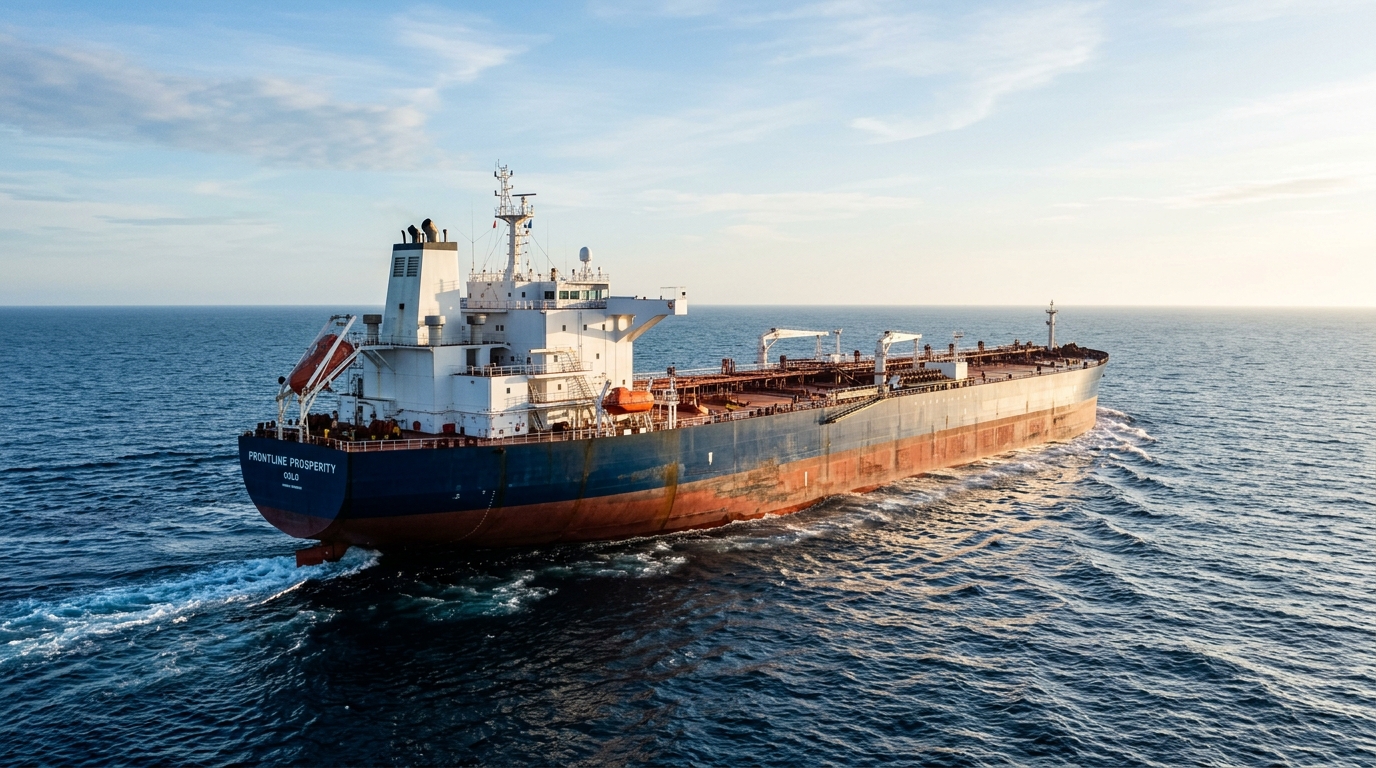
Frontline’s Q3 numbers, disclosed on November 20, settled a question that had been debated all year: can a tanker company really earn this much? The answer, confirmed by a $641.4 million quarterly profit on $921.3 million in revenue, is yes. For Q4, the company has already locked in VLCC spot bookings at $562,600 per day, with Suezmax coverage at $324,300 per day, at roughly 68% and 69% spot-day coverage, respectively. Management called it the platform for the strongest full-year result in Frontline’s history.
The harder question is what any of that is worth to a buyer of the stock today.
Why the Rates Are Here
The Hormuz dislocation is real and, as of this morning, deepening. AIS-visible traffic through the strait ran at about 4% of its pre-crisis rate in the week ending November 22, according to IMF PortWatch data compiled by SymbioLAB. Separately, Kpler has estimated tanker traffic through the Strait of Hormuz was about 42% below pre-war levels in the seven days through November 21, as reported by The Wall Street Journal. Lloyd’s List has put Gulf war-risk cover in a much higher range than pre-war levels; some risk notes cite about 6% to 10% of hull value per voyage, versus roughly 0.25% pre-war. At 8% of hull value, that is roughly $8 million in insurance alone per crossing, or about $4 a barrel added to cargo cost.
Today’s events widen that gap further. A hostile aerial projectile struck Saudi Aramco’s Jazan refinery yesterday, triggering a fire and killing a worker. Separately, Iraq’s state marketer SOMO has delayed between 20 million and 30 million barrels of Basrah crude originally scheduled for November loading, with some cargoes now expected only in the first ten days of December. Buyers are scrambling for prompt Middle East alternatives, pushing regional crude prices higher. Every disruption that keeps cargo off the market extends the shortage of available tankers and supports day rates.
The Bull Case
CMB.TECH’s Euronav division, which disclosed its own numbers November 24, reported Q4-to-date VLCC spot of $635,199 per day on 59% coverage, corroborating Frontline’s figures from a different fleet. Even at the cooled spot levels now circulating, the market is operating at multiples of any historical norm. Frontline’s forward price-to-earnings ratio sits near 6.7, implying the market already prices in significant normalization. Shipyard lead times for new orders typically run years, and a range of industry material puts a newbuild timeline at roughly two to three years for many tanker types, depending on yard capacity and slot availability. Fleet aging adds another constraint: industry sources cited in Frontline materials put 18.3% of the VLCC fleet at over 20 years old.
The case for FRO, DHT, International Seaways, and their peers is that geopolitics have structurally lengthened voyage times, reduced effective fleet capacity, and may do so for years regardless of whether Hormuz traffic recovers partially. Frontline itself has argued that Asian buyers will diversify their crude sources and hold larger strategic reserves, sustaining ton-mile demand well above pre-war levels.
What Could Go Wrong
The orderbook is the most credible threat to that thesis. As of November 11, the global tanker orderbook stood at 763 vessels, representing 27% of the existing fleet. For VLCCs specifically, 332 vessels on order represent 36.2% of the current fleet of 917 ships. That is approaching the kind of ratio that preceded the post-2008 collapse. Frontline’s shares have already pulled back roughly 13% since late November highs, with DHT down about 9% over the same period, as analysts ask openly whether this quarter marks the top.
A ceasefire, partial sanctions relief for shadow-fleet vessels, or simply a faster-than-expected recovery in Hormuz transits could drain the freight premium within weeks. Formula-based dividends that track day rates can fall as fast as they rose.
The Bottom Line
Frontline is not expensive on earnings that exist today. The stock trades at a low single-digit earnings multiple, carries a double-digit dividend yield, and has the Q4 bookings to support another record quarter. The problem is that every investor already knows these facts, and the stock price reflects them. The debate is not about this quarter. It is about whether a 36% VLCC orderbook, combined with any thaw in the geopolitical temperature, compresses day rates faster than the bulls expect. For investors with a short horizon and tolerance for sharp reversals, the entry looks defensible. Anyone pricing the current run as a permanent reset needs to account for 332 new VLCCs that the yards will eventually deliver.