June 9, 2026
NVDA: The Biggest Number in Semiconductors
Big-Tech Custom Silicon Is Growing Fast. Nvidia Is Growing Faster.
First a note from America’s Gold Co
Dear Reader,
When the SpaceX IPO hits, trillions of dollars inside the financial system will move.
Not toward you.
Fund managers liquidate. Institutions rebalance. Wall Street reshuffles to capture the payday of a decade. Your retirement sits inside that machinery. You don’t get a vote on which direction it moves.
You never did.
That’s the part no one is talking about.
Physical gold held outside the banking system works differently. No fund manager can rebalance it. No institution stands between you and it. No IPO frenzy touches it.
We put together a Free 2026 Gold Guide explaining exactly how to move a portion of your retirement outside the system tax-free, penalty-free, and in days.
It costs nothing. Takes 30 seconds to request.
While everyone else is looking at SpaceX, this is the move to protect your wealth from what’s coming.


Nvidia: The Biggest Number in Semiconductors
$81.6 billion. In a single quarter. Up 85% from the same period a year ago.
That’s what Nvidia reported for Q1 FY2027 in May 2026 – and the number still doesn’t fully land until you sit with it for a second. For context, the entire U.S. semiconductor industry generated roughly $100 billion in annual revenue a decade ago. Nvidia just did 80% of that in three months. Data Center revenue alone hit $75.2 billion, up 92% year-over-year, powered by the Blackwell 300 product ramp and sustained demand for InfiniBand and NVLink networking infrastructure.
GAAP net income was $58.3 billion. Up 211% year-over-year. Gross margin at 74.9%.
And yet – the stock is still mid-range. Trading near $208 against a 52-week high of $236.54 and a low of $140.86. Buyers are back after last week’s sector-wide selloff erased roughly $1.3 trillion in chip-related market value. NVDA is recovering. But the core debate is louder than it’s been in months, and it’s worth working through carefully.
Key Metrics At a Glance
- Q1 FY27 Revenue: $81.6B (+85% YoY, +20% QoQ)
- Data Center Revenue: $75.2B (+92% YoY)
- GAAP Gross Margin: 74.9%
- GAAP Net Income: $58.3B (+211% YoY)
- GAAP Diluted EPS: $2.39 (+214% YoY)
- Full FY2026 Revenue: $215.9B (+65% YoY)
- Market Cap: ~$5.05 trillion
- 52-Week Range: $140.86 – $236.54
- Next Earnings (est.): August 25, 2026
What’s interesting is that Nvidia’s revenue base is quietly becoming less dependent on a handful of hyperscaler decisions. Approximately 50% of Data Center revenue in Q1 came from AI clouds, enterprise, industrial, and sovereign customers – not from Google, Amazon, and Microsoft alone. That shift matters more than most commentary acknowledges. A company whose growth is tied to three procurement cycles is fundamentally different from one whose growth is distributed across dozens of customer categories. Nvidia is becoming the latter.
The CUDA software ecosystem is still the structural anchor. Competitors can design faster chips. Displacing the developer toolchain that the entire AI training and inference industry was built on is a different kind of problem – one that requires years of compiler work, open-source framework development, and ecosystem migration at scale. That’s not a 2026 risk. It’s a multi-year transition, and even then, not a guaranteed displacement.
THE EIGHT–LETTER WORD
Five years ago it appeared in zero S&P 500 10–K filings. Today it appears in 60. McKinsey calls what comes next “the most significant opportunity in a generation.” Morgan Stanley sizes the market at $5 trillion. Almost no one has noticed.
The Custom Silicon Question
Here’s where I’d push back on the more bullish framing, because the custom silicon trend is accelerating faster than a lot of NVDA coverage reflects.
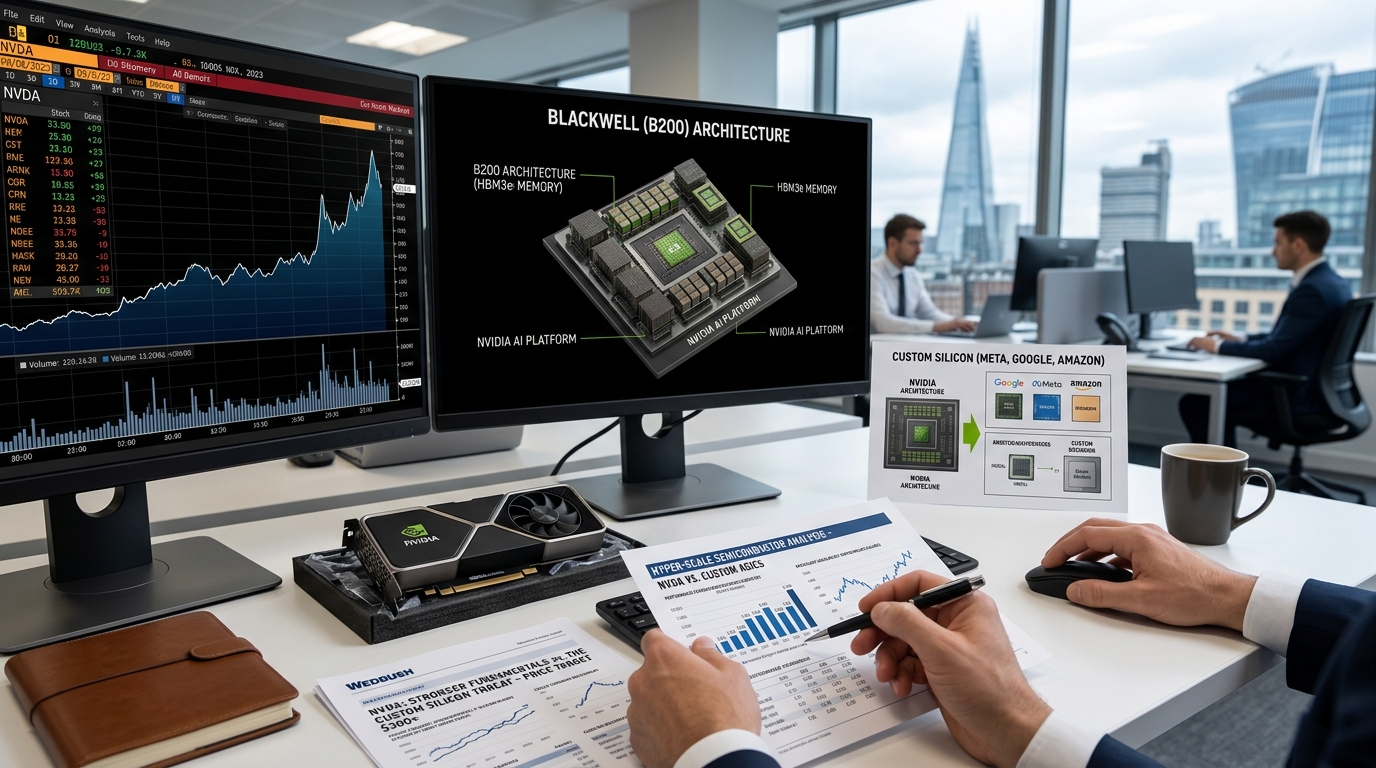
Google’s Ironwood TPU (v7) is a live, production-grade chip running at scale inside Google’s infrastructure. Amazon’s Trainium series is deployed across AWS workloads. Microsoft’s Maia 200 – built on TSMC 3nm with over 140 billion transistors – is optimized for their specific model architecture. These aren’t prototype programs. These are operating fleets. Meta is allocating up to $135 billion on AI infrastructure in 2026, with Broadcom custom ASICs as a central component of that spend.
The numbers are significant. ASIC-based AI server shipments are projected to reach 27.8% of the market in 2026, growing at 44.6% year-over-year – nearly triple the 16.1% growth rate projected for merchant GPUs. Broadcom carries a reported $73 billion AI backlog and is targeting $100 billion in annual AI chip revenue by 2027.
Slight tangent, but it matters: OpenAI – arguably the single most strategically important customer in the AI ecosystem – is developing its first custom AI chip with Broadcom, targeting deployment in 2027. When the company that commercialized large language models at scale starts designing its own silicon, that signals something about the direction of the industry even if it doesn’t immediately threaten Nvidia’s revenue line.
The part people skip: custom ASICs are optimized for specific, known workloads – inference on fixed architectures. They struggle with the flexibility demands of model training, rapid iteration, and novel architectures. That’s where Nvidia’s programmable GPU platform still holds a structural edge. The two product categories are increasingly serving different use cases, not directly competing for the same dollars.
Analyst Targets
- Bank of America: Buy – $275 (reiterated; citing AI platform momentum and strong capital return program)
- Wedbush: Buy – $300+ (bullish on Blackwell ramp and sovereign AI demand)
- Wall Street Consensus (62 analysts): Strong Buy – Average 12-month target ~$298–$305
- Implied upside from ~$208: approximately 43–47%
The Next AI Winner Isn’t Making Chips
Most investors still think the AI boom is about semiconductors.
But a growing number of data centers are running into a different problem: not enough power.
One company has quietly built a $1.5 billion backlog supplying equipment these facilities depend on, yet Wall Street continues to value it like an old-school industrial stock.
Three Scenarios Worth Modeling
Bull Case. The Blackwell Ultra ramp accelerates through H2 2026. Vera Rubin – Nvidia’s next-generation platform targeting up to a 10x reduction in inference cost per token – broadens the addressable market into workloads that weren’t economically viable on current hardware. Sovereign AI programs in Europe, the Middle East, and Asia Pacific diversify revenue further. Stock moves toward analyst consensus of $298–$305 by year-end.
Base Case. Q2 FY27 guidance of approximately $78 billion holds (excluding China Data Center compute). Hyperscaler custom silicon continues capturing incremental inference workloads at the margin without displacing Nvidia at training scale. Stock consolidates between $200 and $240, with August earnings as the next major directional catalyst.
Bear Case. China export restrictions deepen beyond current H20 controls. Hyperscaler capex guidance moderates in upcoming earnings calls. Custom silicon adoption accelerates faster than expected into training workloads. If forward earnings estimates compress and the P/E multiple – currently near 21x forward – comes under pressure in a risk-off environment, the $160–$175 range becomes the relevant support zone.
Technical Structure
NVDA is mid-range by any clean measure. The $205–$210 zone has absorbed selling pressure twice in recent weeks, establishing near-term support. Resistance sits in the $226–$236 band – the upper boundary of the current consolidation range and just below the 52-week high of $236.54. Volume has been elevated on the recovery attempt, which is constructive. A confirmed close above $236 on above-average volume would be the first meaningful technical signal that the stock is resuming toward analyst targets. Below $205 on volume, the conversation shifts.
The VWAP from the May earnings gap sits near $218. That level is worth watching intraday – reclaiming and holding above it would indicate institutional participation on the buy side, not just retail-driven bouncing.
What to Watch Into August
- August 25, 2026 earnings: The first clean read on Blackwell Ultra demand without China Data Center revenue in the comparison base
- Hyperscaler capex commentary: Any material slowdown in AI infrastructure guidance from Alphabet, Amazon, or Microsoft hits NVDA sentiment directly and quickly
- Custom silicon adoption data: Enterprise uptake of Google Ironwood TPU and Amazon Trainium are the early leading indicators of longer-term workload migration
- CUDA ecosystem competition: Progress on Triton and other open-source ML compiler frameworks is the long-cycle risk Nvidia’s software team is most focused on
- China policy developments: Any modification to H20 export controls – in either direction – represents a binary catalyst for Q2 and Q3 revenue estimates
Where to Put $100 Before Trump’s New Tech Law Rolls Out
Everyone is talking about Trump’s new tech law.
Financial Times says this tech puts America “on the verge of a financial revolution.”
Yahoo Finance says it could unlock $400 trillion.
Jeff Brown was consulted by Congressional offices in Washington, D.C. to advise on it.
He says the real number is even bigger – as much as $2.6 quadrillion could pour onto a new type of investment exchange in the days ahead…
Click here and Jeff will show you how to claim your stake starting with just $100.
The real question isn’t whether custom silicon is a threat to Nvidia. It clearly is, and anyone arguing otherwise is ignoring the capital allocation decisions of the five largest companies in the world. The question is about timing and magnitude. If Nvidia’s total addressable market expands fast enough – through enterprise AI, sovereign programs, robotics, and autonomous systems – then a 15 to 20 point shift in inference workloads toward custom ASICs still leaves Nvidia with a larger absolute revenue base than it has today.
That’s the bet the market is currently making. August will tell us whether the numbers support it.
For informational and educational purposes only. Not investment advice. Trading involves risk, including loss of principal.