July 3, 2026
The Dow Just Hit a Record. The Nasdaq Fell. That Split Is the Trade.
The rotation into value, financials, and industrials is accelerating faster than most investors realize.
Two things happened on July 2 that most people treated as contradictions.
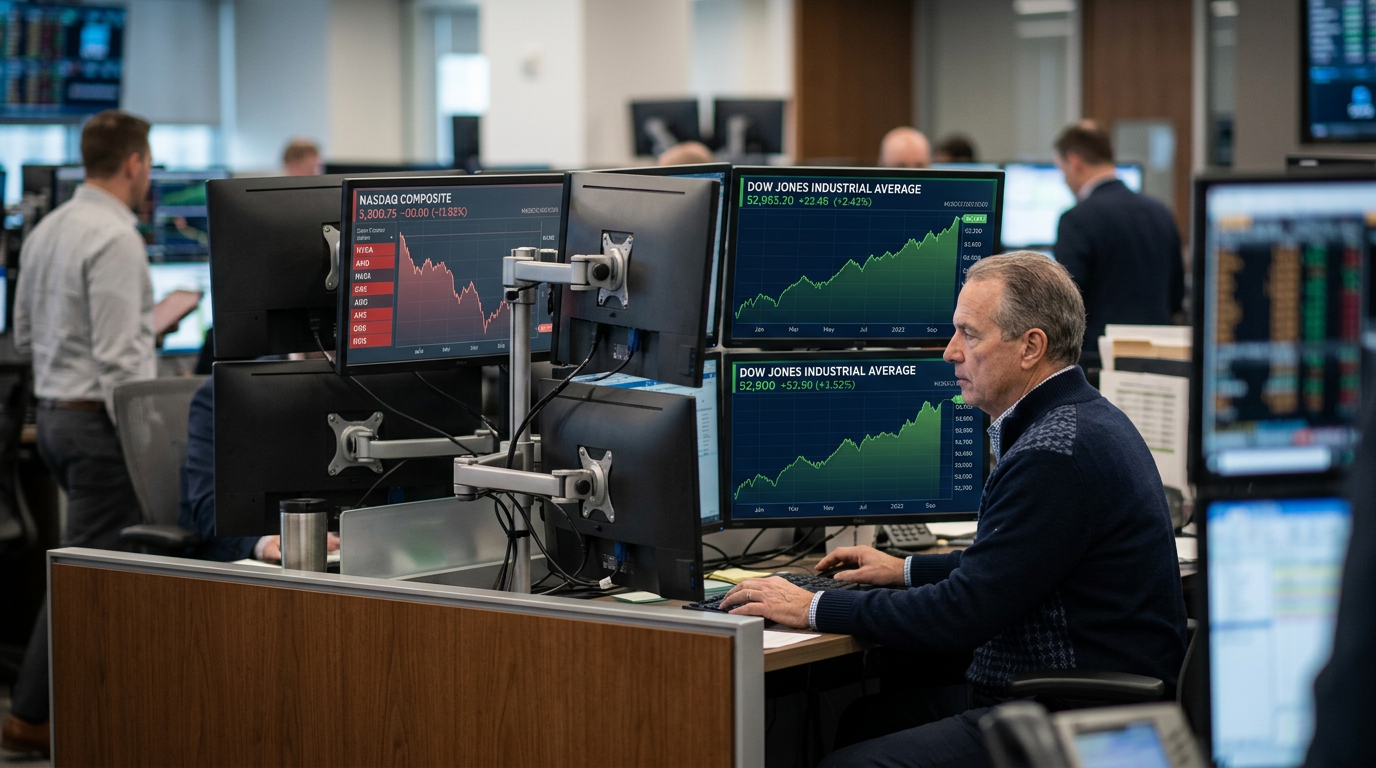
The Dow Jones Industrial Average surged nearly 600 points to a record close of 52,900. The Nasdaq dropped 0.8%. The S&P 500 was basically flat. Chips sold off hard for the second straight session. And yet the headline read: stocks rise.
That framing misses everything.
What actually happened is that a rotation trade accelerated in a way that is starting to look less like noise and more like a regime change. Financials, industrials, healthcare, and consumer staples outperformed. Banks and insurers caught a bid as Treasury yields pulled back. Defensive sectors each rose over 2%. And the Dow – the index nobody glamorizes – just posted its best first-half performance since 2021, up 8.9% through June.
The trigger on Thursday was a soft June jobs number. Nonfarm payrolls came in at 57,000 against expectations north of 100,000. Unemployment ticked down to 4.2%. Wage growth of 3.5% year-over-year stayed in line. The Fed’s worst nightmare – a hot jobs report forcing an aggressive hike – didn’t arrive. Rate-sensitive names exhaled. And money that had been sitting in overextended semiconductor names found somewhere new to land.
Here’s what I keep coming back to though. This rotation has been building for longer than one jobs number explains.
Over the past month, tech and AI-driven sectors have actually declined, while healthcare, industrials, and financials have quietly moved higher. The semiconductor ETF SMH dropped 4.5% Thursday alone. Teradyne fell 13.6%. KLA slid 11.5%. These aren’t rounding errors – they’re signs of real institutional repositioning after chips ran more than 80% in the first half of the year.
The valuation math is the core of it. Many high-quality companies in industrials, healthcare, consumer staples, and financial services are still trading at multiples well below AI leaders, despite producing consistent cash flows, growing dividends, and stable earnings. When the Fed stays cautious and rates remain elevated, the calculus shifts. A tech company whose profits are years away looks less attractive when you can earn a decent yield on a government bond today. Healthcare and industrial companies, generating real profits right now, look comparatively better.
Slight tangent, but it matters: PCE inflation hit 4.2% year-over-year through May – the hottest reading since April 2023. That’s not a market-friendly number for long-duration growth trades. It’s a tailwind for sectors with pricing power and near-term cash generation.
Charles Schwab rates both industrials and healthcare favorably through 2026, citing infrastructure spending, defense demand, and demographic tailwinds as structural drivers. Industrials specifically are getting a lift from capital spending tied to AI data center construction, electricity capacity, and defense procurement – real-economy demand that doesn’t require AI valuations to be right.
The question investors are quietly debating right now: is this a tactical rotation or something more durable?
The Russell 2000 surged nearly 22% in the first half – its best first-half performance since 1991. That kind of move in small caps typically signals broad economic confidence, not a narrow tech bubble. And when small caps lead, it often means the rotation has legs beyond a single sector.
What’s interesting is that the Dow’s record is being treated as a sideshow. Most coverage led with chip weakness. But the Dow hitting all-time highs while Nasdaq falls isn’t a contradiction – it’s a signal. Money isn’t leaving the market. It’s landing somewhere different. And the somewhere different is sectors that have spent three years underperforming a handful of mega-cap tech names.
The risk to this entire trade is simple: if economic data weakens sharply, the rotation unwinds. Value and cyclicals need a resilient economy to keep outperforming. A real growth scare would send money back to defensive large-cap tech, not to industrials. Watch the next CPI print and the upcoming Q2 bank earnings for clues on which direction this goes.
But right now, the Dow is telling a cleaner story than most investors are reading.