August 5, 2026
Burry Cashed Out. The Real Bet Remains.
Featured: Burry Cashed Out. The Real Bet Remains.
In case you missed it…
…make sure you get your free “Simple Options Trading For Beginners” book before your link expires.

I eventually plan to charge money for this training, so do yourself a favor and download it now…
That way, no matter what it costs in the future, you’ll have a free copy.
Sound good?
FREE: Simple Options Trading For Beginners << Get It Now
Good Trading,
Bill Poulos
P.S. Go here to save a copy of your “Simple Options Trading For Beginners” book while it’s still free.
Burry Cashed Out. The Real Bet Remains.
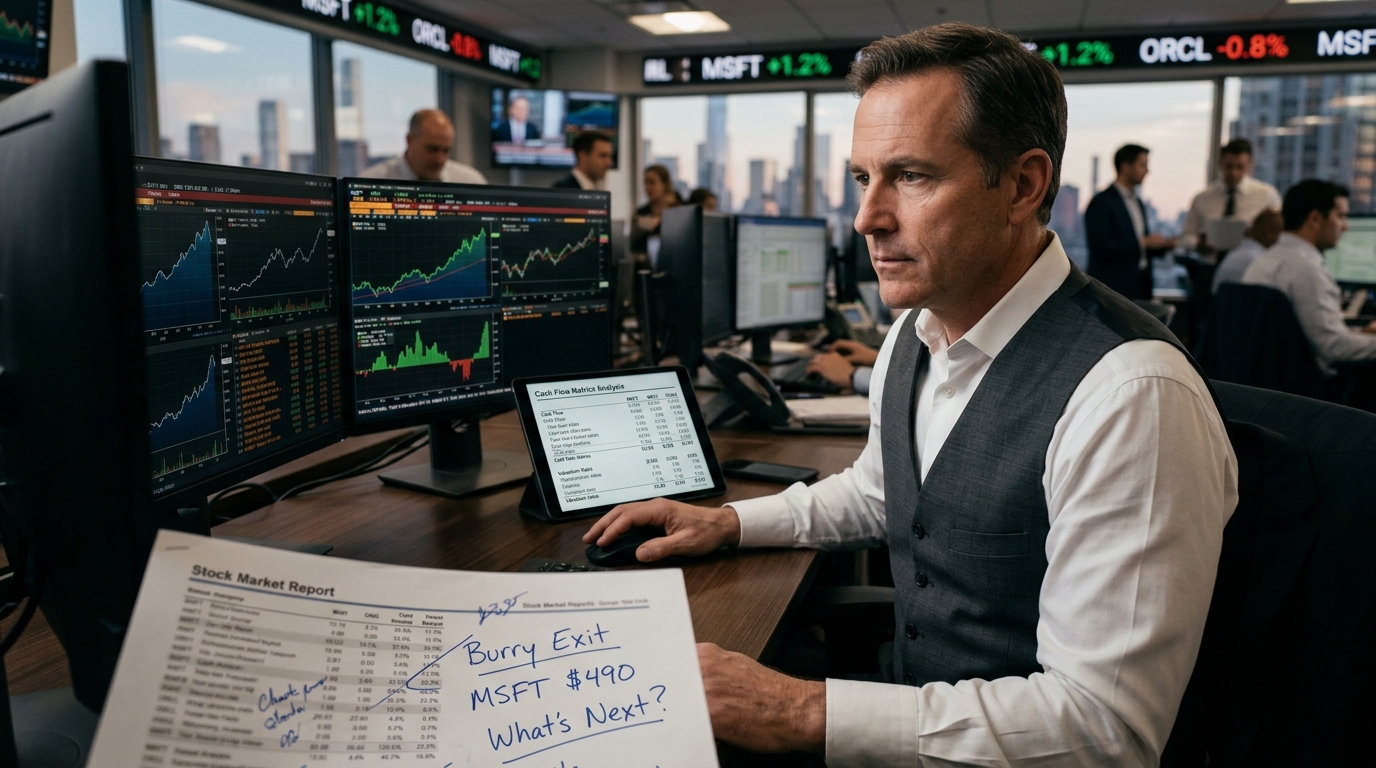
The exits were clean. The remaining book is the story.
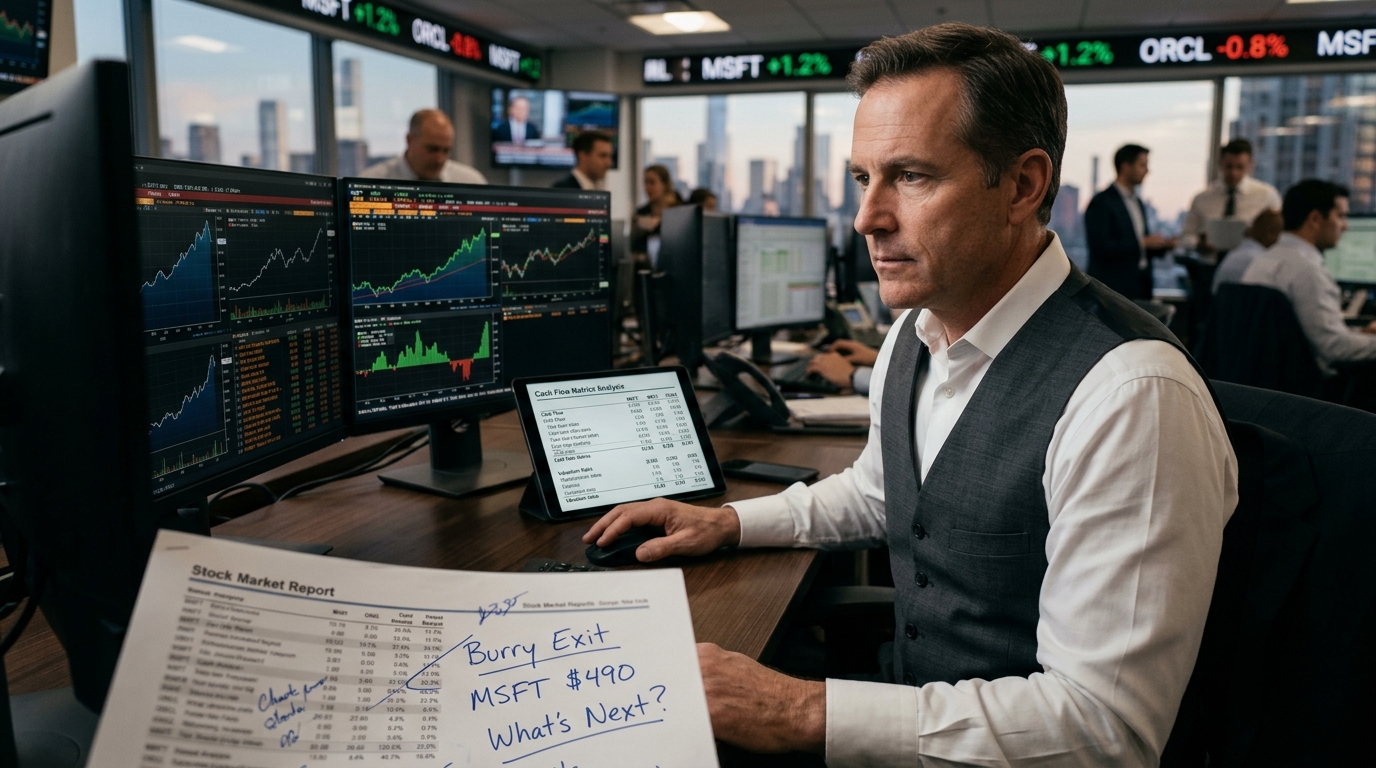
Michael Burry closed his Microsoft long and his Oracle short this week, both profitably and on his own terms. Market commentary has spent the past 48 hours adjudicating whether he was right. He was, on both counts, and that question is already closed. The more consequential read is what he kept, what he added to, and what his Nvidia thesis specifically says about where he believes the AI infrastructure cycle is most vulnerable to a forced unwind.
Bullet Summary
- Burry fully exited his Microsoft LEAP calls, closed all Oracle puts, and let his January 2026 Palantir puts expire, while rolling Nvidia puts to June 2027 and QQQ puts to February 2027.
- Microsoft reported Q4 FY2026 revenue of $90 billion, up 18%, with Azure growing 43% in the quarter and surpassing $100 billion in full-year revenue for the first time. Commercial RPO reached $678 billion, up 84%.
- Oracle carries $167 billion in total debt, generated negative $23.7 billion in free cash flow in FY2026, and faces a projected $42 billion free operating cash flow deficit in FY2027 per S&P Global Ratings, which cut its credit rating to BBB- on July 9.
- Palantir just posted Q2 2026 revenue of $1.94 billion, up 93% year over year, with U.S. commercial revenue surging 149%. Burry kept the direct short and let the options expire, choosing not to pay for more time at 86 times forward earnings.
- Burry’s Nvidia thesis is a demand-authenticity argument: he has written that much of Nvidia’s current and future demand is not driven by genuine end customers but by off-balance-sheet circular financing arrangements, citing the BIS 2026 annual report.
- On July 29 he posted publicly that Nvidia’s five-year credit default swaps are “going parabolic,” calling the pattern “circular spending to biblical proportions.”
- His remaining short book spans Nvidia, Palantir, Tesla, Micron, Applied Materials, Caterpillar, and the SOXX semiconductor ETF, with Micron up roughly 213% in 2026 as his newest short entry.
Market Context: Why This Week Matters
Burry’s disclosure landed in a week where earnings from the largest AI-adjacent names were producing split verdicts. Microsoft surged more than 8% after hours on July 29 after reporting results that were unambiguous on every major metric. Palantir rose 12% after its own Monday report and has since extended those gains. The SOXX semiconductor ETF, meanwhile, has been volatile on conflicting signals from the hyperscaler spending cycle: Alphabet’s Q2 results showed 82% cloud growth but management failed to connect $195-to-$205 billion in 2026 capex to specific AI revenue, and the stock fell more than 5% after hours.
The macro backdrop sharpens the tension. The IMF and the BIS have both flagged AI circular financing as a systemic risk factor in recent publications. Moody’s issued a warning in its latest report that the AI infrastructure race, which is costing nearly $1 trillion annually, is eroding the free cash flow of hyperscale cloud providers. S&P downgraded Oracle on July 9. Credit default swap spreads on Nvidia have roughly doubled in two months. None of that is visible in the demand headlines, but all of it is visible in the credit markets. Burry has been explicit that he is reading the credit architecture, not the revenue projections.
What Burry Actually Did
Burry disclosed that he has fully exited his long positions in Microsoft, closed all short positions in Oracle, liquidated his January 2026 puts on Palantir, and rolled his Nvidia and QQQ puts further into the future. This came after Burry closed Scion Asset Management in November 2025 and has been trading his own capital since then, increasingly vocal on Substack and X.
On the Oracle trade, Burry said the puts were January 2027 low-100s strikes and he decided not to roll them, adding: “The profit there was substantial, and so I left it at that. Should volatility come down, I may re-enter Oracle puts.”
The decision to roll rather than close the Nvidia and QQQ puts is the most important signal. By pushing Nvidia puts to June 2027 and QQQ puts to February 2027, Burry is saying the correction he anticipates has not arrived yet but he expects it within the next year. The counterargument is that Burry has been early before. He held large put positions on major indices in 2023 that expired worthless as markets rallied.
The Microsoft Trade: Entry, Thesis, Exit
Burry first disclosed a long position in Microsoft in April 2026, after the stock had sold off roughly 31% from its October 2025 peak, with an entry near $415 per share. The structure involved December 2028 LEAP calls struck in the low $700s. The thesis was straightforward: the selloff was driven by reflexive fear about AI capital spending returns, not by any deterioration in the underlying business. Enterprise cloud demand was intact. The stock was being priced as if Azure had a problem. It did not.
He exited immediately after Microsoft reported fiscal Q4 2026 results on July 29. Microsoft reported fourth-quarter revenue of $90 billion, up 18% from a year earlier, and said Azure cloud revenue surpassed $100 billion for the first time in fiscal year 2026. The company posted GAAP net income of $35.8 billion, or $4.81 per share, a 31% increase. Adjusted EPS came in at $4.74, compared with analyst expectations of $4.24 per share.
The quarter included a $3.2 billion gain from Microsoft’s investment in AI lab Anthropic and lower-than-expected costs tied to its voluntary retirement program, partially offset by severance expenses and impairment charges in Xbox. Adjusting for those items, the underlying beat was real but narrower than the headline figures. The business case was still resoundingly confirmed.
Burry’s own post-exit assessment was disciplined. He wrote that the position benefited from fortunate timing and that his enthusiasm for the earnings results did not match the market’s. That is a precise read: enter a hated stock, hold through the fundamental confirmation, exit into the euphoria rather than with it. Microsoft had been trading at $390.54 before the earnings announcement and moved to $422.30 in after-hours trading. The post-earnings price crossed the 200-day exponential moving average for the first time since the May/June selloff.
Microsoft: The Numbers Behind the Surge
Azure revenue grew 43% for the quarter, with the full fiscal year surpassing $100 billion, up 41%. Operating income increased 18% for the quarter and 21% for the full year, surpassing $155 billion. Commercial remaining performance obligations grew 84% to $678 billion.
A key differentiator from Alphabet and Meta this earnings season was Microsoft’s stable capex guidance and 84% growth in commercial RPO, signaling that infrastructure spending is backed by concrete demand. AI monetization momentum remains strong, with 30 million paid Copilot seats, suggesting a $10 billion annual run rate.
Capital expenditures and finance leases for the quarter reached $41 billion, up 69%. Microsoft revised its calendar 2026 capex forecast down to approximately $175 billion from about $190 billion by lengthening the assumed useful life of its office and data center properties. Management said Microsoft expects to remain free cash flow positive in fiscal year 2027.
For Azure, management expects revenue growth of approximately 45% in constant currency in Q1 FY2027 and remains focused on delivering efficiencies as customer demand continues to exceed supply. Customer demand for Azure continues to exceed available capacity, leading to supply constraints that could limit near-term growth. That supply constraint is simultaneously the reason Azure growth may decelerate and the reason capex will stay elevated. Traders watching the multiple need to hold both of those dynamics at the same time.
Deutsche Bank analysts, who recommend buying Microsoft stock, noted in a recent note that Microsoft is confronting “some concentration risk” with its OpenAI relationship, especially with the ascent of open-source models. Microsoft said in January that around 45% of its $625 billion in commercial RPO were tied to OpenAI. The same counterparty risk Burry identified in Oracle’s backlog exists in Microsoft’s, to a lesser but still material degree.
The Oracle Trade: Thesis Confirmed, Exit Clean
Burry originally disclosed the Oracle put positions in a January 2026 Substack post. His bear thesis centered on Oracle’s aggressive AI infrastructure spending, what he viewed as questionable financing, and heavy customer concentration around OpenAI. From its peak in the third quarter of 2025, the stock dropped approximately 51% by early February 2026.
The thesis received institutional validation on July 9. S&P Global Ratings downgraded Oracle’s long-term issuer credit rating one notch to BBB- on July 9, 2026, leaving the company a single step above speculative grade. The agency retained a stable outlook but identified Oracle’s concentrated exposure to OpenAI as a key credit risk, noting that OpenAI accounts for roughly half of Oracle’s remaining performance obligations. Moody’s Ratings has a negative outlook, meaning another cut is possible over the medium term.
S&P now forecasts Oracle’s fiscal 2027 capital expenditure at $90 billion to $95 billion, up from a prior estimate of $60 billion, and projects a free operating cash flow deficit of negative $42 billion, against an earlier projection of negative $24 billion. Adjusted debt-to-leverage is expected to reach the mid-4x range in fiscal 2027, above the threshold S&P considers appropriate for a standard BBB profile. Oracle carries approximately $160 billion to $167 billion in total debt obligations.
Fiscal 2026 capital expenditures were $55.7 billion, producing negative free cash flow of $23.7 billion despite $32.0 billion of operating cash flow. Oracle raised $43 billion in debt financing and $5 billion in equity financing in fiscal 2026 and plans approximately $40 billion more financing in fiscal 2027. OpenAI is a private company that has never generated a profit and continues to burn significant cash. It now represents one of the largest single-customer exposures in Oracle’s history. S&P warned that if OpenAI struggles to meet its obligations, Oracle could be left holding long-term data center leases with no easy exit.
Louis Navellier: Don’t buy OR sell another AI stock…
Until you’ve heard this urgent AI warning from the man who called Nvidia before its 44,000% rise…
According to Louis, a massive reset is coming in an obscure corner of the AI market.
This $100 trillion disruption could send some of the world’s biggest AI stocks to zero… and one off-the-radar stock soaring… starting now.
Oracle: Fixed, or Just Cheaper?
Oracle fiscal year 2026 total revenues were up 17% to a record $67.4 billion. Cloud revenues increased 39% to $34.0 billion. For fiscal year 2027, management has raised total revenue guidance to $90 billion. CFO Hilary Maxson said Oracle expects net cash outlay for capital expenditures of about $70 billion in FY2027. In fiscal year 2027, Oracle expects to raise approximately $40 billion through a combination of debt and equity financing including its previously announced $20 billion at-the-market equity issuance.
On those headline metrics, the business looks like it is working. Revenue is growing. The backlog is expanding. Cloud infrastructure revenue surged 77%. The problem is the gap between contracted demand and cash. Free cash flow was negative $23.7 billion for fiscal year 2026 as Oracle continued investing to support the growth of its Cloud Infrastructure business. Remaining performance obligations ended the quarter at $638 billion, up 363% year over year and up $85 billion sequentially from the end of Q3.
Oracle says 12% of that $638 billion converts to recognized revenue within 12 months. That is visibility into revenue, not cash. A forward P/E of roughly 18 times tells you almost nothing useful about near-term equity risk when the company has $167 billion in total debt, is planning $70 billion in net capex in FY2027, and roughly half the backlog is tied to a single private customer. OpenAI has postponed its planned IPO to 2027, and SoftBank recently reduced an OpenAI share-backed loan from $10 billion to $6 billion due to valuation uncertainties. That is the counterparty risk Oracle’s equity holders are sitting on top of.
Burry covered because the bear case played out. He did not cover because the bull case arrived. Those are not the same thing.
Palantir: Why He Kept the Short but Dropped the Options
Palantir just delivered what its CEO called an “otherworldly” quarter. The company posted $1.94 billion in quarterly revenue and lifted its full-year forecast to at least $8.15 billion. U.S. commercial revenue rose 149% year over year to $764 million, while U.S. government revenue grew 90% to $809 million. Total U.S. revenue reached $1.57 billion, a 115% increase from a year ago. Palantir stock surged 29% on earnings, erasing $3 billion in short-seller gains in a single session.
Burry was short. He sold or let expire his January put options on Palantir, but kept his direct short position in the stock. Of the three stocks, Palantir is the most richly valued, trading at 86.2 times its forward earnings. His view on the valuation has not changed. He has simply stopped paying options premium to rent time on a thesis he still holds, choosing instead to maintain the outright short and absorb whatever pain the earnings surge delivers.
The structural argument Burry has articulated on Palantir centers on accounting and capital allocation practices rather than on whether the business is growing. The Q2 results confirm the business is growing at an extraordinary rate. The disagreement is about what that growth is worth in the current capital structure. At 86 times forward earnings, there is almost no margin for the growth rate to disappoint before the multiple becomes untenable. Burry is betting that at some point, it will.
The Nvidia Thesis: A Demand Argument, Not a Valuation One
This is where Burry’s current thinking is most distinct from conventional AI bear arguments. He is not simply arguing that Nvidia is overvalued relative to earnings. He is arguing that a significant portion of the demand driving those earnings is not real in the traditional sense.
He stated bluntly that a very significant proportion of Nvidia’s current and future demand is not driven by genuine end customers, and that the financing arrangements for this demand exist off-balance-sheet and are undisclosed, with future revenue “largely financed through circular arrangements.” To support this view, he specifically cited the Bank for International Settlements’ 2026 annual report. The BIS report noted that the AI buildout is highly concentrated, partially debt-financed, with intertwined cash flows and exposures among various parties.
The criticism coincides with reports that Nvidia signed data center leases worth up to $50 billion in Texas to support its “neocloud” partners, a financial maneuver that skeptics argue keeps high costs off Nvidia’s balance sheet while artificially driving demand for its own GPUs. The circular financing practice, where a tech giant funds a startup or customer, who then uses that capital to purchase the supplier’s hardware, has drawn increasingly harsh scrutiny.
On July 29, Burry posted that “there is a reason $NVDA’s 5 year credit default swaps are going parabolic,” adding “all this overreaching by Nvidia to push the circular spending to biblical proportions.” Burry’s original trade was built on credit default swaps. He bought insurance on subprime mortgage bonds during the housing bubble and collected when they collapsed. When he points to Nvidia’s CDS going parabolic, he is pointing at something he understands as well as anyone. Jensen Huang has called the circular financing criticism “ridiculous.” That disagreement is itself a market event worth tracking.
The Book He Kept: Sector Breakdown
The remaining short book reads like a who’s who of companies riding the AI and semiconductor wave: Nvidia, Palantir, Tesla, Micron, Applied Materials, Caterpillar, and the SOXX semiconductor ETF. As of his 2026 disclosures, Burry’s largest position is a combination of put options against Nvidia and Palantir, representing as much as 80% of his disclosed portfolio.
The semiconductor complex is the obvious expression of the circular-financing argument. If Nvidia’s demand is partly self-financed through equity investments and off-balance-sheet guarantees, then Micron, Applied Materials, and SOXX are downstream beneficiaries of the same dynamic. Micron is up about 213% in 2026 and is his newest short. Burry has previously shorted Micron at higher levels, so the re-entry here reflects a view that the memory cycle has been amplified by the same AI spending surge he is skeptical of.
Caterpillar requires a separate read. The construction equipment maker has been a beneficiary of data center buildout spending, a physical-infrastructure play on the same AI capex wave. Shorting Caterpillar alongside SOXX and chip equipment names suggests this is not a pure chip-valuation bet. It is a bet against the entire physical and digital capital spending cycle that AI has ignited. If the circular financing dynamic forces a pullback in hyperscaler spending, the impact would flow through to the concrete, steel, and heavy equipment markets as quickly as it would through to GPU orders. That is the implicit macro call in the Caterpillar short.
Investors watching this space should pay attention to upcoming earnings from Nvidia, Micron, and Applied Materials, as well as capital expenditure guidance from hyperscalers like Microsoft, Google, and Amazon.
Data Snapshot
Microsoft (MSFT), Q4 FY2026 and Full Year:
- Q4 revenue: $90.01 billion, up 18% year over year; Street estimate $87.62 billion.
- Adjusted EPS: $4.74; consensus $4.24. GAAP EPS $4.81, up 31%.
- Azure growth: 43% in Q4, accelerating from 40% in Q3; full-year Azure revenue surpassed $100 billion for the first time, up 41%.
- Microsoft 365 Copilot: over 30 million paid seats, up from 20 million in April.
- Commercial RPO: $678 billion, up 84% year over year, up $51 billion sequentially.
- Q4 capex and finance leases: $41 billion, up 69%.
- Full-year operating income: more than $155 billion, up 21%.
- Q1 FY2027 Azure guidance: approximately 45% constant-currency growth.
- Forward P/E: approximately 25 times.
Oracle (ORCL), FY2026:
- Full-year revenue: $67.4 billion, up 17%; cloud revenue $34 billion, up 39%.
- FY2026 capital expenditures: $55.7 billion; FY2027 net capex guidance: approximately $70 billion.
- FY2026 free cash flow: negative $23.7 billion; S&P FY2027 forecast: negative $42 billion.
- Remaining performance obligations: $638 billion, up 363% year over year.
- FY2027 revenue guidance: $90 billion.
- FY2027 financing plan: approximately $40 billion, including $20 billion ATM equity issuance.
- Total debt: approximately $160-$167 billion.
- S&P credit rating: BBB-, one notch above speculative grade as of July 9, 2026. Moody’s outlook: negative.
- OpenAI share of RPO: roughly 50%.
- Forward P/E: approximately 18 times.
Palantir (PLTR), Q2 FY2026:
- Revenue: $1.94 billion, up 93% year over year; Street estimate $1.81 billion.
- U.S. commercial revenue: $764 million, up 149%. U.S. government revenue: $809 million, up 90%.
- Adjusted EPS: $0.41; consensus $0.35.
- Full-year 2026 revenue guidance raised to $8.15-$8.16 billion, implying 82% growth.
- Forward P/E: approximately 86 times.
- Burry position: direct short maintained; put options allowed to expire.
Bull / Base / Bear
Microsoft Bull: Azure sustains approximately 45% growth through Q1 FY2027 as supply constraints ease and Copilot seat adds compound. The $678 billion RPO converts to revenue faster than the bear case assumes. Capex guidance revisions downward, combined with FCF-positive management commitments, allow the multiple to hold at 25 times or expand. The stock reclaims territory above $450.
Microsoft Base: Azure growth holds in the high 30s after the Q1 beat, as supply constraints moderate and the comparison base becomes harder. Copilot adds continue but the pace decelerates from the current doubling rate. Capex at $175 billion keeps FCF under pressure, capping multiple expansion. The stock oscillates in a range centered around the post-earnings surge level. Burry’s exit looks like a well-timed sale at the top of a trading range.
Microsoft Bear: Azure decelerates sharply in Q2 FY2027 once the supply-constrained catch-up period ends and real demand is stress-tested. Capex continues rising above guidance. FCF turns negative. OpenAI concentration risk in the RPO becomes a headline event. Multiple contracts from 25 times to below 20 times. The stock revisits the $380-$390 zone that preceded the Q4 earnings surge.
Oracle Bull: The $638 billion RPO converts at the guided 12% annual pace and accelerates in FY2027 as OCI data centers reach full contractual revenue contribution. Gross margin steps back up as infrastructure matures. Free cash flow turns toward positive in the back half of FY2027. The equity issuance executes at a price above current levels, limiting dilution damage. ORCL rerates toward $180.
Oracle Base: Revenue grows in line with the $90 billion FY2027 guidance, but the ATM equity issuance, OpenAI concentration overhang, and Moody’s negative outlook keep institutional buyers cautious. The stock remains range-bound between $130 and $160 until FCF data, not backlog headlines, confirms the investment thesis.
Oracle Bear: Backlog conversion disappoints in Q1 FY2027. OpenAI faces a financing setback that forces a contract renegotiation. The ATM equity issuance hits at a price below $130, diluting holders at a new multi-year low. Moody’s converts the negative outlook to a downgrade. Adjusted leverage breaches 4x and the stock retests its FY2026 intraday low near $121.
Technical and Positioning Framework
Microsoft reclaimed its 200-day exponential moving average on the post-earnings gap to $422. That level, approximately $390-$395, is now the first meaningful support on any pullback. The pre-earnings base between $385 and $400 is likely where institutional buyers who missed the move are watching for re-entry. Volume on the four-session post-earnings surge was well above average, confirming the move rather than flagging it as a thin, low-conviction rally. Azure guidance above 45% for Q1 FY2027 is the catalyst that sustains the move. A revision below 42% would be the first signal of deceleration.
Oracle’s chart reflects the credit story. The stock touched a 52-week low near $121 on July 18, roughly 63% below its all-time high of $345.72. The July bounce after the S&P downgrade was shallow and was quickly reversed. VWAP from the post-downgrade session sits near $135. Any rally that fails to hold above $135 is technically unconvincing. The next quarterly report’s RPO conversion data is the only fundamental catalyst that could change the weight of evidence for bulls.
Palantir’s post-earnings gap higher, approaching 29% in a single session, creates an air pocket below the new range. The stock had been down roughly 29-30% year to date before the earnings release, meaning long-term holders were still underwater entering the report. Short interest was high, and the 29% gap is consistent with a forced short-cover event rather than new long money establishing positions at those levels. Burry’s decision to keep the outright short rather than re-establish options suggests he views the gap as a technical overshoot rather than a fundamental revaluation.
Active Trader Strategy Framework
On Microsoft: Burry’s exit is not a sell signal for holders. The business is sound, the quarter was decisive, and the forward guidance is constructive. It is a caution flag for anyone chasing post-earnings momentum above $420. The multiple at 25 times forward earnings prices continued Azure acceleration and Copilot compounding with very little room for disappointment. Position sizing should reflect that the easy money has already been made. Traders looking to initiate should define their entry around the $385-$400 zone that formed the pre-earnings base, not at the current extended level.
On Oracle: Burry covering his puts is not a buy signal. The structural problems he identified, negative free cash flow, near-junk credit from S&P, Moody’s negative outlook, OpenAI concentration, and $40 billion in planned FY2027 financing, remain fully active. The right catalyst for a long entry is not a covered short. It is evidence of FCF inflection in reported quarterly numbers. Until the free operating cash flow deficit starts narrowing materially versus S&P’s negative $42 billion FY2027 projection, the stock is an execution story with a heavy financing burden, not a value play.
On Nvidia and SOXX: Burry’s circular-financing thesis is a structural argument with a long fuse. He has been explicit that he does not know the timing, which is why he rolled puts to June 2027 rather than letting them expire. Traders with a view on this thesis should watch Nvidia’s CDS spreads, the BIS and IMF’s next quarterly financial stability assessments, and any change in hyperscaler capex guidance as the primary early indicators. The SOXX ETF is the most liquid expression of the same thesis for traders who want broad semiconductor exposure rather than single-name concentration.
On Palantir: The 29% post-earnings gap makes the direct short painful for anyone holding it into the report. Burry is absorbing that. His decision to let the options expire and keep the outright short is a position management choice: stop paying time premium on a valuation thesis while maintaining the directional view. At 86 times forward earnings with full-year revenue guidance implying 82% growth, the stock is priced for sustained hypergrowth. Any guidance miss or slowing in U.S. commercial seat adds is the short trigger. Risk management on any short here requires tight stops given the demonstrated willingness of this stock to gap 30% on a single session.
Key Levels and Triggers to Watch
- MSFT Azure Q1 FY2027 growth: Guided at approximately 45% constant currency. Any reported result below 42% signals deceleration and puts pressure on the 25-times forward multiple.
- MSFT Copilot seat adds: 30 million paid seats as of Q4, up from 20 million in April. Watch whether the next update shows the doubling pace sustained or reverting toward a more linear add rate.
- MSFT capex trajectory: Revised calendar 2026 guidance at approximately $175 billion. FCF-positive commitment for FY2027 is a management credibility anchor. Any revision upward on capex or downward on FCF guidance would be a material negative signal.
- ORCL RPO conversion rate: Oracle says 12% of $638 billion converts to revenue within 12 months. That implies approximately $76 billion in recognized revenue from backlog alone in FY2027. Watch whether the pace matches, beats, or trails that implied run rate in Q1 reporting.
- ORCL free cash flow: S&P projects negative $42 billion in FY2027 versus negative $23.7 billion in FY2026. Any narrowing relative to that projection is the primary bull catalyst. Any widening confirms the bear case structurally.
- ORCL ATM equity issuance timing and pricing: The $20 billion at-the-market issuance is part of the $40 billion FY2027 financing plan. Execution price relative to current trading levels is a near-term equity catalyst and a read on institutional appetite for the Oracle equity story at current debt levels.
- NVDA 5-year CDS spreads: Burry highlighted these explicitly on July 29, noting they have roughly doubled in two months. Watch for further widening as a leading indicator of stress in the circular-financing ecosystem, ahead of any equity market reaction.
- Hyperscaler capex guidance revisions: Alphabet, Amazon, and Microsoft Q1 FY2027 capex guidance will be the most direct real-time read on whether the AI infrastructure spending cycle is accelerating, stabilizing, or showing its first signs of revision. Any negative revision would be the single most important short-side catalyst across Nvidia, SOXX, Micron, and Applied Materials simultaneously.
Bottom Line
Burry entered Microsoft when it was hated, held through a decisive fundamental beat, and exited into euphoria at a price roughly 7% above the post-earnings after-hours print. That is not lucky. That is disciplined process. The company he sold into is not broken. Azure crossing $100 billion annually with 43% Q4 growth and 30 million paid Copilot seats is not an illusion. But at 25 times forward earnings and with capex guidance above $175 billion for calendar 2026, the stock no longer offers the margin of safety that made the April entry defensible. He said so himself.
The Oracle closure is simpler to read. He was right. The thesis played out. A 51% drop from peak, an S&P downgrade to BBB-, a Moody’s negative outlook, and a projected $42 billion free operating cash flow deficit in FY2027 represent the bear case finding confirmation. He collected his substantial profit and left the door open to re-entering if volatility on the options side eases. That is not a bear turning bullish on Oracle. That is a trader who got paid and is watching what comes next.
What his remaining book tells the market is more important than what his exits tell it. He has narrowed his AI skepticism to its most concentrated and most structurally grounded expression: the companies whose demand he believes is partially self-financed through off-balance-sheet circular arrangements. Nvidia, Micron, SOXX, Applied Materials, and Caterpillar are not random names. They are the physical and digital infrastructure of the AI spending cycle, and Burry’s argument is that the financing architecture underneath that cycle does not survive a serious stress test.
He may be early again. He was early on his 2023 index puts. He has been explicit about that risk and chose to pay for more time on Nvidia by rolling puts to June 2027. The timing uncertainty is built into the position. What is not uncertain is the thesis: if circular financing is real and if it reverses, the names Burry is short will not be the last to know. They will be the first.
For informational and educational purposes only. Not investment advice. Trading involves risk, including loss of principal.