
August 25, 2026
Bonus Content: Freight Is the Cleanest Read on Trump’s Jan. 1 Canada Tariff
One lump of coal holds six separate commodities, and almost every company on earth just sets it on fire. Frontieras patented a way to split it apart instead.
Their process pulls diesel, jet fuel, naphtha, sulfuric acid, metcoke, and fertilizer from coal without burning any of it, tapping into a $2.1 trillion total addressable market.
Here’s why now is the moment to invest:
- Contracted revenue: Every ton of coal has a 10-year buyer locked in, securing revenue before the facility even ramps up.
- Patent protection: Patents across 9 countries mean no competitor can replicate the process and cut into that revenue.
- Diversified income: Five revenue streams from one raw material remove dependence on any single commodity swinging the wrong way.
The investment window isn’t open for long. Don’t wait: become a Frontieras shareholder before the opportunity closes on August 27.
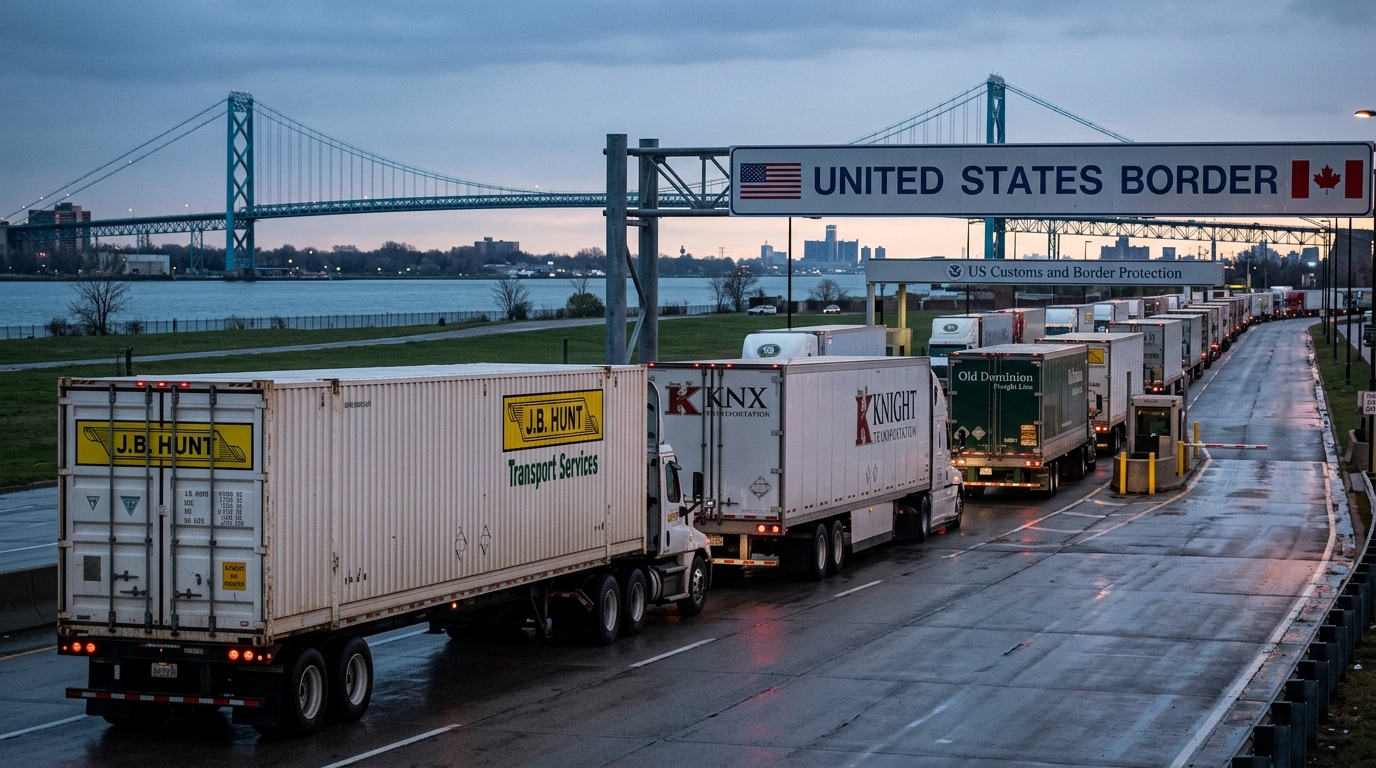
Monday’s move in freight stocks was unusually clean for a tariff headline: J.B. Hunt Transport Services dropped 5%, Knight-Swift fell 3%, and Old Dominion shed 2% after President Trump posted on Truth Social that tariffs on all Canadian cars, trucks, automotive parts, and steel will rise to 50% on January 1, 2027. The current regime taxes only non-US content at 25%. The rejected deal, which collapsed when talks broke down Friday, August 21, would have cut autos to 15% and metals to 25%. That gap is now the trade.
Why Freight Felt It First
Cross-border volume is the transmission mechanism. J.B. Hunt, which posted $12.0 billion in 2025 revenue and saw Q2 2026 revenue surge 19% on record intermodal volumes, runs an explicit cross-border logistics business across the US-Canada corridor. Its intermodal segment generated 50% of Q2 2026 revenue. When tariffs at this level are confirmed for a specific date, shippers front-load ahead of the deadline, then volumes collapse. That pattern produces a revenue spike followed by a cliff, and the market appears to be discounting the post-January freight environment, not the pull-forward.
Knight-Swift, which posted $7.47 billion in 2025 revenue and operates dedicated cross-border trucking and documentation services, faces the same dynamic. Its truckload segment alone generates the majority of its run-rate revenue. Canada’s retaliatory tariffs, announced by Prime Minister Mark Carney and set to take effect September 8, add a second variable: southbound loads may thin before northbound demand collapses, compressing utilization on both legs of the corridor.
Steel Names Staged the Opposite Reaction
Nucor added roughly 2% Monday and Steel Dynamics gained about 2%, a reversal that requires context. The prior week, both names sold off hard as headlines suggested a tentative deal could cut Canadian steel tariffs from 50% to 25%. Nucor closed Friday at $243.63 against a 52-week high of $280.11 and a 17-analyst consensus Buy with a $282.81 average target. Monday’s rebound simply restored the tariff premium the deal-hope headlines stripped away. US hot-rolled band steel was already pricing at $1,208 per metric ton as of June 24, 54% above Western European levels and 146% above the world steel export market. A deal that lowered the Canadian barrier was a direct threat to that spread; no deal preserves it.
Technical Framework
JBHT’s 52-week range spans $130.12 to $299.76, and Monday’s move pushed shares toward the lower half of that band. The 200-day moving average becomes the first meaningful structural reference on any further weakness. Volume context matters here: a 5% single-session decline on above-average volume with no bounce into the close is a distribution signal, not a dip. KNX, where Q2 2026 adjusted EPS beat consensus by $0.12, showed more resilience on a percentage basis, which may reflect its lower implied cross-border revenue sensitivity relative to JBHT’s intermodal concentration.
For NUE, the question is whether Monday’s gap held by the close. If the stock fails to sustain above $248 to $250 on volume, the risk is that Canadian retaliation caps the domestic steel price advantage, even without a formal tariff reduction. Canada’s dollar-for-dollar retaliation framework, effective September 8, introduces steel export disruption from the Canadian side simultaneously.
Scenario Modeling
Bull Case
Talks resume before January 1. The Jan. 1 date is a negotiating lever, not a locked policy, and Ottawa has a September 8 retaliation deadline it can use as counter-leverage. If a framework is announced before Q4 ends, freight names recover sharply; JBHT back toward $290 to $295 is plausible. NUE and STLD would retrace Monday’s gains and revisit the $240 to $245 zone.
Base Case
The January 1 date holds. Shippers accelerate cross-border moves through October and November, inflating freight volumes temporarily. JBHT and KNX report strong Q3 numbers then guide conservatively for Q1 2027. Steel names hold their tariff premium through year-end. JBHT consolidates in the $255 to $270 range; NUE trades between $255 and $270 as well.
Bear Case
Canada’s September 8 retaliation triggers broader volume disruption earlier than expected. Shippers route around the corridor entirely or delay shipments, hitting freight utilization before the pull-forward benefit materializes. JBHT breaks below its 200-day moving average; KNX tests the low $50s. Canadian retaliation also targets US agricultural exports, adding a second leg of cross-border freight contraction.
Active Trader Strategy Framework
The long-short structure here is straightforward in concept, more nuanced in execution. Long NUE or STLD versus short JBHT monetizes the divergence in tariff sensitivity, but the pair has two separate catalysts: steel pricing dynamics and freight volume. Position sizing should reflect that both legs can move independently. Monitor Canada’s September 8 retaliation announcement for product specifics; if automotive-related inputs appear on the list, KNX’s cross-border exposure amplifies the short thesis. For NUE, the $243 to $248 zone is technical support; a clean hold there on volume confirms the tariff premium is being priced back in. Earnings calendars matter: KNX reports Q3 results around October 21, which creates an event risk window on both sides of the trade.
The January 1 date is the anchor. Every development between now and December 31 should be evaluated against whether it moves the probability of that date holding or collapsing.