
September 20, 2026
Bonus Content: Crude Is Falling. Diesel Margins Are Not. The Refiner Trade Is Widening.
Dear Reader,
The biggest mistake investors made during America’s first Great Deflation was buying the railroads.
More than 100 of those railroads eventually went bankrupt.
The best investments were the companies that used collapsing freight costs to crush their competition.
And I believe investors are making the exact same mistake with AI today.
They’re piling into the obvious “railroads”: NVIDIA, Microsoft, Meta, and Google.
Meanwhile, one little-known aerospace manufacturer has connected 19 factories around the world into a single AI-ready data system.
And it is already producing remarkable results.
Its record profit margins climbed 25% year over year.
Revenue rose 11% last year.
But I don’t believe the story is finished.
This company isn’t trying to build the next artificial-intelligence empire. It’s using AI to make every factory faster, leaner, and more profitable.
It has now hit all five triggers in my proprietary stock-selection system, including accelerating sales, rising earnings, breakout momentum, insider buying, and meaningful disruption.
Don’t make the mistake of chasing the railroad while this potential “Price Killer” races ahead.
Good investing,
Alexander Green
Chief Investment Strategist, The Oxford Club
P.S. 19 connected factories, record margins, and all five of my triggers tell me the larger story may still be ahead.
See my larger prediction here.
Crude Is Falling. Diesel Margins Are Not. The Refiner Trade Is Widening.
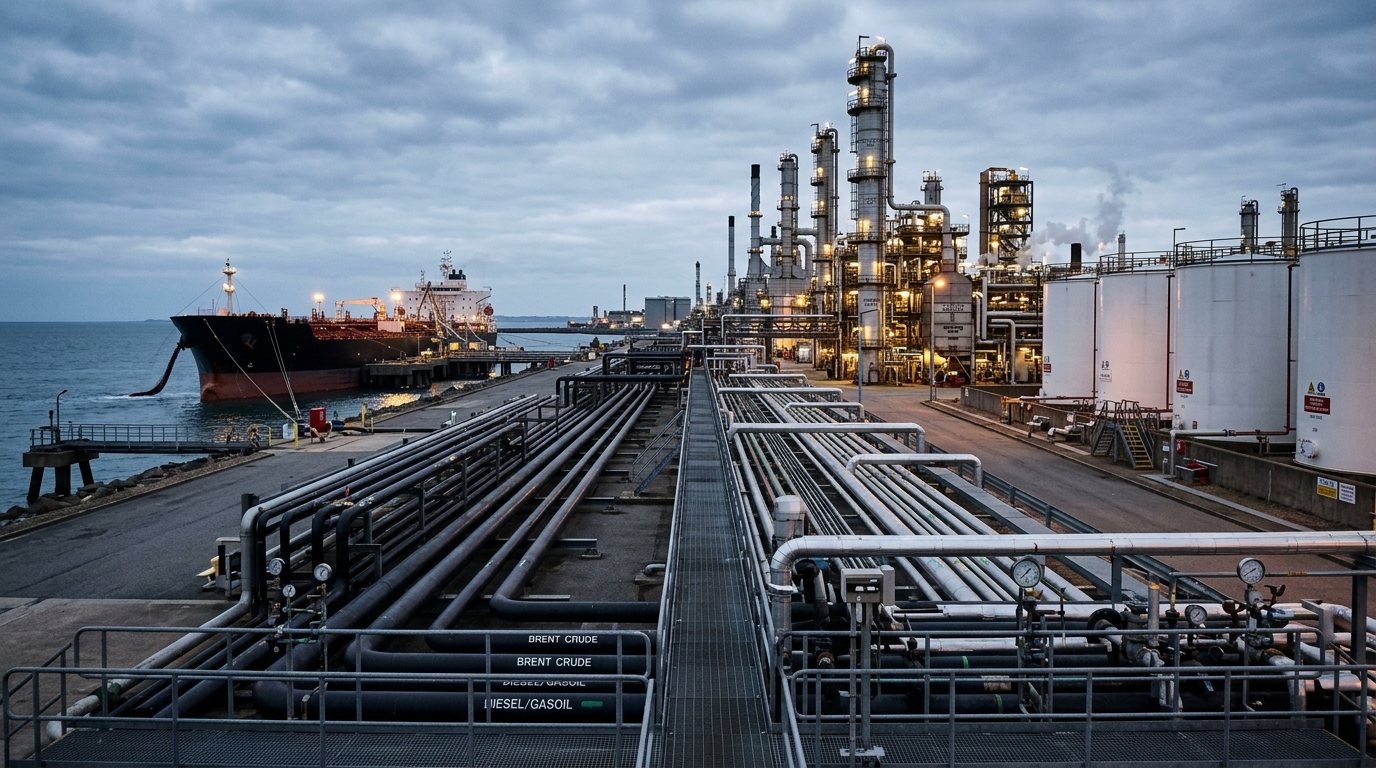
Brent has shed roughly 5% over three sessions, finishing Friday near $103.87 as Saudi Arabia moved to restore partial flow through its drone-damaged East-West pipeline. Traders read the partial repair as evidence the crude supply shock was peaking and sold accordingly. European diesel margins read that same headline and barely moved. Low-sulphur gasoil margins stayed elevated into Friday, and early-September assessments showed the ARA diesel crack at record highs above the mid-$90s per barrel over Brent before easing.
That decoupling is the trade. Crude has a workaround. Distillate does not.
Market Context
The Saudi East-West pipeline, which can carry up to 5 million barrels per day to the Red Sea terminal at Yanbu and is the kingdom’s primary Hormuz bypass route, was hit by drones on September 11 and was expected to be largely out of service for weeks as repairs proceed. The pullback in Brent reflects the market’s shifting view of how quickly Saudi flows can be restored, not a clean reset in product fundamentals.
Hormuz vessel traffic tells a different story. Tracking data and market reporting showed commodity vessel transits falling to single digits on some days in early September, including reported counts around four transits on a Thursday versus a 10-day average near the mid-teens. The IEA’s September report estimates Gulf diesel and gasoil net exports averaged 390,000 barrels per day in August, just over a quarter of pre-war levels. U.S. distillate inventories remain unusually tight for the season, and refineries have been running in the high-90% range on utilization, leaving limited operating slack.
The Crack Spread Is the Story
The U.S. ULSD crack spread against WTI reached record territory in late August and early September, with industry benchmarks near $100 per barrel around September 1. In Europe, the ARA diesel crack hit a record $98 per barrel on September 1 before easing from those highs in subsequent sessions. Both Atlantic Basin benchmarks have remained far above typical seasonal ranges.
The arithmetic at the pump confirms the inversion. U.S. diesel prices pushed into record territory this month, with EIA’s national on-highway diesel series showing levels above $6 per gallon in September. The crisis is in conversion capacity, not in the barrel.
Refiner Financials
Marathon Petroleum’s Q2 2026 Refining and Marketing adjusted EBITDA reached $6.66 billion, up from $1.89 billion a year earlier, with margin per barrel climbing to $36.33 from $17.58. Q2 EPS of $17.73 beat consensus, on revenues of about $52.34 billion. The valuation comparison in the market has moved with the cycle, so treat any single forward-multiple snapshot as time-sensitive rather than a fixed anchor.
Valero’s Q2 2026 results showed sharply higher earnings, with adjusted EPS of $12.54 (and GAAP EPS of $12.62). Some of the draft’s percentage claims for quarter-over-quarter EPS growth, operating margin expansion, year-to-date stock performance, and a specific Q3 reporting date were not supportable from primary company disclosures as written, and have been removed. Separately, Goldman Sachs has raised its outlook for U.S. diesel refining margins to about $63 per barrel in 2027, framing the squeeze as potentially longer-lived if disruptions persist.
PSX achieved record 88% clean product yield in Q4 2025 at 99% crude utilization. Broad index performance claims for refiners versus drillers vary by index definition and timestamp, so treat the relative-strength signal as real, but avoid pinning it to a single unverified year-to-date percentage.
Technical Framework
VLO, MPC, and PSX have all reached or extended 52-week highs alongside the crack spread move. The group tends to hold its bid as long as the gasoil crack remains above $70 on a weekly close basis, a level consistent with structurally elevated refiner margins. A weekly close below that threshold on the European benchmark would signal demand destruction beginning to bite. Watch ULSD front-month volume on any crude bounce: product staying bid while crude rallies is confirmation; product softening with crude would suggest some margin compression is ahead of Q3 earnings.
Scenario Modeling
Bull Case: Hormuz traffic remains constrained into October, the Amsterdam-Rotterdam-Antwerp hub records no meaningful import relief late in September, and winter demand lifts European gasoil back toward the early-September record zone. VLO and MPC Q3 EPS come in 20%-plus above current consensus. European gasoil crack sustains above $85.
Base Case: Saudi pipeline restoration progresses over the coming weeks, easing crude by another 3%-4%. Distillate margins compress modestly but hold above $70 over Brent as inventory rebuilding remains slow. Goldman’s roughly $63 per barrel U.S. margin forecast for 2027 proves directionally correct; refiner stocks consolidate gains rather than extending them ahead of October earnings.
Bear Case: Saudi pipeline capacity returns faster than expected, de-escalation signals improve shipping confidence, and U.S. distillate exports normalize. European gasoil cracks fall toward $55, erasing the primary earnings catalyst. Refiner equities give back 20%-30% of their year-to-date advance.
Active Trader Framework
The asymmetry favors refiners with the highest distillate yield and the largest throughput base as long as the ARA hub records no material import increase. With earnings dates varying by company and subject to change, traders should confirm the next reporting calendar rather than anchor on a single day. Identify the $70 gasoil crack as a key monitoring level for margin assumptions. Position sizing in a group that has already rallied hard warrants discipline: the structural thesis is intact, but the easy leg has been run. Monitor weekly EIA distillate data each week as the most reliable real-time signal on whether the inventory picture is shifting.
Preparation here means watching the product, not the barrel. Crude has a Saudi workaround. Diesel does not have one yet.