Hey Trader,
I have a huge problem.
I’ve developed a “genius” trading system that picks winners at a 95.3% rate – I’m talking about 838 winners out of the last 879 trades.
But the trading system is so automatic it’s almost boring!
Most days look exactly the same – place the trade in the morning, let it expire that night, and collect the cash. Repeat, repeat, repeat.
If you can stifle a yawn, this is an incredible way to grow a trading account…
Free Report: Super Boring Trade Strategy Spots 95.3% Winning Trades
To Your Success,
Dave Aquino
Self-Driving Trucks Cut 35% Off Sunbelt Freight Costs. Here Is Who Captures the Margin.
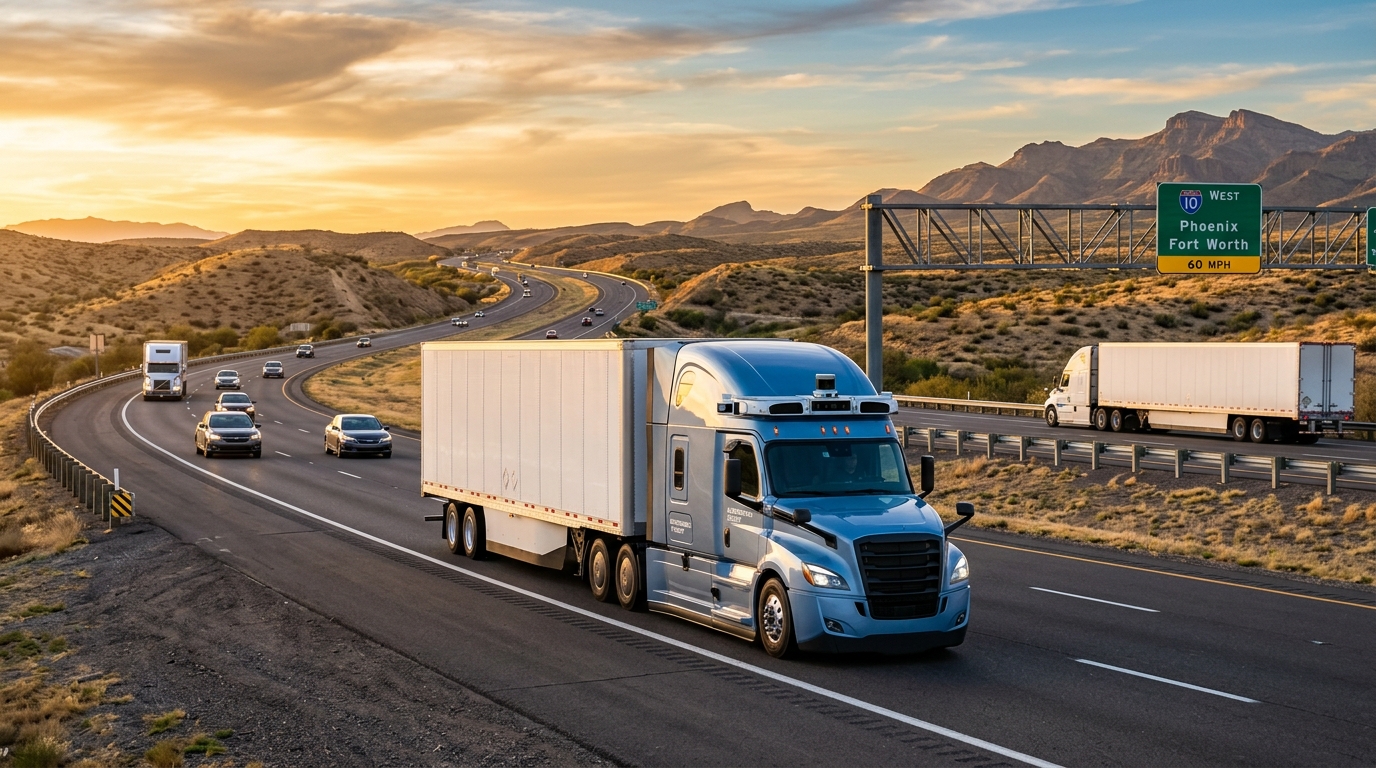
The Fort Worth-to-Phoenix run is 1,000 miles. A human driver, bound by Hours of Service rules, needs two days to complete it. Aurora Innovation’s autonomous trucks cover the same corridor in approximately 15 hours, and they do it without a single mandated rest stop. That time compression is not an operational curiosity. It is the core of a freight cost argument that is now moving real revenue.
A University of Illinois study released in July 2026 estimated that driverless trucks could reduce transportation costs by 35%. That figure maps closely to what operators are booking on live lanes. Aurora has said it expects to price its Driver-as-a-Service at about $0.85 per mile, while noting that direct driver wages plus benefits alone are north of $1 per mile in third-party benchmarks. Against a current ATRI industry benchmark of $2.336 per mile for a fully loaded human-driven truck in 2025, the autonomous cost wedge is significant and widening.
The Corridors That Matter
Aurora tripled its driverless network to 10 routes across the Sun Belt in February 2026, accumulating over 250,000 driverless miles with zero Aurora Driver-attributed collisions as of January 2026. The active lanes include Dallas to Houston at roughly 240 miles, Fort Worth to El Paso at 600 miles, and El Paso to Phoenix at 430 miles, all running on commercial freight today. Operations are concentrated on I-10, I-20, and I-45 in the Sun Belt, corridors chosen precisely because favorable weather and long uninterrupted highway stretches lower the complexity threshold for autonomous systems.
The middle-mile picture looks different but equally concrete. Gatik operates fully driverless medium-duty trucks 24 hours a day across Texas, Arizona, and Arkansas, and has reached $600 million in contracted revenue for daily deliveries to multiple Fortune 50 retailers. The company has completed 60,000 fully driverless orders without incident, according to the company. Berkshire Hathaway’s McLane, meanwhile, traveled over 280,000 autonomous miles in Texas with Aurora and delivered 1,400 loads at a 100% on-time delivery rate during its pilot.
The Valuation Disconnect
Aurora trades near $5.60 with a market cap around $11 billion as of October 2, 2026. The company expects 2026 revenue of $14 to $16 million, up 400% year-over-year at the midpoint. Financial targets include $5 billion-plus revenue and 60%-plus gross margins by 2030. The gap between today’s revenue base and that 2030 target is where all the risk lives. Trailing twelve-month free cash flow was about negative $646 million, while trailing twelve-month revenue is roughly $5 million. The company reported $136 million of cash and cash equivalents and $1.081 billion of short-term investments as of June 30, 2026, which buys runway but does not close the execution gap.
Aurora’s business model involves charging per mile rather than selling hardware, which lowers the barrier for carrier adoption but also means revenue scales only as fast as truck count and utilization. Aurora has said it expects to exit 2026 with 200 driverless trucks in operation across the Sun Belt. Analyst consensus price targets sit around $12, implying the 2030 targets are achievable. Conviction in that view requires believing scale arrives on schedule, which no autonomous trucking company has yet demonstrated at the numbers management is projecting.
Three Scenarios
Bull case: Aurora reaches 200 trucks by December 2026 with utilization above 70%, pushes annualized revenue toward the $80 million run rate the company has highlighted for exiting 2026, and the Driver-as-a-Service model gains a second major shipper beyond McLane. AUR trades back toward $8 to $9 as 2027 contract visibility improves.
Base case: Fleet ramp lands in the 150-truck range by year-end, 2026 revenue closes at the $15 million midpoint, and the stock consolidates between $5 and $6.50 as the market waits for 2027 contract announcements. Sun Belt corridor deployments continue growing at roughly 19% annually, enough to sustain the story but not enough to force a rerating before hard revenue data arrives.
Bear case: A system-attributed incident on any active Sun Belt lane triggers a regulatory review. State frameworks in Texas, Arizona, and other states that have established commercial autonomous vehicle operating frameworks are young enough that a single high-profile event could stall permit expansion. Cash burn at the current pace puts the 2027 capital raise question back on the table, and AUR tests the low end of its 52-week range near $3.60.
Active Trader Framework
The next earnings date is not yet confirmed by the company, but market calendars currently point to late October or early November 2026 as the likely window based on prior reporting patterns. Traders should watch truck count disclosure and any language around the 200-truck year-end target. A shortfall there is likely to compress the stock faster than a revenue beat can lift it, given how little current revenue matters relative to fleet trajectory. Volatility is elevated, with a high beta, so position sizing relative to that beta matters more than the directional call. McKinsey projected the autonomous trucking industry could become an approximately $600 billion market by 2035, which sets the total addressable market context, but the trade in front of you is a 200-truck fleet count and a cash burn rate, not a 2035 projection.
Preparation over prediction. The Sun Belt lanes are real, the cost math is real, and the execution gap is also real. Know which of the three you are trading.