October 3, 2026
Bonus Content: Banks Are Paying Millions to Replace COBOL. AI Changed Who Wins
Dear Reader,
Do you hold any of these AI stocks?
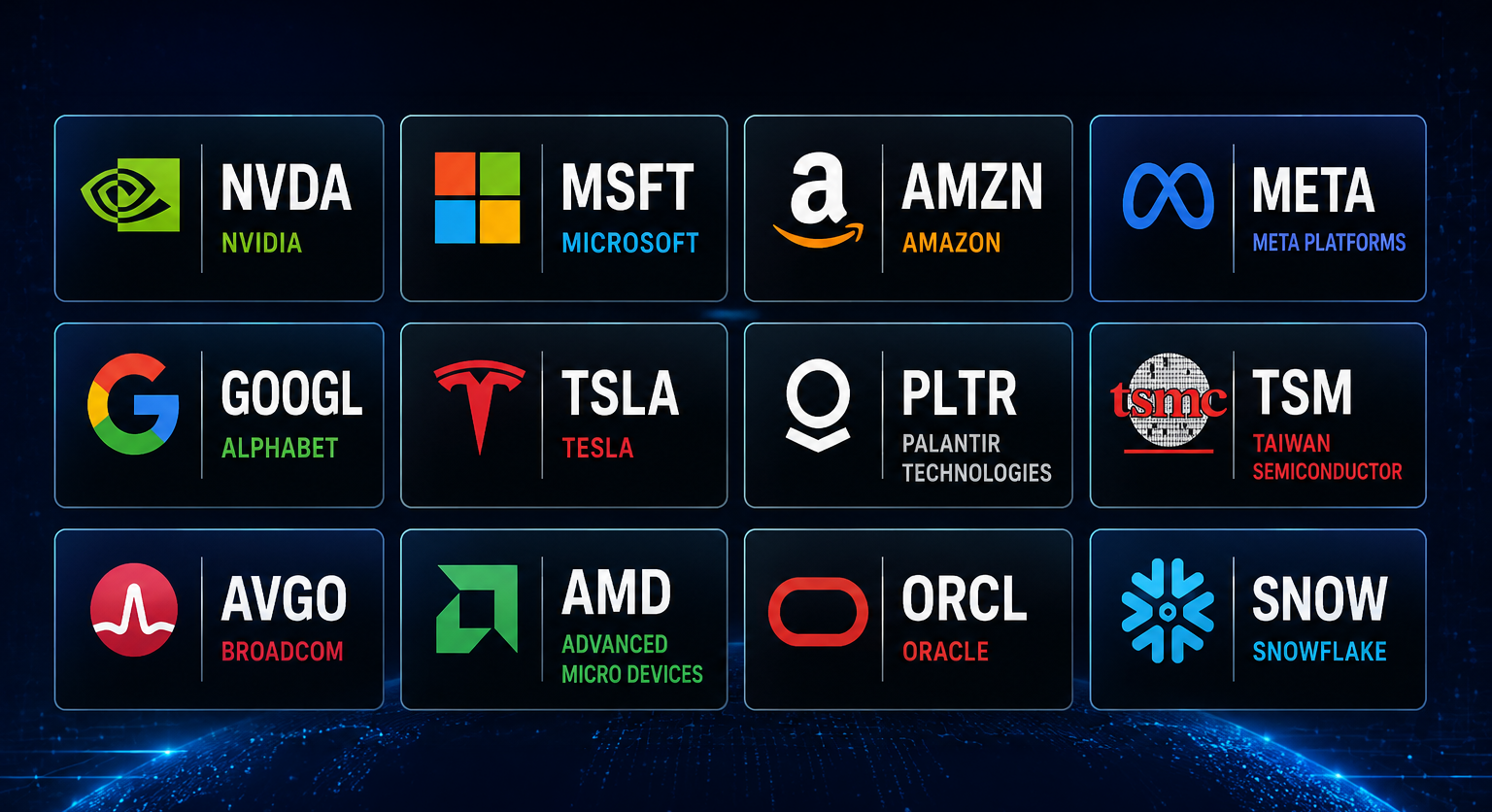
Wall Street insider Jason Bodner – the man who called Nvidia at $4.50 – says today’s AI stocks are about to hit a wall.
And a completely different group of AI firms… names Wall Street is starting to ignore… are about to take off.
This has nothing to do with SpaceX…
A new chatbot…
Autonomous robots…
Or anything you’re likely hearing about.
It has to do with a brand-new “light-speed” device turning AI as we know it into “Accelerated AI”…
Making it 100 times faster…
And 100 times more energy efficient – right here, on Earth.
Already, some of the biggest tech investors like Elon Musk, Mark Zuckerberg, Cathie Wood, and Bill Gates are moving money into it.
Just to name a few…
They’re all moving money to prepare for what’s coming.
But you won’t hear anything about it in the mainstream news…
In fact, TV pundits spent most of this past year talking about AI worries and its “existential risk” to jobs…
Or arguing whether we’re in an AI bubble and when it would pop…
That’s why most Americans won’t see it coming until it’s too late.
Don’t be one of them…
Because if you’re holding the wrong AI stocks when “Accelerated AI” goes mainstream…
You could spend the next decade just trying to claw back to even…
But if you make the one move Jason reveals in this urgent video message…
The next 12 to 24 months could hand you bigger gains than the entire AI boom of the last three years.
Click here to hear the full story and get ahead of the crowd.
But hurry, because this opportunity won’t stay hidden much longer.
We have so much to look forward to,
Jeff Brown
Founder & CEO, Brownstone Research
P.S. Jason also shares details on 10 popular AI stocks he says you must dump before this shift goes mainstream. Names sitting in millions of 401(k)s, IRAs, and brokerage accounts. Click here to see if yours made the list.
Banks Are Paying Millions to Replace COBOL. AI Changed Who Wins

There are still 220 billion lines of COBOL running in production, maintained by a workforce retiring faster than it can be replaced. That single fact has created one of the largest enterprise software backlogs in a generation. What is changing now is not the scale of the problem, it is who profits from fixing it.
Modernization project costs are moving lower as automation improves, but there is no widely accepted, independently reported benchmark showing an average drop from $9.1 million in 2023 to $6.8 million in 2026. The directional point stands: what looks like good news for bank CIOs is a direct threat to billable hours for legacy IT services contractors.
Where the Backlog Sits
The banking, financial services, and insurance vertical is consistently cited as one of the largest slices of the application modernization market, with some market summaries placing it in the mid-20% range. Surveys of bank technology leaders also continue to flag legacy integration as a core blocker, but the specific claim that 70% of firms cite it as the primary obstacle is not consistently corroborated across primary survey releases. The urgency is not theoretical: claims that the COBOL talent pool will shrink from roughly 220,000 specialists to 18,000 by 2030 are widely circulated, but the underlying methodology is not consistently documented, and the numbers should be treated as directional rather than precise. Likewise, the idea that roughly 10% of the workforce exits annually is plausible but not reliably supported as a universal, sourced statistic.
The cost math on the infrastructure side is often presented as stark, but the specific comparison of a “typical 5,000-MIPS workload” costing $7.88 million a year on z/OS versus $2.40 million on AWS is not supported by a broadly accepted primary source and will vary materially by software licensing terms, capacity pricing model, utilization profile, and migration approach. The underlying driver remains valid: when the fully loaded mainframe run-rate meaningfully exceeds a cloud or hybrid steady state, that gap becomes the economic engine behind modernization contracts.
AI Agents Compress the Discovery Phase
The real disruption is not in the migration itself, it is in the phase that always preceded it. Discovery timelines and price tags vary widely by institution and portfolio complexity, and the specific claim that vendors quoted discovery at 18 to 24 months and $5 million or more as a standard baseline is not reliably supported as a general market benchmark. What can be stated with confidence is that AI-assisted analysis, mapping, and documentation can compress early-stage understanding and documentation work substantially in many programs.
That compression is showing up inside major institutions. Morgan Stanley has said it modernized more than 17 million lines of COBOL, Software AG’s Natural, and PERL code into modern languages including Java and Python using its in-house platform, DevGen.AI. The separate claim that the platform reduces coding tasks that previously required a week to half a day is not consistently supported in primary reporting and is best treated as an illustrative outcome rather than a verified, repeatable metric. Multi-agent architectures are delivering similar results at scale, but the specific description of “one large bank” achieving over 50% reduction in development time in an agentic AI digital factory cannot be verified without a named institution and a primary report.
The Competitive Split
Traditional IT services firms face a structural question. Accenture reported $74.2 billion in fiscal 2026 revenue, becoming a live test case for whether generative AI shrinks the billable work that IT services firms depend on. Its answer so far is bookings growth: the company reported fourth-quarter fiscal 2026 bookings of $22.17 billion with a 1.2 book-to-bill ratio, and it also reported a record 141 quarterly client bookings of $100 million or more for the year.
Smaller specialist platforms are taking the other side of that trade. Blitzy said it raised a $200 million growth round at a $1.4 billion valuation and markets a model that orchestrates large numbers of AI agents to modernize and validate changes across legacy enterprise codebases. The model aims to strip humans out of commodity translation work while leaving architecture decisions and regulatory validation to senior engineers.
The Risk the Backlog Is Hiding
Speed creates its own exposure. Precise split figures vary by system and risk tolerance, and the specific claim that the remaining 15 to 30% of modernization work that AI cannot automate concentrates in unstructured business rule recovery, data migration, and integration testing is a reasonable framing but not a universally validated benchmark. More defensible is the principle: the hardest residual work clusters where context, edge cases, and operational risk live, precisely the areas where a failure surfaces at 2 a.m. during a nightly batch run. Broad “80% handled by AI” statements should be treated as program-dependent and vendor-dependent rather than a general law of modernization.
For traders, the modernization backlog is not a single position. The large integrators are defending margin through scale and bookings velocity. The specialist AI platforms are compressing per-project economics. The institutions that own the COBOL are the buyers, not the beneficiaries. Knowing which layer captures the spread is the actual trade.