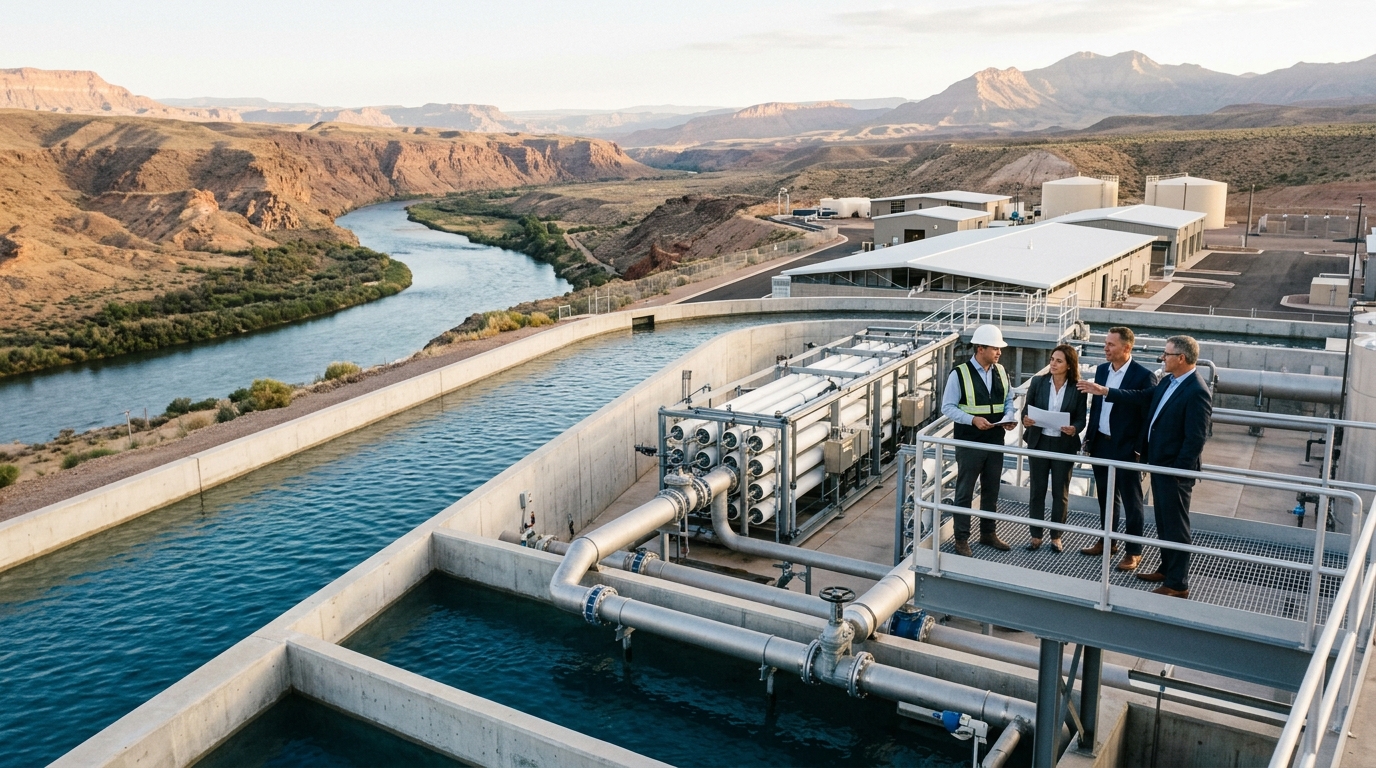
The water trade is live, and it is not waiting for consensus. On June 3, water authorities in Arizona, California, Nevada, and the federal Bureau of Reclamation signed a first-of-its-kind memorandum of understanding to jointly explore how desalination and advanced water purification could support interstate exchanges across the Colorado River Basin, including potential future exchanges tied to San Diego County Water Authority’s desalinated seawater supply. The MOU does not move a single gallon across state lines physically. It also does not alter existing water rights or commit any party to a specific project. What it moves is capital and contracting urgency.
The macro case is no longer theoretical. Lake Mead and Lake Powell have fallen to their lowest combined storage since before Glen Canyon Dam began filling in 1963. The Colorado River Basin lost approximately 27.8 million acre-feet of groundwater between 2002 and 2024, a volume roughly equal to Lake Mead’s full capacity. Congress authorized $250 million in IIJA desalination project grant funding for FY2022 through FY2026. That is a policy floor, not a ceiling.
Where the Contract Dollars Are Landing
The global water desalination market stood at $21.74 billion in 2024. Forecasters project it reaches $58.38 billion by 2033. Municipal drinking water projects specifically are growing at 7.1% annually, with modular containerized systems gaining share in water-stressed communities. The Middle East accounts for an estimated 38.1% of market share in 2026, but the structural story for traders is the acceleration in North American municipal procurement.
Consolidated Water (CWCO) is the cleanest listed operator exposure for U.S. accounts. The company reported H1 2026 revenue of $62.8 million, down from $67.3 million a year earlier, with the decline driven primarily by a sharp drop in manufacturing revenue. Beneath that drag, bulk revenue rose 20% to $9.9 million in Q2, and construction revenue surged 89% to $5.3 million. The company carries $132.6 million in cash with minimal debt, providing balance-sheet capacity as its project pipeline builds.
Two contract milestones define the near-term catalyst window. In July, Consolidated Water said it received a Limited Notice to Proceed from the Honolulu Board of Water Supply authorizing approximately $6 million in long-lead equipment procurement for the Kalaeloa seawater reverse osmosis plant, a 1.7-million-gallon-per-day facility operating under a design-build-operate-maintain structure with a 20-year base term plus two five-year extension options. Construction remains blocked by an archaeological preservation permit that management has described as a critical gating item. Separately, CWCO announced a record $10.1 million Florida municipal equipment order, its largest membrane and filter order to date, with delivery scheduled for November 2027.
The Technology Layer: ERII’s Margin Problem
Energy Recovery (ERII) sits one step up the value chain, supplying the pressure-exchanger technology that makes modern SWRO economics viable. With isobaric energy recovery devices, energy consumption falls from 7 to 12 kWh per cubic meter on legacy systems to 2.5 to 4.0 kWh, slashing the cost of production to $0.40 to $0.80 per cubic meter at scale. That efficiency gain is the reason municipal RO can now compete structurally.
The investment case is more complicated. ERII posted H1 2026 revenue of $21.7 million, down 40% year-on-year, with megaproject revenue falling from $14.8 million in Q2 2025 to $2.7 million in Q2 2026 as shipment volume fell amid delays tied to the war in Iran. The company did not provide 2026 revenue guidance, and in Q1 reported revenue of $9.7 million, up 20% year-on-year and 17% ahead of consensus, but with gross margin compressed to 27.8% from 55.3% due largely to charges tied to winding down the CO2 retail grocery business within Emerging Technologies. The CO2 exit removes a distraction, but revenue visibility remains thin.
Scenario Modeling
Bull Case: The Colorado River MOU advances to formal purchase agreements in H1 2027. CWCO’s Kalaeloa archaeological permit clears by Q1 2027, triggering full notice to proceed on a roughly $204 million project. ERII books a megaproject order wave from the Gulf states resuming in Q4 2026, lifting revenue toward the $119.6 million full-year consensus estimate and restoring margins above 40%. CWCO’s bulk and services segments maintain double-digit growth. CWCO trades toward 2.5x book; ERII re-rates toward 6x forward sales on order recovery.
Base Case: Kalaeloa moves to full construction in mid-2027, keeping CWCO’s near-term revenue flat as manufacturing weakness persists through Q4 2026. ERII closes 2026 with revenue near $120 million on gradual Middle East normalization, margins recovering toward 35% as CO2 drag fades. CWCO’s 25-year Grand Cayman license, approved in June with a stated commencement date of August 1, 2026, underpins the retail segment. Both stocks range-bound into year-end absent a permit catalyst or a large order announcement.
Bear Case: Archaeological permitting on Kalaeloa extends into 2028, delaying the roughly $204 million revenue recognition cycle and pressuring CWCO’s services margin, which fell to 16% in Q2 2026 on O&M contract expirations. ERII faces renewed order slippage if Saudi or UAE procurement is deferred again, pushing full-year revenue toward $100 million and widening net losses beyond the $15.4 million H1 figure.
Active Trader Framework
For CWCO, the permit timeline is the only variable that matters. The $132.6 million cash position removes balance-sheet risk as a bear catalyst; the manufacturing segment drag is transitory and already partly visible in consensus. Watch for any Honolulu regulatory filing or EPA permit update as the decisive level trigger. For ERII, the Q3 earnings report is the key date: megaproject backlog of $8.8 million expected in H2 2026 either grows on new award announcements or confirms the revenue gap. Position sizing should reflect the lack of guidance and the binary permit outcome on Kalaeloa. Volatility in both names tends to compress between earnings events and expand sharply on contract news.
The structural demand is verified. Arizona is negotiating to buy desalinated Pacific water. The Bureau of Reclamation has two active funding rounds closing in 2027. The capital question is not whether the contracts exist; it is which part of the value chain captures them first and on what timeline. That is the discipline the next three months will test.