Boeing trades around $190 with earnings ten days out, roughly a 75x trailing P/E. Q2 gross margin was about 9.8%, and the balance sheet cut total debt by about $8.2 billion in the first half of 2026. CEO Kelly Ortberg’s recovery thesis is tight: focus on core planes, pare peripheral businesses, and let free cash flow confirm the turn. Q2 revenue hit $24.6 billion, up 8% year over year, with 171 deliveries, the highest quarterly total since 2018. The market saw all of that and still sent BA down about 15% year to date.
What the recovery framing leaves off the ledger is the energy chemistry question embedded in the August 10 Archer deal. Boeing agreed to transfer Wisk Aero, Insitu, and SkyGrid to Archer in exchange for a 19.75% Class A stake, two warrants with up to four years of term, and a commitment to invest up to $55 million in Archer’s next equity raise on or before March 31, 2027. The stake was worth roughly $930 million at announcement. That is the headline. The technical detail that matters for forward positioning is the retained access clause: Boeing kept access to Wisk’s core autonomous flight technology for use in current and next-generation commercial and defense aircraft.
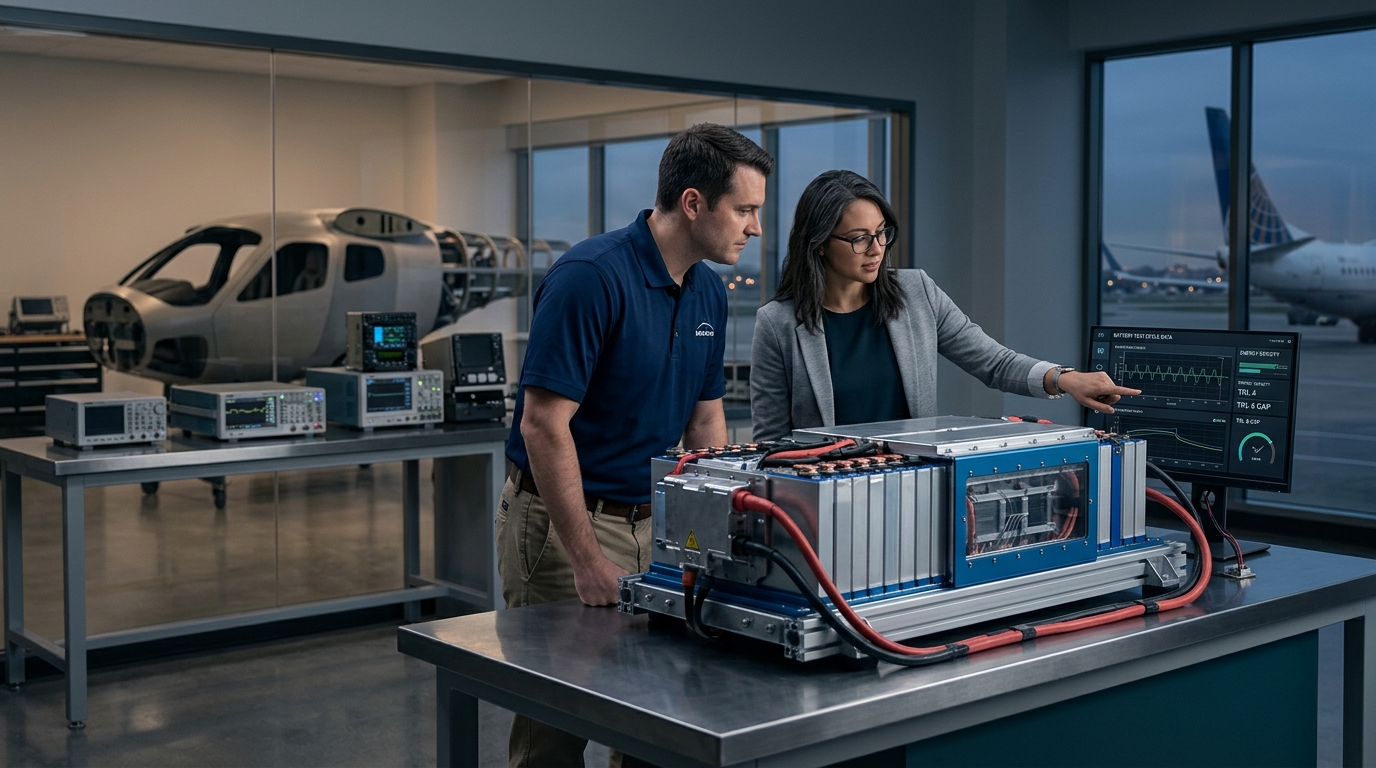
Those next-generation aircraft need a battery chemistry that does not yet exist at flight-ready scale. Current lithium-ion cells top out at 250 to 300 Wh/kg at the cell level. A common threshold cited for meaningful commuter and regional electrification is roughly 500 to 600 Wh/kg at the pack level, with larger narrow-body applications requiring far more. Lithium-sulfur carries a theoretical ceiling of 2,567 Wh/kg. What matters is the practical curve: aviation-grade cycle life, power density for takeoff, thermal management, and certification evidence, not the theoretical number.
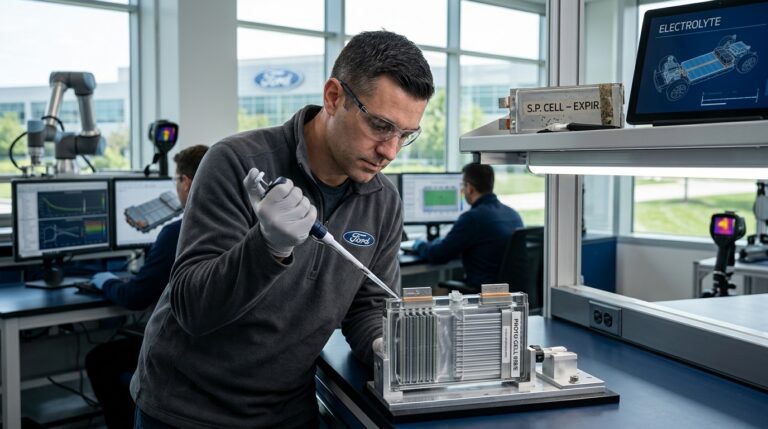
Lyten has positioned lithium-sulfur for aviation and defense use cases and says it is manufacturing lithium-sulfur cells in San Jose while operating energy storage manufacturing in Gdańsk. It also says it holds 550+ granted or pending patents. Reaching Wisk-grade autonomous eVTOL specs through Archer, and eventually Boeing’s next commercial platforms, runs through whoever closes the TRL gap first.
Scenario Modeling
Bull case: Lyten or a comparable supplier demonstrates a repeatable path to 500 Wh/kg with cycle life that supports aviation duty cycles, and the program builds toward certification under DO-311A. Boeing’s Archer stake appreciates materially, and BA re-rates toward the $235 analyst target as Q3 results show continued free cash flow progress past the $631 million Q2 reading.
Base case: Li-S remains pre-commercial for aviation through 2027. Boeing’s core recovery story, 737 MAX production toward 47 per month, 737-7 and 737-10 certification, and full-year free cash flow of $1 to $3 billion, drives BA back toward $210. The Archer stake is an option, not a catalyst.
Bear case: Q3 earnings on October 27 miss on margin, Air Force One overruns expand beyond the $280 million Q2 charge, and Li-S commercialization slips further. BA retests the 52-week low near $177, with the Archer stake providing limited offset at current ACHR valuations.
The October 27 binary is not unique to Boeing among large defense and aerospace primes. RTX showed how a record backlog and multi-quarter beat streak can still leave traders exposed when margin expectations are set too high.
Active Trader Framework
The October 27 earnings date is the near-term binary. Watch gross margin against the Q2 reading of about 9.8% and free cash flow versus the $631 million Q2 figure. The 52-week range of $176.77 to $254.35 gives the structural anchors. RSI near the mid-30s signals oversold territory but does not resolve the margin trajectory question. Position sizing ahead of earnings should account for BA’s beta of 1.26. The Li-S angle is a 12 to 18-month thesis, not an October trade; its relevance now is in assessing whether the Archer deal was a clean divestiture or a structured bet on the next propulsion cycle.