Abbott Laboratories reports Q3 2026 results before the opening bell on Wednesday, October 21. Wall Street is looking for $1.42 in adjusted EPS on $12.99 billion in revenue, a 14.3% year-over-year top-line increase. The number that matters most for structural positioning sits inside the Diagnostics line.
The Lab That Fits on a Cart
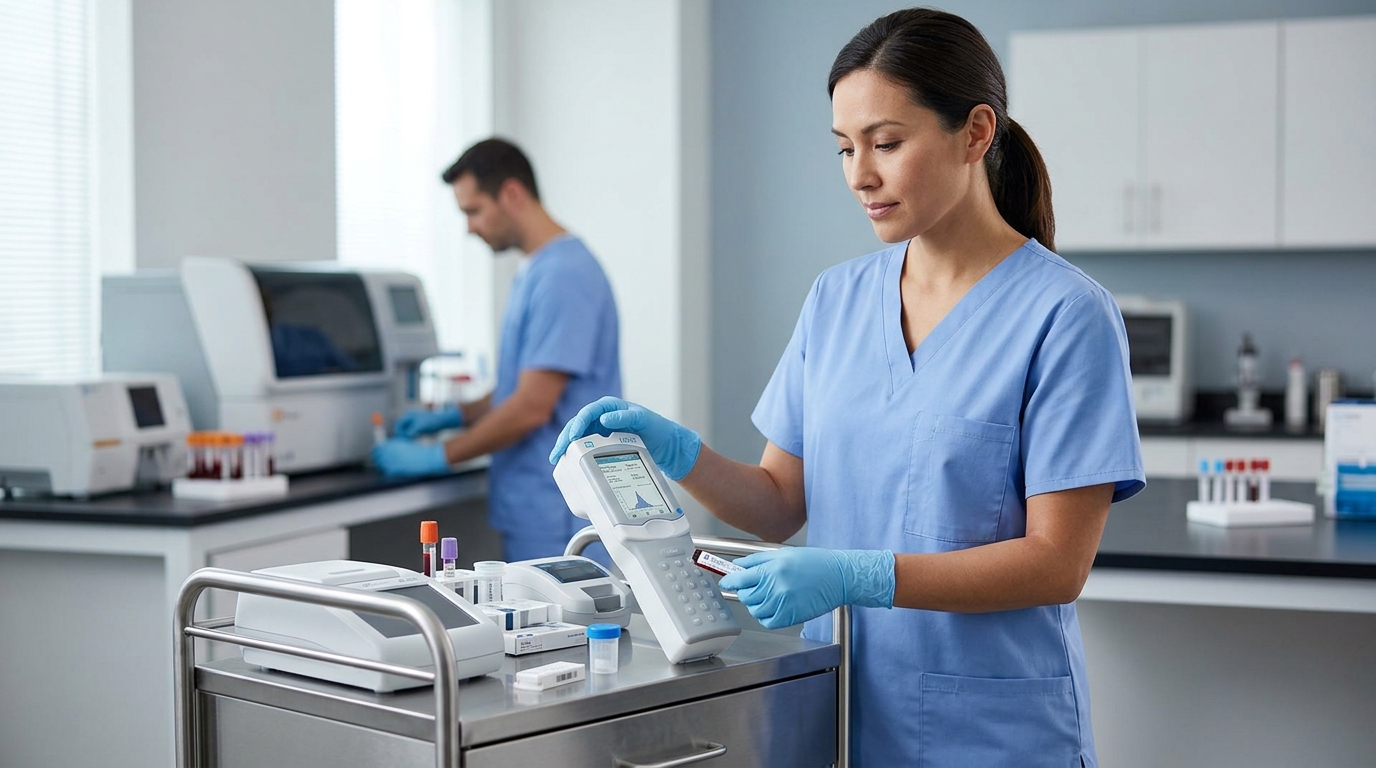
Analysts project Q3 Diagnostics revenue at $3.29 billion, a 45.9% year-over-year increase. That figure is Exact Sciences acquisition-inflated, but the organic engine underneath it is Abbott’s point-of-care microfluidic platform: the i-STAT system. The i-STAT Alinity and i-STAT 1 run blood gases, electrolytes, coagulation markers, cardiac troponin, and traumatic brain injury biomarkers from a single whole-blood draw, returning results in roughly 15 minutes using cartridges built on microfabricated silicon chips with gold amperometric electrodes. That is a clinical laboratory compressed into a device a nurse can carry to a bedside.
Abbott says its systems and tests screen more than 50% of the world’s blood and plasma supply across its broader diagnostics infrastructure. The Point of Care business generated $588 million in 2025 sales, modest relative to Core Laboratory’s $5.235 billion, but the strategic weight is disproportionate. Every cartridge sold is a recurring consumable attached to a placed instrument, a razor-and-blade model running at hospital scale.
The Market Pricing the Hardware, Not the Cartridge Stream
ABT trades at a forward P/E that varies by data source and estimate set, and remains elevated relative to many large-cap healthcare peers. The gap reflects the market rewarding Abbott’s device franchise without fully separating the durable microfluidic consumables stream from cyclical respiratory testing demand. In Q1 2026, Rapid and Molecular Diagnostics sales were down about 10% on a weaker respiratory season.
The broader microfluidics market provides context. Market research forecasts commonly peg the category near $11.9 billion in 2026 and around $20.7 billion by 2030, implying a mid-teens annual growth rate. The key point for traders is not the exact TAM math, but the embedded installed base logic: Abbott’s i-STAT footprint is a direct claim on decentralized testing growth without needing to win a new platform cycle.
Abbott is not the only medical-device name where competitive dynamics inside diagnostics and electrophysiology are reshaping the installed-base math. Boston Scientific’s EP share losses to Abbott and Medtronic show how quickly a dominant platform position can erode when a rival’s cartridge economics improve.
Three Scenarios Into Wednesday
Bull Case: Abbott beats on Diagnostics, with cancer diagnostics growing above the 13% Q1 comparable rate and Core Lab expanding internationally. Management raises full-year EPS guidance above the current $5.45-$5.60 range. The stock tests the ~$120.7 consensus analyst target.
Base Case: Revenue lands near $12.99 billion with EPS at $1.42. Cancer diagnostics and Core Lab carry the quarter; Rapid and Molecular remain soft on low respiratory volumes. No guidance change. ABT holds near current levels around $104.
Bear Case: Diagnostics misses the $3.29 billion estimate on continued respiratory weakness and China volume-based procurement drag. Nutrition legal costs surface as a margin headwind. EPS comes in below $1.38 and the stock revisits the $95-$97 support zone seen earlier in 2026.
What Active Traders Should Map
The $104 level is near-term consolidation support; $108.50 was the rejection point from September. Implied volatility on ABT options heading into the report has been pricing a move of roughly 4%-5%, consistent with its recent post-earnings range. Positioning around the Diagnostics beat-or-miss is the cleanest catalyst expression. Monitor the cartridge margin commentary on the 9:00 AM ET conference call, not just the headline revenue figure. That is where the microfluidic moat is either confirmed or questioned.