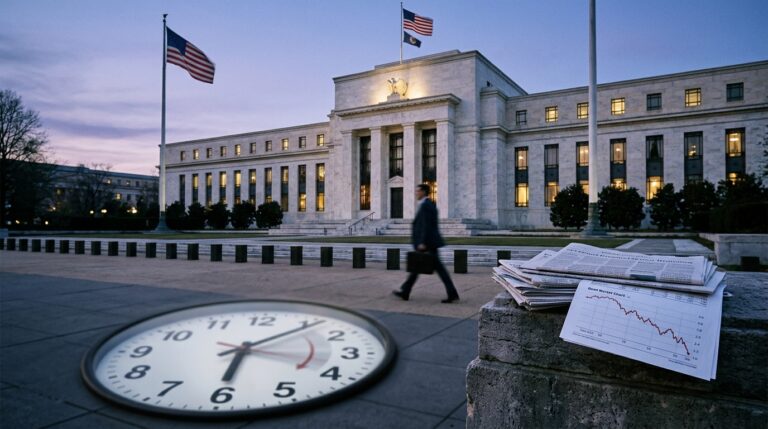
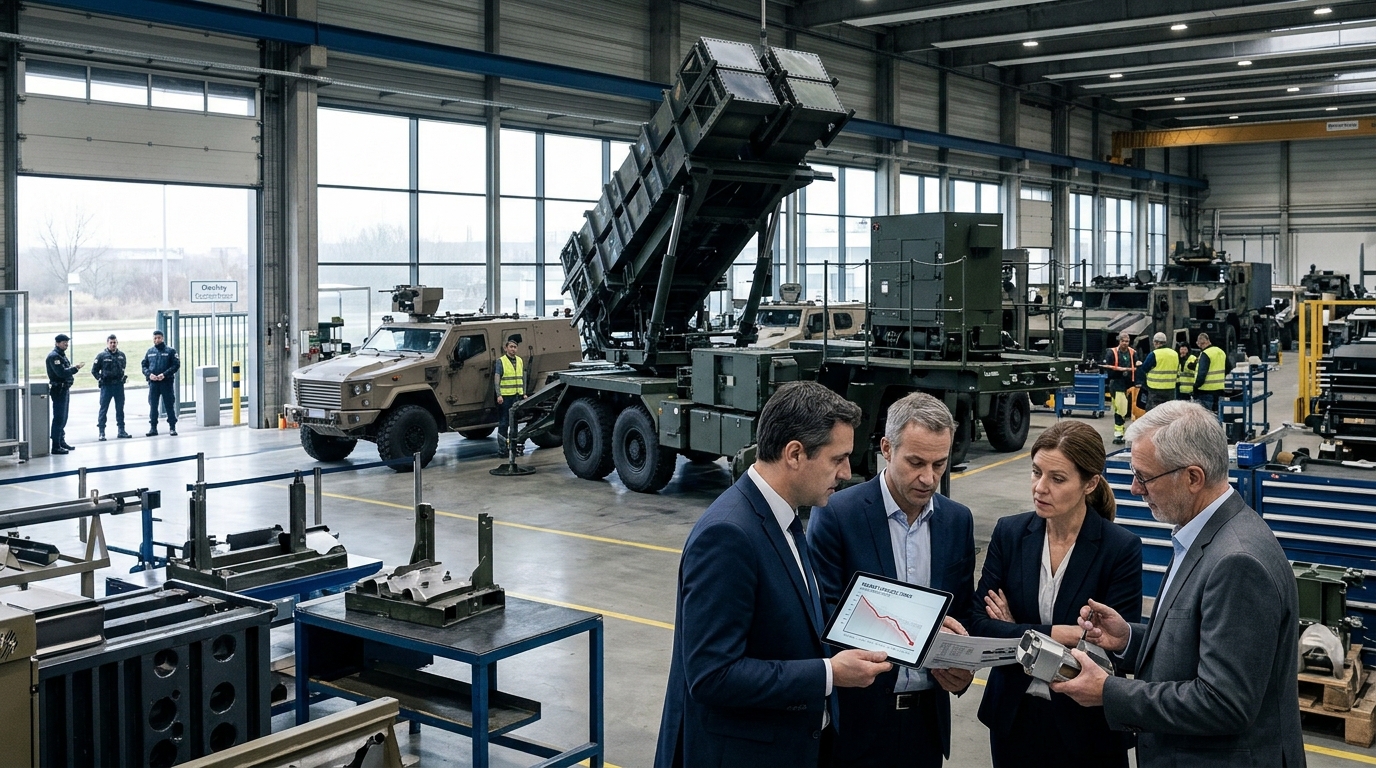
A localized ceasefire took effect in Oleshky on October 27. Both Russia and Ukraine agreed to a temporary ceasefire beginning October 29, allowing humanitarian aid to enter Oleshky and designating a civilian evacuation route. It is a single town, not a peace treaty. But the market is already rehearsing what a broader settlement looks like, and the reaction every time talks advance tells traders exactly where the risk sits.
- A Goldman Sachs basket of defense shares slid as much as 5.1% in April when a senior Ukrainian official signaled that a resolution to the war may not take long to achieve.
- Lockheed Martin reported Q3 2026 sales of $20.7 billion, up 11% year over year, with a record backlog of $292.0 billion including $52.5 billion tied to PAC-3 MSE interceptors.
- RTX ended Q3 with a record $340 billion backlog. RTX described the backlog as up 18% sequentially, but did not frame it as 36% year-over-year growth.
- NATO kept its 2% guideline and added a separate 5% of GDP commitment to be reached by 2035, consisting of at least 3.5% for core defense and up to 1.5% for defense- and security-related projects.
- European allies and Canada are expected to increase their combined core defense budgets to roughly $634 billion in 2026, representing about 2.53% of their total GDP.
- Rheinmetall fell 5.9% and BAE Systems dropped 3.3% in a single session in April following Ukraine ceasefire optimism.
The Backlog Is the Moat
The first instinct when peace headlines land is to sell defense indiscriminately. That instinct misreads the mechanics of large U.S. prime contractors. Lockheed’s backlog rose sharply from the prior quarter, setting a new record at $292.0 billion. On October 22, Lockheed reported that record order book and raised its full-year 2026 free cash flow forecast to nearly $8 billion. That is not Ukraine-specific revenue. The PAC-3 and THAAD awards are driven by NATO rearmament commitments that exist independently of whether Kyiv and Moscow sign a deal.
RTX presents a similar picture. RTX posted Q3 2026 adjusted earnings of $2.26 per share, with adjusted EPS up 33% year over year and net sales of $24.965 billion. Management raised its 2026 adjusted sales outlook to $97.0-$97.5 billion and increased earnings guidance to $7.65-$7.75 per share. Both companies’ backlogs extend years into the future, making a ceasefire a margin-of-error event, not a demand destroyer.
European Names Carry More Asymmetric Risk
The calculus is less favorable for European contractors with higher Ukraine revenue exposure. Reports of a U.S.-driven Russia-Ukraine peace deal triggered a downturn in European defense stocks, with names down between 10% and 20% since October highs. Rheinmetall had only EUR 1.7 billion of Ukraine orders within its backlog. The selloff was disproportionate to the actual revenue at risk, but sentiment remains the near-term driver.
The structural counterargument is compelling. A Hensoldt spokesperson argued that even a ceasefire would leave Europe under threat, noting that a cessation of hostilities would give Russia the opportunity to reconstitute its military capabilities. Morningstar analysts called the market reaction overstated, arguing that European defense valuations are anchored in structural budget increases rather than short-term Ukraine revenue, and that rearmament plans are unlikely to reverse even in the event of a peace agreement.
The structural case for European rearmament extends beyond legacy platforms. NATO’s procurement doctrine has shifted toward autonomous systems and battlefield AI, redirecting budget flows that won’t reverse with a ceasefire.
The NATO Spending Floor Does the Heavy Lifting
The irreversible driver for the sector is the NATO commitment, not the conflict. Core European defense spending has doubled since 2019 and, under NATO’s 3.5% benchmark, could reach roughly €800 billion by 2030. NATO says its European members plus Canada increased defense expenditure by over $90 billion in 2025 compared to 2024, measured in 2021 prices. None of that spending evaporates with a ceasefire. Replenishing stockpiles, modernizing platforms, and hardening infrastructure are decade-long programs.
The scale of that commitment is worth anchoring to hard numbers. European defense expenditure surged 14% to $864 billion in 2025, the fastest annual increase among NATO members since 1953, underscoring why backlog-driven valuations are structural rather than conflict-dependent.
Scenario Framework
Bull Case. Peace talks stall, the Oleshky ceasefire collapses, and European NATO members accelerate procurement to cover Ukraine’s security gap. LMT and RTX convert backlog at the high end of guidance; Rheinmetall and BAE Systems recover their October losses fully. LMT pushes above $650.
Base Case. A partial, fragile ceasefire holds along current lines. U.S. contractors trade sideways on backlog momentum; European names remain 10-15% below peaks as markets wait for fiscal proof that the 5% GDP commitment translates to signed contracts. Rheinmetall stabilizes near current levels, trading on earnings delivery rather than geopolitical premium.
Bear Case. A comprehensive peace agreement, rapid drawdown of European threat perception, and fiscal pressure in France and Italy slow budget approvals. France and Italy are widely cited as among the more fiscally constrained large European NATO economies as alliance spending expectations rise. A crowded positioning unwind in European defense ETFs could push names another 15-20% lower from current levels.
Active Trader Framework
The asymmetry favors U.S. primes over European names on a risk-adjusted basis in a ceasefire scenario. LMT and RTX carry multi-year backlog coverage that buffers a demand shock; European contractors with thin Ukraine revenue but elevated valuations carry the cleaner downside expression. Watch the 50-day moving average on the STOXX Aerospace and Defense index as the first technical level that separates dip-buyers from distribution. Volume on any peace headline will confirm whether institutional money is rotating or simply hedging. Crowded positioning amplifies both the selloff on peace headlines and the snapback when those headlines fade. Position sizing matters more than directional conviction here.
Preparation is the edge. A ceasefire is a sentiment event in the near term; the NATO 5% GDP commitment is a structural event measured in years. Know which you are trading before the headline lands.