November 2, 2026
Bonus Content: Three US Reports Today Could Move December Rate Odds
Dear Reader,
In February 2017, I called my father and told him to buy Nvidia.
Back then, most of his friends still called it “that video game company.”
It was going for just $2.80 split adjusted….
Today his stake is worth almost $500,000 – a gain of more than 7,000%.
Why am I telling you this?
Because right now, I’m making the same kind of call.
And this time, I’m letting you in on it too.
Click here to learn all the details – including the name and ticker of my #1 stock pick, for free.
Let the money flow to you,
Jason Bodner
Founder, Inflection Point
Three US Reports Today Could Move December Rate Odds
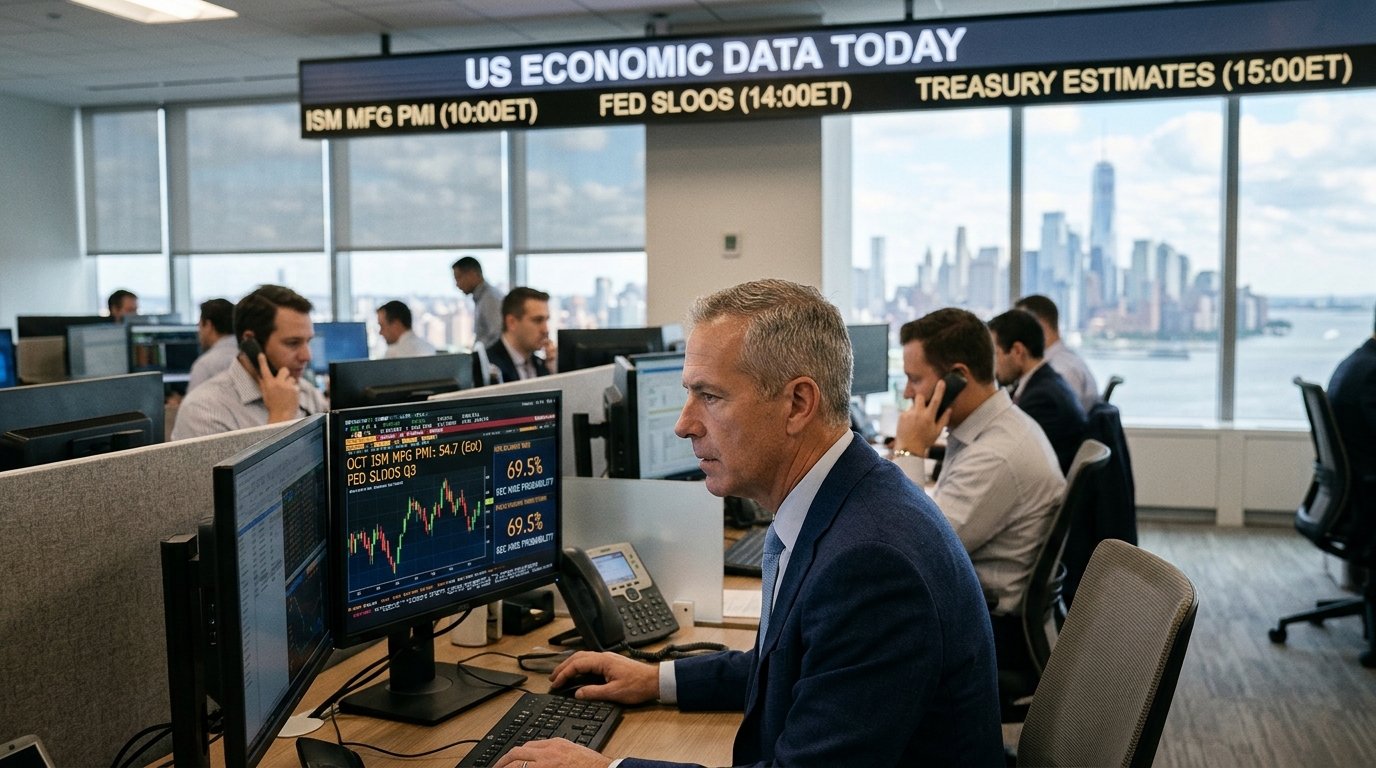
- October ISM Manufacturing PMI due at 10:00 ET: consensus 54.7, prior 54.5; prices paid sub-index consensus 77.5 against September’s elevated 77.9.
- Fed’s Senior Loan Officer Opinion Survey released at 14:00 ET, covering Q3 lending standards and demand across commercial, residential, and consumer credit.
- Treasury quarterly borrowing estimates at 15:00 ET, part of the quarterly refunding cycle, with more details later in the week.
- December hike odds have declined from roughly 85% post-FOMC to around 69–70% on fed funds futures and prediction markets as of this morning.
- The Fed held at 3.75–4.00% on October 28 in a 10–2 vote; Governor Lisa Cook and Cleveland Fed President Beth Hammack dissented in favor of an immediate 25 basis points.
- The 10-year yield sits near 4.93%, a seven-week low, while the 2-year closed Friday at 4.61%, leaving the spread near 32 basis points.
- The Nasdaq shed 2.86% Friday and the S&P 500 fell 1.82%, with rate-hike fears compounding AI earnings doubts and China growth concerns.
The Day’s Context
Monday arrives carrying more macro weight than most. Three US releases are scheduled for the same session, each capable of shifting the calculus on whether the Federal Reserve follows through on what two of its own policymakers already wanted: a quarter-point hike in December. The bond market has already started to price in relief. The 10-year yield, which was back near 5% late last week, has pulled back to about 4.93%. The 2-year, which is far more sensitive to near-term policy expectations, closed Friday at 4.61%, down from about 4.67% on October 28. With the curve still inverted, that roughly 32 basis-point gap between the two can move sharply on any of today’s three catalysts.
The backdrop from equities is unambiguous. The Nasdaq fell 2.86% Friday to 25,437, while the S&P 500 dropped 1.82%. The S&P 500 also closed out a third straight losing week, with rate-hike anxiety and disappointing AI-linked earnings reinforcing each other.
Three Releases, Three Questions
10:00 ET, ISM Manufacturing (October). The consensus sits at 54.7, a marginal step up from September’s 54.5 actual. The index has held above 50 for nine straight months, supported by strong new orders and resilient hiring. September’s prices-paid sub-index reached 77.9, a sharp jump from August’s 71.1. A repeat or beat today on the headline, combined with another elevated prices-paid reading, strengthens the inflation case for December and likely pushes hike odds back toward the mid-70s or higher. A miss below 54.0 does the opposite, especially if prices paid cools meaningfully.
14:00 ET, Senior Loan Officer Opinion Survey. The Fed publishes this quarterly to measure how banks are adjusting credit availability and loan demand. The July survey showed little net change in commercial and industrial lending standards for small firms. Today’s release covers Q3, a period that included the Fed’s September hike. If banks tightened meaningfully in response to higher funding costs, the data argues for a pause. Easier conditions or stable demand would give hawks additional room.
15:00 ET, Treasury borrowing estimates. This is Treasury’s quarterly update on expected borrowing and cash balance assumptions, a key input into the refunding supply conversation. The August estimate put October to December borrowing at $628 billion in privately held net marketable debt, assuming an end-of-December cash balance of $850 billion. Any upward revision, or guidance that implies larger coupon auction sizes, can pressure the long end via term premium, even with the 10-year already near 4.93%.
Where Rate Odds Stand
Markets came out of the October 28 meeting with December hike odds near 85% in widely followed futures-based trackers. Since then, pricing has eased toward roughly 69% to 70% into the December 8-9 meeting window. Prediction markets such as Kalshi and Polymarket have also clustered around 70%. The slide is meaningful: it tells traders the market is not simply rubber-stamping the dissenters’ view. Today’s three releases are the first chance to either validate or erase that doubt.
The bond market’s reaction to shifting hike odds has not always followed the intuitive script. Long-end yields rose even as futures slashed October hike odds after a dramatically weak payrolls print, a reminder that term premium and supply dynamics can override the rate-path signal.
Scenario Framework
Bull case (risk assets): ISM prints below 54.0 with prices paid under 74, the SLOOS shows tightening standards consistent with slowing demand, and Treasury borrowing estimates come in at or below $610 billion. December hike odds fall below 60%. The 2-year yields down to 4.45–4.50%, the 10-year moves toward 4.80%, and the Nasdaq recovers 1.5–2.0% from Friday’s close.
Base case: ISM prints 54.5–55.0, in line with or fractionally above consensus. Lending standards show modest tightening but no credit crunch signal. Borrowing estimates land near the prior $628 billion figure. December odds hold at 68–72%, and the rate-sensitive 2-year stays in the 4.55–4.65% corridor. Equities stabilize without conviction.
Bear case (risk assets): ISM beats 55.5 with prices paid at or above 78, the SLOOS shows only marginal tightening, and Treasury signals higher-than-expected coupon supply. December hike odds climb back above 80%, the 2-year yields through 4.70%, the 10-year tests 5.00% again, and the Nasdaq extends losses by another 1.5% or more.
Active Trader Considerations
The sequencing of today’s releases matters as much as the numbers. ISM at 10:00 sets the initial direction, but the SLOOS at 14:00 adds the credit-channel read the ISM cannot provide. Traders focused on the front end of the curve should watch the 2-year at the 4.70% level as a clear signal of re-acceleration in hike odds. On the downside, 4.50% is where meaningful relief trades become possible. For equities, the Nasdaq’s three-week drawdown raises the stakes on any ISM beat: growth stocks have already absorbed a valuation reset, but the floor holds only if hike odds do not re-escalate. Treasury borrowing at 15:00 closes the day and sets the supply conversation for the rest of refunding week. Position sizing ahead of three sequenced catalysts demands width in stops and discipline on adding exposure between releases.
Preparation, not anticipation, is the framework today. The data will set the range. The question is whether traders are structured to respond rather than react.