November 3, 2026
Bonus Content: Adobe’s $27.5B ARR Machine Meets Its Cheapest Competitor Yet
Dear Reader
In 2009, Greece’s debt-to-GDP ratio hit 130%.
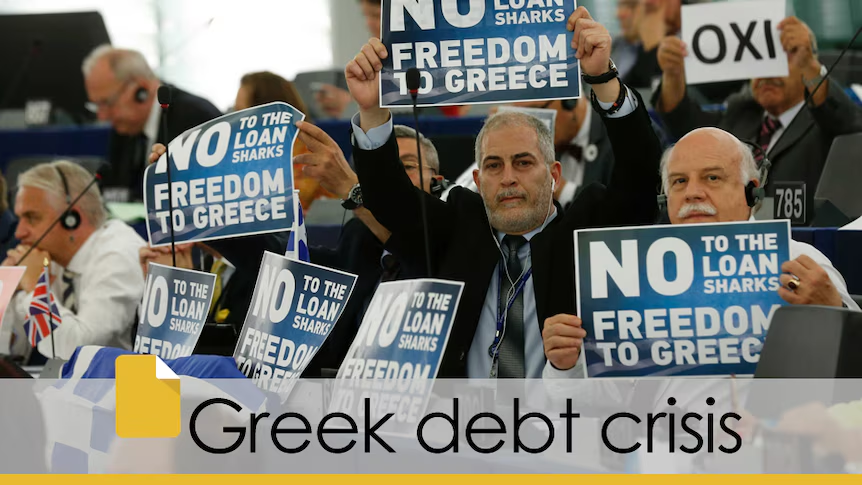
Within 24 months…
Pensions were slashed 40% overnight.
Bank accounts were frozen.
ATMs were capped at roughly €60 per day.
Retirees who saved their entire lives stood in lines outside banks… waiting to withdraw just enough to buy groceries.
That was at 130%.
The IMF now projects the United States will hit 143.4% debt-to-GDP by 2035.
Higher than Greece before the collapse.
And there’s a critical difference.
When Greece collapsed… the EU and IMF swooped in with $300 billion in bailouts.
When America crosses that line… there is no bigger economy to save us.
The U.S. IS the emergency bailout for the rest of the world.
“But surely the government has a plan?”
They do.
In a free presentation I just recorded, I show you exactly what it is…
Why it’s going to create the single biggest wealth transfer of our generation…
…and how you can position yourself on the right side of it.
It’s called “The 2026 AI Gold Rush“… and here’s what I’ll be covering:
→ Why we believe America’s only escape from $39 trillion in debt depends on a single technology (and it’s already being funded with $2 trillion)
→ Why BlackRock just moved $100 billion into the one asset class positioned to capture this wave
→ And why the window to position yourself is closing faster than most people realize
Watch the free AI briefing (urgent) →
To your wealth,
Tan Gera, CFA®
Decentralized Masters
P.S. BlackRock, Goldman, and 170 public companies are all positioning into the same asset class. Watch the free presentation to see which one →
Adobe’s $27.5B ARR Machine Meets Its Cheapest Competitor Yet

Adobe enters December’s leadership handover in a structurally uncomfortable position. ADBE is down roughly 28% year-to-date, trading near $246 with a 52-week range of $190.12 to $362.71. The stock now sits at approximately 13.6 times earnings versus a median S&P 500 multiple of 22.8x. That discount is not a valuation anomaly. It is a question the market is asking out loud: how durable is a $27.5 billion ARR base when the replacement cost of your core product just dropped to zero?
- ADBE closed near $246, down ~28% year-to-date versus the S&P 500’s ~10.6% price return
- Q3 FY2026 revenue: $6.76B, up ~13% year-over-year; Creative and Marketing Professionals subscription revenue at $4.65B quarterly
- Total ARR of $27.5B; AI-first ARR exceeds $650M, growing more than 150% year-over-year
- PhotoCraft, ArtCraft’s open-source Photoshop alternative, has surpassed 34,000 GitHub stars since launching in late September 2026
- Anil Chakravarthy assumes the CEO role December 1; Shantanu Narayen moves to Executive Chair after roughly 19 years as CEO
- Wells Fargo downgraded ADBE to Underweight with a $225 target; analyst consensus sits at Hold, average target near $268
- Adobe’s FY2026 full-year revenue target: $26.576B to $26.626B, implying roughly flat sequential growth in Q4
The Open-Source Variable Wall Street Has Not Priced
ArtCraft’s suite, which launched publicly in late September 2026, is not a mature threat. Every PhotoCraft action is designed as a command, allowing the engine to run from the UI, a command-line tool, a JSON control channel, or an MCP server. That architecture matters: it is built for AI agents, not just human users, which removes the switching-cost argument Adobe has relied on for a decade.
PhotoCraft has accumulated over 16,000 GitHub stars in its earliest version, with the project’s own estimate suggesting a pro daily-switch rate of roughly 25 to 35%, while FilmCraft’s figure sits near 50 to 60%. Those numbers come from ArtCraft itself and should be read skeptically. But even a fraction of that capture rate across Adobe’s billion-plus monthly active users reframes the ARR growth story materially.
The clean-room implementation means no proprietary Adobe code was used in development, making the tools legally distinct and fully independent. That removes the clearest litigation path Adobe might otherwise pursue.
What Chakravarthy Inherits
Anil Chakravarthy, president of Adobe’s Customer Experience Orchestration business and worldwide field operations, will become Adobe’s next president and CEO effective December 1, 2026. His background is enterprise and data infrastructure, not creative tools. Prior to Adobe, he served as CEO for four years at Informatica. That profile is precisely calibrated for the Document Cloud and Experience Cloud segments, which carry less open-source exposure. It is less obvious as a creative software defense.
The numbers Chakravarthy inherits are strong on the surface. Record Q3 cash flows from operations were $2.52 billion. Adobe achieved record revenue of $6.76 billion in its third quarter of FY2026, and the company continued repurchasing shares during the quarter. That is a capital return story running in parallel with a product threat the buybacks do nothing to address.
Scenario Framework
Bull case: Chakravarthy accelerates AI-first monetization beyond the current $650M ARR base, PhotoCraft stalls at alpha-stage limitations, and the valuation discount compresses toward the sector median. Price recovery toward the $310 to $315 range cited by RBC and JPMorgan becomes achievable by mid-2027.
Base case: Creative Cloud churn edges higher in lower-tier subscription tiers as PhotoCraft matures, ARR growth decelerates from 10.2% toward the high single digits, and ADBE consolidates in the $240 to $270 range through H1 2027. The Wells Fargo $225 target stays an outlier but no longer looks irrational.
Bear case: Open-source adoption accelerates among freelancers and emerging-market users, Adobe responds with pricing concessions that compress the Creative and Marketing Professional margin line, and the stock revisits the $190 52-week low. The leadership transition amplifies execution risk in that environment.
The sector context matters for sizing the trade. Software rotating out of favor relative to QQQ signals de-risking that can amplify individual stock drawdowns.
Levels and Framework
ADBE’s 200-day moving average sits well above current price, confirming the stock remains in a structural downtrend. The $240 zone, tested multiple times in October, is the nearest support. A weekly close below $235 opens the path to retest the $190 low. On the upside, $270 is the first meaningful resistance where sellers have reloaded twice since September.
Volatility around the December 1 CEO transition is a known calendar event. Traders watching the open-source threat should track PhotoCraft’s GitHub star velocity and any enterprise plugin announcements as leading indicators of real adoption pressure, not headline commentary. Preparation is the edge here, not prediction.