August 26, 2026
Canada’s Tariff Tier List Is a Target List.
Ottawa’s C$27.6 billion retaliation lands Sept. 8.
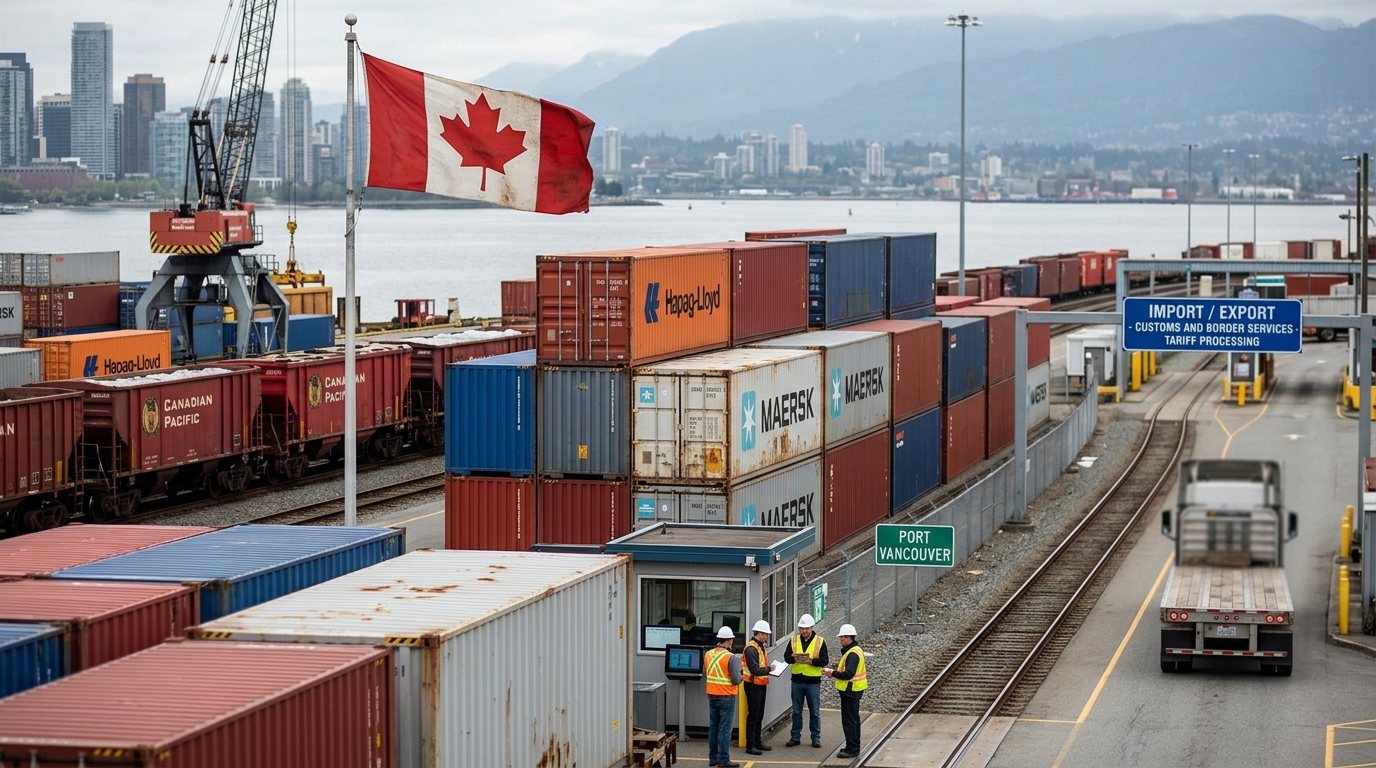
Tuesday’s announcement from Ottawa is the first hard counter-punch since late-Friday talks collapsed without agreement. Canada will impose duties of 50%, 25%, and 15% across more than 700 products (874 tariff items) on C$27.6 billion ($19.94 billion) of U.S. goods, effective September 8, 2026, matching Washington’s rates dollar-for-dollar on the same categories. The C$7.5 billion business and worker support package running alongside it tells you Ottawa intends to hold this position, not use it as a bargaining chip.
Read the bracket list as a sector exposure map, not a diplomatic document.
The Tier Structure and Who Sits Inside It
50% bracket: Steel and aluminum products, furniture, and clothing. At 50%, the channel closes harder. Nucor (NUE) and Steel Dynamics (STLD) are the two names Jefferies identified as most exposed among U.S. flat-rolled producers, given Canada previously represented roughly 22% of total U.S. steel import supply before 2025. With NUE’s Q2 steel mill shipments hitting a record 7.1 million tons and revenue running 23% above year-prior at $10.4 billion, the demand thesis is intact domestically. The friction point is the retaliation effect on downstream U.S. steel-consuming industries that buy from NUE and STLD and export finished goods north.
25% bracket: Appliances, cheese, certain seafood, and steel derivatives. This is the WHR (Whirlpool) bracket. The company entered 2026 already absorbing roughly $300 million in annual tariff costs and guiding full-year revenue near $15 billion at 1.5% like-for-like growth, with ongoing EBIT margin targeted around 4%. Section 232 tariffs alone hit margins by 200 basis points in Q2. A 25% counter-tariff compressing the Canadian appliance channel, which Whirlpool’s own Q4 filing flagged as a region driving volume declines, adds another layer of demand destruction that does not yet appear priced into consensus.
The $400 Million Clue
A little-known industrial company just landed the largest order in its history: $400 million.
The project centers on on-site power generation, the kind companies turn to when waiting on utilities isn’t an option. What’s interesting is the timing. New orders are surging, backlog has climbed to $1.8 billion, and the biggest contracts keep getting bigger.
15% bracket: Electronics, tools, and rubber/machinery parts. Lower headline rate, but the breadth across Chapter 84 and 85 HS codes (50 machinery items, 16 electrical items) means the cumulative drag on U.S. industrial goods exporters is wider than the rate implies.
JBHT: The Cross-Border Volume Confirming Signal
J.B. Hunt (JBHT) is not a tariff target, but it is the best real-time indicator of whether cross-border freight actually contracts. JBHT’s intermodal segment set a quarterly record in Q2 2026 with over 578,000 loads, total operating revenue up 19% year-over-year to $3.50 billion, and operating income up 32% to $259.5 million. A sustained drop in cross-border Canada-bound intermodal volumes on CN and CP Kansas City rail corridors would be the confirming signal that tariffs are actually redirecting supply chains, not just resetting prices. Watch weekly load counts against the Q2 baseline.
Scenario Modeling
Bull Case
Talks resume before September 8, 2026. The duty schedule becomes leverage rather than law. NUE and STLD hold recent gains as the domestic tariff regime stays intact and Canadian supply remains restricted. JBHT intermodal volumes sustain above Q2 levels. Price target on NUE: analyst consensus sits around $272.
Base Case
Tariffs take effect September 8, 2026 as announced. Canadian appliance demand for WHR contracts further into Q3. U.S. domestic steel prices stay elevated, supporting NUE and STLD margins through Q3, but forward guidance gets more cautious as downstream customers face margin compression. JBHT cross-border volumes decline 10-15% from peak, partially offset by domestic lane strength.
If I Only Taught One Strategy: Expert Reveals Retirement Hack
A comfortable retirement may seem increasingly out of reach, but investing expert Dave Aquino says that just one simple strategy is turning even his novice students into profitable investors.
In his free guide, “How To Master The Retirement Trade”, Aquino reveals the little known strategy to…
Bear Case
Ottawa accelerates beyond the September 8, 2026 list, triggering additional duties on agricultural equipment and vehicles. U.S. industrial export volumes into Canada fall sharply across multiple sectors simultaneously. WHR’s 4% EBIT margin guidance becomes unachievable. NUE’s Q3 earnings guidance, flagged positively by management on the July call, gets revised lower. STLD’s $48 million per 1% move in steel prices cuts both ways on the downside.
Active Trader Framework
On NUE and STLD: the domestic tariff regime remaining intact is the underlying bid. The risk is that Canada’s retaliatory 50% rate cools the downstream industrial customers both mills supply. Monitor steel service center inventory data and hot-rolled coil spot prices against the $240 level that served as STLD’s key reference point after the talks collapsed August 21, 2026. A hold above that level into September 8, 2026 confirms the market is pricing continued tariff support.
On WHR: tariff pressure was already the primary margin headwind before Tuesday. The question is whether the Canadian channel deterioration moves from manageable to structural. Position sizing should reflect the company’s limited margin buffer at current guidance levels.
JBHT cross-border load data is the macro confirming signal for the entire thesis. Rising loads suggest supply chains are adapting through rerouting. Falling loads confirm genuine trade contraction.
The $16 Trillion Rare Earth Discovery
The Guardian calls it “the beginning of the biggest gold rush in history”… and one stock under $5 owns exclusive rights to harvest these rare earths.
Elon Musk and his companies need these minerals before a January 1 Pentagon deadline.
Conclusion
Ottawa’s tier list is precise by design. Finance Minister Champagne’s team used 2024 trade data to maximize economic pain while targeting politically sensitive U.S. states ahead of the November 2026 midterm elections. That political calculus makes a quick resolution less likely than the market may assume. Traders who map the bracket structure to individual equity exposure, quantify the margin impact against current guidance, and watch cross-border freight volume as the real-time confirming signal will be positioned ahead of a September 8, 2026 deadline that is now 13 days away.
Know your levels. Know your risk. The calendar is not ambiguous.
For informational and educational purposes only. Not investment advice. Trading involves risk, including loss of principal.