
September 4, 2026
The August Jobs Number Just Landed
With the Fed split and the 10-year near 4.78%, payrolls is a key input before the Sept. 15-16 decision.
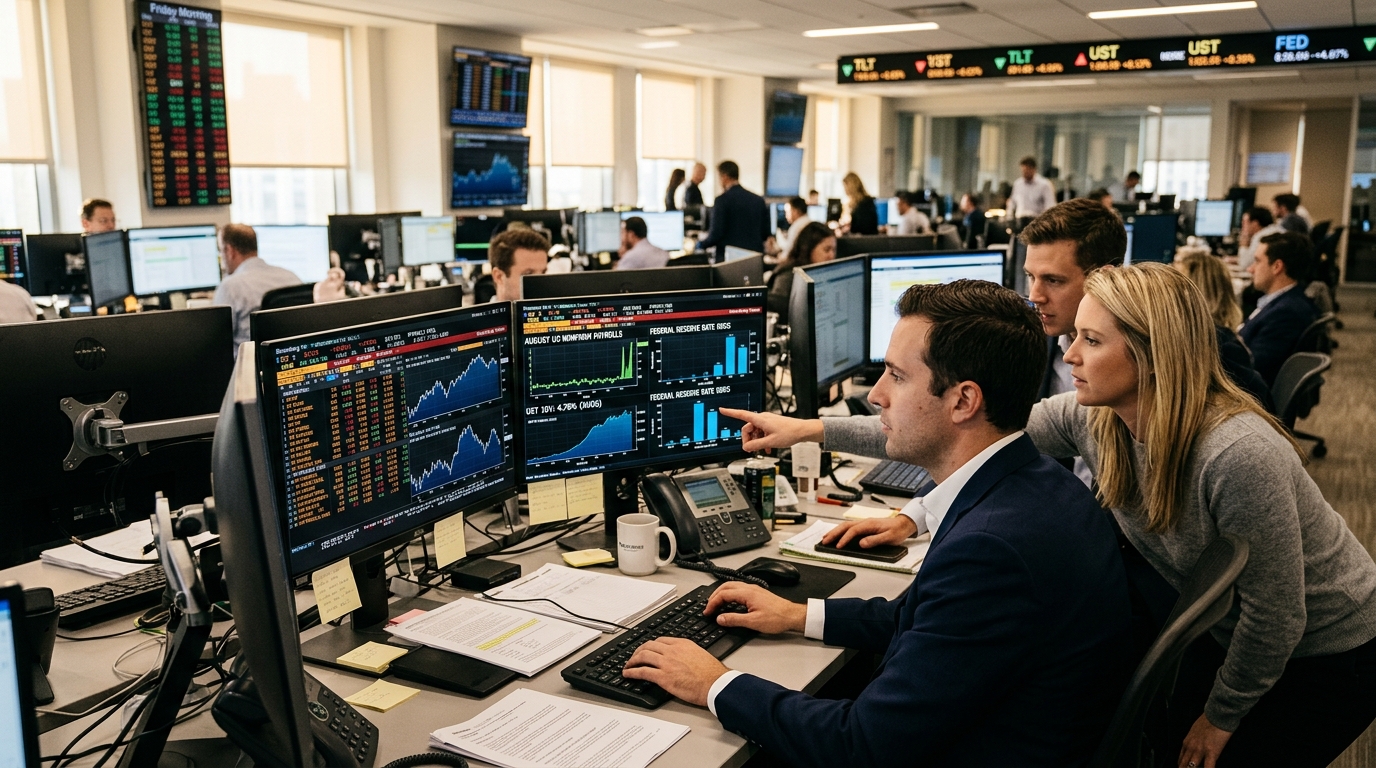
Friday mornings do not get more consequential than this one. The BLS Employment Situation for August dropped at 8:30 a.m. ET, and every basis point on the 10-year Treasury and every tick in TLT will move in direct proportion to how far the headline strays from the Dow Jones consensus of +53,000 nonfarm payrolls.
Your Download Link Will Expire
If you still haven’t downloaded my free “Safe Trade Options Formula” guide…
…please take a few seconds and download it right now before your new temporary download link expires.
I eventually plan to charge money for this training, so do yourself a favor and download it now…
That way, no matter what it costs in the future, you’ll have a free copy on your computer.
Make sense?
- Dow Jones consensus: +53,000 August nonfarm payrolls; unemployment expected steady at 4.1%
- July’s read: minus 23,000, with May and June revised down a combined 103,000
- ADP private payrolls Wednesday: +38,000 versus +47,000 expected, weakest since January
- September hike odds on CME FedWatch: roughly a coin flip after Waller’s Thursday remarks
- 10-year Treasury yield: 4.78% as of Wednesday’s close, after an intraday peak near 4.81% earlier this week, a near three-year high
- TLT closed near $81.95 Thursday; SPY rallied 1.06% to roughly $773 on cooling hike odds
- Fed internally split: three FOMC members dissented at July’s meeting in favor of an immediate hike
The Setup Entering This Print
Three consecutive months of near-zero or negative headline payroll counts have quietly redefined this labor market. June and July together produced a net loss of 3,000 jobs before today’s August figure, and the preliminary annual benchmark revision published August 28 marked total nonfarm employment down 79,000 through March 2026. The labor force itself shrank 264,000 in July, pushing participation to 61.4%, the lowest outside of the Covid period since March 1976. Average hourly earnings cooled to a 3.2% annual pace in July, down from stronger spring readings.
That is the fragile foundation the ADP reading cracked further Wednesday. Manufacturing shed 17,000 private jobs, professional and business services fell 16,000, and nearly all of August’s 38,000 private-sector gains came from education, health, and construction. Large employers with 500 or more workers accounted for 34,000 of those 38,000 additions. Small business hiring is stalling.
The weakness in Wednesday’s ADP print did not arrive in a vacuum — it was the second of two labor releases that markets had flagged as the final data the FOMC would see before voting. our earlier breakdown of why this week’s ADP and payrolls reports determine the September hike decision laid out why the sequencing of these releases matters as much as the numbers themselves. With ADP now in the books, Friday’s BLS print carries the full weight of that two-report sequence.
The Waller Variable
Thursday changed the volatility calculus. Governor Christopher Waller, speaking at a Reuters event, signaled he would support holding rates steady at the September 15-16 meeting if disinflation continues, shifting market-implied September hike odds from near 65% by Wednesday toward roughly a coin flip. Chair Kevin Warsh’s Jackson Hole speech the prior week had gone the other direction, committing publicly to the 2% inflation target and describing labor markets as quite stable. With PCE running at 3.7% over 12 months and three FOMC dissenters already on record, the committee is genuinely fractured.
In at 9:35 AM. Out by 10.
I call it the “Opening Bell Breakout.” It’s the same setup I used to catch moves like 113% on GOOGL and 240% on META. I trade one simple 15-minute window each morning – and I’m usually done by 10 AM.
That fracture is what makes this morning’s number so binary.
Waller’s break from the hike camp was the single most market-moving development of the week before today’s print, and understanding exactly what he said — and what he left open — is essential context for reading how the FOMC will interpret whatever the BLS delivers. a detailed look at how Governor Waller’s remarks shifted the September rate outlook covers the specific conditions he attached to his hold preference, which remain directly relevant to how markets will price the number this morning.
The Trade: Two Scenarios That Matter
Bull Case for Risk (Sub-25,000 or Negative Print)
A miss of that magnitude, combined with the ADP signal, would almost certainly collapse September hike odds toward 35-40%. The 10-year yield, already at 4.78% after pulling back from 4.81%, likely retests 4.60-4.65%. TLT, near $82, would push toward the $84-$85 resistance band. SPY would add to Thursday’s 1.06% gain, with rate-sensitive sectors, utilities and REITs, leading. The Waller precedent matters here: markets have already demonstrated they will move meaningfully on a single governor’s comment. A sub-25,000 BLS read is worth far more than that.
Base Case (Print Near +53,000)
An in-line number confirms a soft but not collapsing labor market. September hike odds likely drift back toward the mid-to-high 50s. The 10-year holds the 4.75-4.80% range. TLT stays rangebound near current levels. SPY gives back some of Thursday’s gains but finds support at the 20-day moving average. Volatility, with VIX near 14, does not spike materially.
Legendary trader makes the boldest prediction of his 40-year career
In 2020, Larry Benedict told CNBC the market was about to fall. Few believed him. Within weeks, markets dropped 34% but his readers had the chance to make 62%.
In 2022, he predicted the worst market in a generation. He went 11-for-11. One trade returned 117% in under a month.
Now he’s speaking out again… and he says what’s coming makes both of those look like a warm-up.
Click here to hear his new prediction and get his #1 ticker free.
Bear Case for Risk (70,000 or Better, Upside Revision)
A strong beat, especially with positive revisions to June and July, reactivates the Warsh playbook. Hike odds surge back above 65%. The 10-year revisits 4.81% and eyes 5.00% as the next psychological level. TLT breaks below $81.50 support. SPY faces renewed pressure, particularly in growth and long-duration names. Given the initial August figure has often been revised lower in recent years, this scenario carries lower prior probability but outsized market impact if realized.
The path from 4.81% to 5.00% is not just a round-number story — it reflects a specific supply and duration dynamic that was already in motion before today’s print. why the 10-year breaking 4.75% left duration exposed through payrolls with no Fed cover explains the structural pressure on Treasuries that a strong jobs number would amplify, making the bear case for risk more than just a rates repricing.
Active Trader Framework
The hour between 8:30 and 9:30 a.m. ET is where positions are made or broken today. Key levels: TLT’s $81.50 floor and $84.00 ceiling define the binary range. On SPY, watch $760 as short-term support and $780 as resistance into the close. The VIX near 14 prices in complacency; a shock in either direction re-rates that quickly. Traders carrying duration risk through TLT or rate-sensitive sector ETFs should size for a 15-20 basis-point intraday move in yields under a surprise scenario. The revision line, not just the headline, deserves equal weight. Position sizing and defined risk levels matter more this morning than directional conviction.
Preparation built before 8:30 determines outcomes. The number now exists. Execution is what follows.