
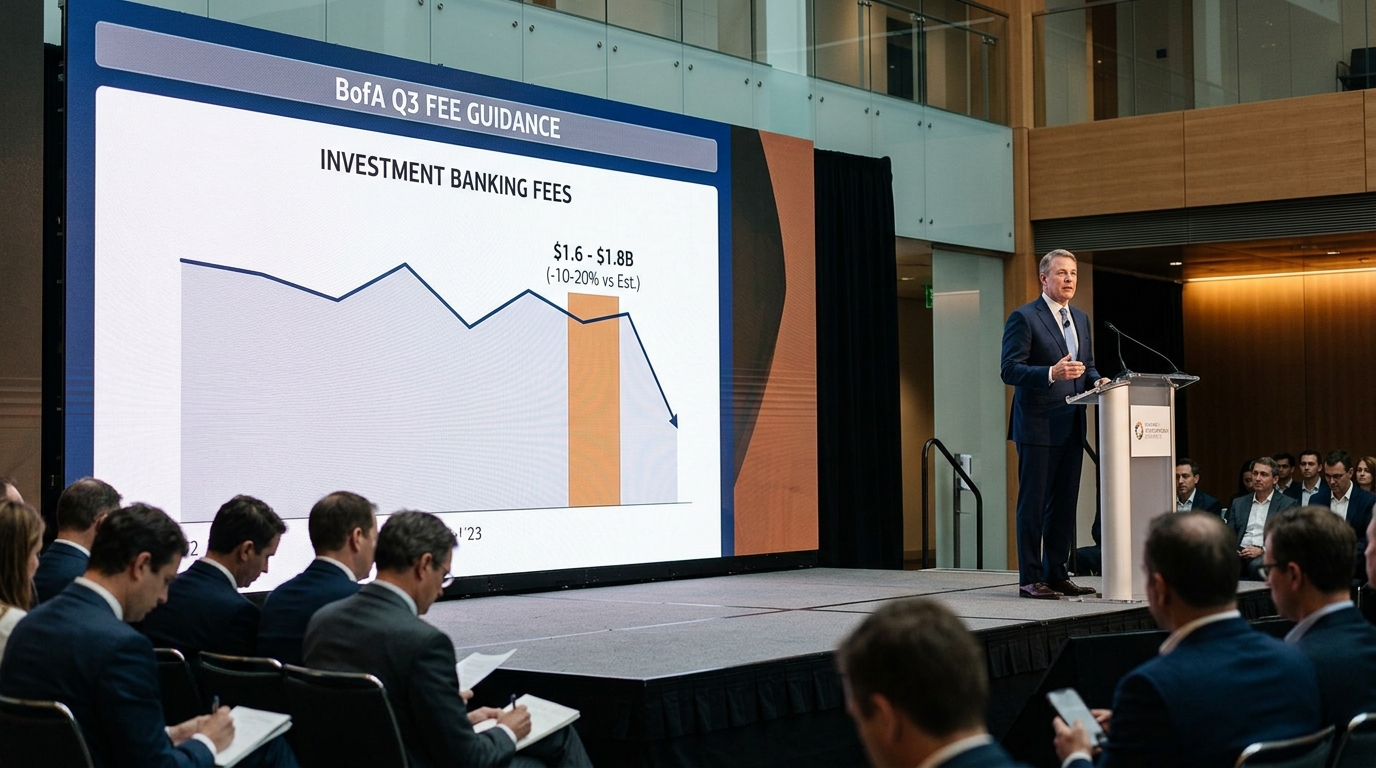
- BofA CEO Brian Moynihan guided Q3 investment banking fees to $1.6-1.8B, roughly 10-20% below the Street’s ~$2B estimate.
- BAC closed down ~5% Monday, making it one of the worst performers in the KBW Bank Index; GS, C, and JPM also fell in sympathy.
- The KBW Bank Index fell about 2% on the session.
- BofA’s Q3 trading revenue guided flat versus Q3 2025’s ~$5.4B, a stark reversal from Q2’s 33% surge and a 50% jump in IB fees.
- JPMorgan’s Doug Petno presents at the same Barclays conference today at 2:45 p.m. ET, making this an active, unresolved catalyst.
- Q3 bank earnings begin October 14; today’s Petno remarks carry outsized pre-reporting weight.
Market Context
Moynihan told the Barclays Global Financial Services Conference that BofA’s investment banking fees would likely decline more than 10% year on year in Q3, against a second quarter in which the bank posted a 50% jump in IB fees and a 33% jump in trading revenue. The velocity of that reversal is what rattled markets. A boom quarter followed immediately by a guidance cut to a range well below consensus is not a soft landing; it is a hard stop.
Moynihan projected investment banking revenue to be between $1.6 billion and $1.8 billion for Q3, down from about $2.0 billion in the same period a year earlier. Analysts had expected those fees to be closer to $2 billion. That gap, $200-400M below consensus, is large enough to matter for forward earnings models across the entire sector.
Moynihan said he expects sales and trading revenue to be relatively flat in Q3 versus the $5.4 billion posted in Q3 2025. He said the deals pipeline remains strong but cautioned that if interest rates move higher, that will slow some financing demand, adding: “Right now we’re seeing it solid, and the pipelines are staying full.”
Sector Breakdown
BAC dropped roughly 5% on the session, one of the worst performers in the KBW Bank Index, while Goldman Sachs, Citigroup, and JPMorgan saw their shares dragged lower as well. The contagion logic is straightforward: BofA’s IB business is a reasonable proxy for broad capital markets activity. When its CEO cites Dealogic data to explain the market-wide slowdown, peers cannot easily separate themselves from the read-across.
Goldman Sachs posted a 53% year-over-year surge in Global Banking and Markets revenue in Q2, while JPMorgan delivered an 86% year-over-year increase in equity markets revenue alongside a 30% jump in investment banking fees. Those Q2 figures set a high comparison base heading into Q3, which is precisely why Moynihan’s warning carries so much weight for GS and JPM specifically. Both now face the same deceleration question that BofA just answered publicly, and neither has spoken yet this cycle.
Goldman Sachs is heavily oriented toward investment banking, trading, and institutional activity, with performance linked to deal volumes and market conditions. That concentration makes GS the highest-beta name to any IB fee read-across. Morgan Stanley carries a more diversified profile, with its wealth management segment providing recurring fee income that cushions capital markets volatility.
The 2:45 Catalyst
Doug Petno, Co-President of JPMorganChase and CEO of the Commercial and Investment Bank, will present at the Barclays Global Financial Services Conference in New York City today, September 15, 2026, at 2:45 p.m. Eastern. JPMorganChase reported $5.0 trillion in assets and $375 billion in stockholders’ equity as of June 30, 2026. Petno commands the largest bank on the planet by assets. His remarks on Q3 trading and IB conditions will either confirm Moynihan’s read or diverge from it. Either outcome moves the sector.
If Petno echoes BofA’s tone, expect a second leg lower across BAC, GS, MS, and C. If JPMorgan’s CIB is running ahead of peers, the read-across flips: BAC’s underperformance may reflect its own mix rather than an industry-wide contraction, which changes the relative value calculus going into Q3 earnings on October 14.
Technical Framework
BAC broke its near-term support on Monday’s 5% decline on above-average volume, a distribution signal. The KBW Bank Index’s roughly 2% single-session drop warrants watching the index’s 50-day moving average as an immediate area of interest; a close below it on confirmed volume would suggest institutional sellers are not finished.
JPM has been the relative strength leader in the group year-to-date. Watch whether JPM holds its own 20-day moving average into today’s close. A divergence, JPM green while BAC and GS remain red, would confirm a stock-specific rotation rather than a sector-wide exit.
Scenario Modeling
Bull Case
Petno signals JPMorgan’s CIB is tracking at or above Q3 2025 levels. The market reads BofA’s miss as idiosyncratic to its business mix, not as a sector call. BAC stabilizes near Monday’s close, GS and MS recover 1-2%, and the KBW index reclaims its prior support. Catalyst: a direct Petno statement that JPM’s IB pipeline is stronger than the market heading into October earnings.
Base Case
Petno acknowledges broadly softer IB conditions consistent with Moynihan’s Dealogic data, but notes JPMorgan’s trading desk is running modestly above flat. The sector settles into a range; BAC stays pressured, JPM and GS trade mixed. The October 14 earnings date becomes the true resolution point, and implied volatility across the group remains elevated through then.
Bear Case
Petno confirms weakness across both IB fees and trading, offering no qualitative offset. The KBW Bank Index breaks its 50-day moving average with conviction. BAC tests the next technical floor, GS trades down toward its pre-Q2 earnings level, and C, already the group’s cheapest on price-to-tangible-book, becomes the focal point of defensive repositioning. This scenario pulls Q3 earnings estimate cuts forward from October into the next two weeks.
Active Trader Strategy Framework
The 2:45 p.m. Petno presentation is the defining event for the bank sector today. Traders should define their risk before the session, not during it. Key levels to monitor: BAC’s Monday closing price as the first resistance level for any relief rally; the KBW Bank Index’s 50-day moving average as the structural line; and implied volatility on near-term options across GS and JPM, which is likely to compress or expand sharply within an hour of Petno’s opening remarks.
Position sizing into a live conference catalyst should reflect that uncertainty cuts both ways. The base case offers no clear directional edge; the two tail scenarios are where conviction is warranted, and only after Petno speaks. Traders focused on relative value rather than outright direction may find the BAC-versus-JPM spread the more tractable expression: the gap between the two is already widened, and Petno’s remarks will clarify whether it compresses or extends.
Conclusion
Moynihan gave the market a specific number: $1.6-1.8B, against a $2B consensus, on a 50% comp from Q2. That is not a vague warning; it is a quantified miss delivered in public. The sector sold it hard. What happens next depends entirely on whether JPMorgan confirms the industry read or carves out an exception. Preparation here means having your levels, your sizing, and your reaction plan in place before 2:45. The outcome will be known quickly. The traders who are ready for both scenarios are the ones positioned to act on it.